
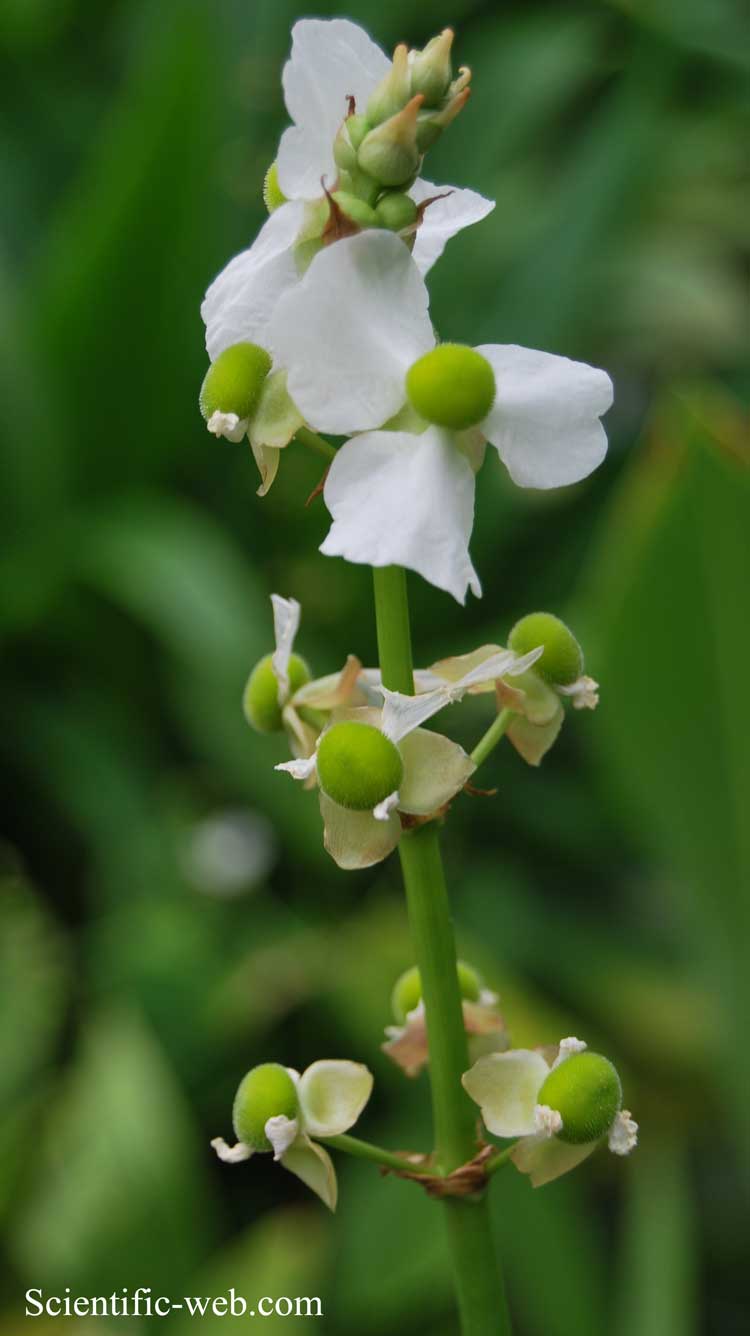
Sagittaria lancifolia, Photo: Michael Lahana
Classification System: APG IV
Superregnum: Eukaryota
Regnum: Plantae
Cladus: Angiosperms
Cladus: Monocots
Ordo: Alismatales
Familia: Alismataceae
Genus: Sagittaria
Species: Sagittaria lancifolia
Subspecies: S. l. subsp. lancifolia – S. l. subsp. media
Name
Sagittaria lancifolia L., 1759
Synonyms
Drepachenia lancifolia (L.) Raf.
Homonyms
Sagittaria lancifolia H.Vilm., nom. illeg. = Sagittaria sagittifolia L.
Distribution
Native distribution areas:
Continental: Northern America
Alabama; Florida; Georgia; Louisiana; Mexico Gulf; Mexico Southeast; Mexico Southwest; Mississippi; South Carolina; North Carolina; Virginia
Continental: Northern America
Bahamas; Belize; Brazil North; Brazil Northeast; Cayman Is.; Colombia; Costa Rica; Cuba; Dominican Republic; Ecuador; El Salvador; French Guiana; Guatemala; Guyana; Haiti; Honduras; Jamaica; Jawa; Nicaragua; Panama; Puerto Rico; Suriname; Venezuela; Windward Is.
References: Brummitt, R.K. 2001. TDWG – World Geographical Scheme for Recording Plant Distributions, 2nd Edition
References
Linnaeus, C., Syst. Nat. ed. 10, 2:1270. 1759
Links
Hassler, M. 2018. Sagittaria lancifolia. World Plants: Synonymic Checklists of the Vascular Plants of the World In: Roskovh, Y., Abucay, L., Orrell, T., Nicolson, D., Bailly, N., Kirk, P., Bourgoin, T., DeWalt, R.E., Decock, W., De Wever, A., Nieukerken, E. van, Zarucchi, J. & Penev, L., eds. 2018. Species 2000 & ITIS Catalogue of Life. Published online. Accessed: 2018 Jul. 15. Reference page.
International Plant Names Index. 2018. Sagittaria lancifolia. Published online. Accessed: Jul. 15 2018.
The Plant List 2013. Sagittaria lancifolia in The Plant List Version 1.1. Published online. Accessed: 2018 Jul. 15.
Tropicos.org 2018. Sagittaria lancifolia. Missouri Botanical Garden. Published online. Accessed: 15 Jul. 2018.
USDA, ARS, Germplasm Resources Information Network. Sagittaria lancifolia in the Germplasm Resources Information Network (GRIN), U.S. Department of Agriculture Agricultural Research Service. Accessed: 08-Apr-12.
Vernacular names
English: bulltongue arrowhead
Sagittaria lancifolia, the bulltongue arrowhead,[3] is a perennial, monocot plant in the family Alismataceae, genus Sagittaria, with herbaceous growth patterns. It is native to the southeastern United States. It is known from every coastal state from Delaware to Texas.[3] The species is also considered native to Mexico, Central America, the West Indies and northern South America. It has become naturalized on the Island of Java in Indonesia.[4]
A common name is "duck potato" because of the large potato-like corms which can form underground.[5]
Contents
1 Description
2 Sensitivity to in-situ burning of applied crude oil
3 Notes
4 External links
Description
Sagittaria lancifolia L.
The plant is conspicuous for its large, lance-shaped leaves which grow up from underground rhizomes and its showy, white three-petaled flowers which form at the end of long, thick stalks. Each flower has three green sepals, three white or pink-tinged petals, at least six stamens, and pistils which may be in separate flowers.[6] The plant likes to grow in fresh or brackish water and is commonly found in ditches, marshes, swamps and along the shores of lakes and streams.[5]
Sagittaria lancifolia reproduces both asexually through spreading rhizomes and sexually through reproduction of copious achenes, a dry fruit each of which carries a single seed.[7] The achenes are dispersed through animal vectors and through hydrochory (dispersal through wind, water, or gravity). The achenes germinate only under light, and with or without available fluid, but the period of their germination is shorter when they are submersed in water. Temperature is a factor, with 100% germination occurring at 20 °C (68 °F). Germination is reduced in anaerobic conditions. Growth is also dependent on temperature.[7][8]
Sensitivity to in-situ burning of applied crude oil
Louisiana is one of the top five U.S. states in oil production, oil that is piped through marshes in Louisiana to market and sometimes leaks into the marsh land polluting it. Field studies suggest that, although the application and burning of South Louisiana Crude oil on Sagittaria l. plants in plots of fresh Louisiana marsh land had short term negative effects on the growth rate of Sagittaria l., over time plant recovery was just as rapid as in the plots where the plants were oiled but not burned. This suggests that allowing a polluted marsh to degrade and recover without burning is a viable option, while burning is a viable option when a rapid recovery is needed on sensitive lands.[9]
Notes
Syst. Nat. ed. 10. 2: 1270. 1759
The Plant List Sagittaria lancifolia
USDA, NRCS (n.d.). "Sagittaria lancifolia". The PLANTS Database (plants.usda.gov). Greensboro, North Carolina: National Plant Data Team. Retrieved 26 October 2015.
"World Checklist of Selected Plant Families: Royal Botanic Gardens, Kew". apps.kew.org. Retrieved 2017-01-30.
"Duck potato | Center for Aquatic and Invasive Plants". plants.ifas.ufl.edu. Retrieved 2009-12-22.
"NPIN: Sagittaria lancifolia (Bulltongue arrowhead)". www.wildflower.org. Retrieved 2009-12-22.
E. Gordon Collon1 and J. Velasquez (1989). "Dispersion, germination and growth of seedlings of Sagittaria lancifolia L.". Folia Geobotanica. 24: 37. doi:10.1007/BF02854790. S2CID 25749020.
Rafinesque, Constantine Samuel. 1825. Neogenyton, or Indication of Sixty-Six New Genera of Plants of North America, Drepachenia lancifolia
Lindau, C. W. & Delaune, R. D (2000). "Vegetative response of Sagittaria lancifolia to burning of applied crude oil". Water, Air, & Soil Pollution. 121: 161–172. doi:10.1023/A:1005284530282. S2CID 93986432.
Retrieved from "http://en.wikipedia.org/"
All text is available under the terms of the GNU Free Documentation License
