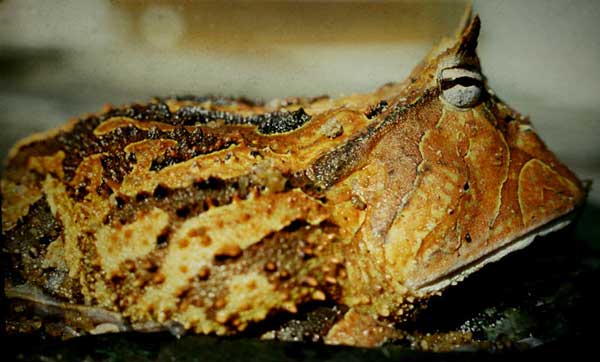
Ceratophrys cornuta (Information about this image)
Superregnum: Eukaryota
Cladus: Unikonta
Cladus: Opisthokonta
Cladus: Holozoa
Regnum: Animalia
Subregnum: Eumetazoa
Cladus: ParaHoxozoa
Cladus: Bilateria
Cladus: Nephrozoa
Superphylum: Deuterostomia
Phylum: Chordata
Cladus: Olfactores
Subphylum: Vertebrata
Infraphylum: Gnathostomata
Megaclassis: Osteichthyes
Cladus: Sarcopterygii
Cladus: Rhipidistia
Cladus: Tetrapodomorpha
Cladus: Eotetrapodiformes
Cladus: Elpistostegalia
Superclassis: Tetrapoda
Cladus: Batrachomorpha
Classis: Amphibia
Subclassis: Lissamphibia
Superordo: Batrachia
Cladus: Salientia
Ordo: Anura
Familia: Ceratophryidae
Genus: Ceratophrys
Species: Ceratophrys cornuta
Name
Ceratophrys cornuta (Linnaeus, 1758)
Type locality: "Virginia"
Holotype: Seba, 1734, Locuplet. Rer. Nat. Thesaur. Descript. Icon. Exp. Univ. Phys. Hist., 1: pl. 72, figs. 1-2.
Original combination: Rana cornuta
Combination: Bufo cornutus — Laurenti, 1768
Combination: Buffo cornuta — Lacépède, 1788
Combination: Pipa cornata — Oken, 1816
Combination: Stombus cornutus — Gravenhorst, 1825
Combination: Ceratophrys cornuta — Schlegel, 1837; Peters, 1872
Combination: Ceratophrys (Stombus) cornuta — Lynch, 1982
Synonyms
Rana megastoma Spix, 1824
Stombus megastomus — Gravenhorst, 1825
Ceratophrys megastoma — Wagler, 1830
Ceratophris spixii Cuvier, 1829
Ceratophris daudini Cuvier, 1829
Phrynoceros vaillanti Tschudi, 1838
References
Linnaeus, C. 1758. Systema Naturae per regna tria naturæ, secundum classes, ordines, genera, species, cum characteribus, differentiis, synonymis, locis, Tomus I. Editio decima, reformata. Holmiæ: impensis direct. Laurentii Salvii. i–ii, 1–824 pp DOI: 10.5962/bhl.title.542: 212. Open access Reference page.
Lynch, 1982, Syst. Zool., 31: 166–179.
Frost, D.R. 2021. Amphibian Species of the World: an Online Reference. Version 6.1. Electronic Database accessible at https://amphibiansoftheworld.amnh.org/index.php. American Museum of Natural History, New York, USA. DOI: 10.5531/db.vz.0001 Ceratophrys cornuta . Accessed on 20 May 2008.
2007 IUCN Red List of Threatened Species IUCN: Ceratophrys cornuta (Least Concern) Downloaded on 20 May 2008.
Vernacular names
Boarisch: Surinam-Herndlfrósch, gmoider Herndlfrósch
brezhoneg: Touseg kornek Amazonia
čeština: Rohatka brazilská
Deutsch: Surinam-Hornfrosch, gemalter Hornfrosch
English: Surinam horned frog
español: Escuerzo de Surinam, rana cornuda de Surinam
suomi: Brasiliansarvikonna
français: Ceratophrys cornuta
magyar: Nagy szarvasbéka
日本語: アマゾンツノガエル
polski: Rogatka itania
slovenčina: Rohačka brazílska
svenska: Surinamhorngroda
Türkçe: Surinam boynuzlu kurbağası
中文: 蘇利南角蛙
The Surinam horned frog (Ceratophrys cornuta), also known as Amazonian horned frog, is a bulky frog measuring up to 20 centimetres (7.9 in) found in the northern part of South America. It has an exceptionally wide mouth, and has horn-like projections above its eyes. Females lay up to 1,000 eggs at a time, and wrap them around aquatic plants. The frog eats other frogs, fish, lizards, and mice.[2] Tadpoles of the Surinam horned frog attack each other (and tadpoles from other species) soon after being hatched. This species was once considered the same species as Ceratophrys ornata. This dispute was later settled because the Surinam Horned frog inhabits a different habitat than its smaller cousin and does not interbreed with it in the wild (but will do so in captivity). This species has been known to prey upon the other species of horned frog, especially the northern race of Ceratophrys ornata.
References
Enrique La Marca, Luis A. Coloma, Santiago Ron, Claudia Azevedo-Ramos (2004). "Ceratophrys cornuta". IUCN Red List of Threatened Species. 2004: e.T56337A11464093. doi:10.2305/IUCN.UK.2004.RLTS.T56337A11464093.en. Retrieved 12 November 2021.
"Ceratophrys cornuta". Animal Diversity Web.
Enrique La Marca, Luis A. Coloma, Santiago Ron, Claudia Azevedo-Ramos (2004). "Ceratophrys cornuta". IUCN Red List of Threatened Species. 2004: e.T56337A11464093. doi:10.2305/IUCN.UK.2004.RLTS.T56337A11464093.en. Retrieved 12 November 2021. Database entry includes a range map and justification for why this species is of least concern
Animal, Smithsonian Institution, 2005, pg. 445
Ditmar's Reptiles of the World: 1937
Retrieved from "http://en.wikipedia.org/"
All text is available under the terms of the GNU Free Documentation License