Fine Art

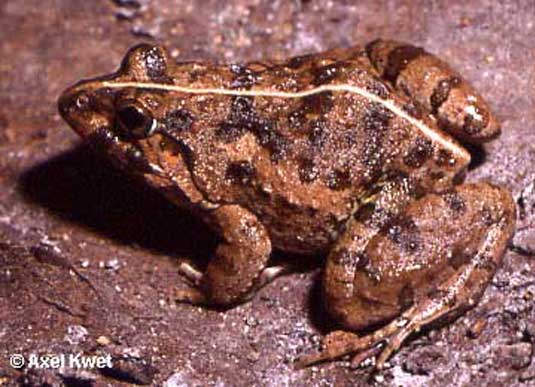
Fejervarya limnocharis

Fejervarya limnocharis (Information about this image)

Life-forms

Superregnum: Eukaryota
Cladus: Unikonta
Cladus: Opisthokonta
Cladus: Holozoa
Regnum: Animalia
Subregnum: Eumetazoa
Cladus: ParaHoxozoa
Cladus: Bilateria
Cladus: Nephrozoa
Superphylum: Deuterostomia
Phylum: Chordata
Cladus: Olfactores
Subphylum: Vertebrata
Infraphylum: Gnathostomata
Megaclassis: Osteichthyes
Cladus: Sarcopterygii
Cladus: Rhipidistia
Cladus: Tetrapodomorpha
Cladus: Eotetrapodiformes
Cladus: Elpistostegalia
Superclassis: Tetrapoda
Cladus: Batrachomorpha
Classis: Amphibia
Subclassis: Lissamphibia
Superordo: Batrachia
Cladus: Salientia
Ordo: Anura

Familia: Dicroglossidae
Subfamilia: Dicroglossinae
Genus: Fejervarya
Species: Fejervarya limnocharis
Name

Fejervarya limnocharis (Gravenhorst, 1829)

Type locality: Java, Indonesia.

Neotype: RMNH 4287.
Synonyms

Rana limnocharis Gravenhorst, 1829
Rana limnocharis Wiegmann, 1834
Rana lymnocharis — Stoliczka, 1872
Rana (Fejervarya) limnocharis — Bolkay, 1915
Rana wasl Annandale, 1917
Rana (Rana) limnocharis — Boulenger, 1920
Rana limnocharis limnocharis — Mertens, 1930
Dicroglossus limnocharis — Deckert, 1938
Rana (Rana) limnocharis — Nakamura & Ueno, 1963
Rana (Dicroglossus) limnocharis limnocharis — Dubois, 1974
Rana (Euphlyctis) limnocharis — Dubois, 1980
Rana (Euphlyctis) limnocharis — Dubois, 1981
Rana (Fejervarya) limnocharis — Dubois, 1984
Euphlyctis limnocharis — Poynton & Broadley, 1985
Limnonectes (Fejervarya) limnocharis — Dubois, 1987
Fejervarya limnocharis — Iskandar, 1998
Fejervarya wasl — Fei, Ye, Jiang & Xie, 2002

References

Gravenhorst, 1829, Delic. Mus. Zool. Vratislav., 1: 42.
Iskandar, 1998, Amph. Java Bali: 71.
Frost, D.R. 2021. Amphibian Species of the World: an Online Reference. Version 6.1. Electronic Database accessible at https://amphibiansoftheworld.amnh.org/index.php. American Museum of Natural History, New York, USA. DOI: 10.5531/db.vz.0001 Fejervarya limnocharis . Accessed on 27 May 2008.
2007 IUCN Red List of Threatened Species IUCN: Fejervarya limnocharis (Least Concern) Downloaded on 27 May 2008.

Vernacular names
English: Boie's Wart Frog
Bahasa Indonesia: Kodok tegalan
日本語: ヌマガエル

Fejervarya limnocharis is a species of frog found in South East Asia and parts of Indochina. It is known under many common names, including Boie's wart frog, rice field frog, and Asian grass frog. Molecular studies of the species complex (after Boulenger)[2] suggest that there may be multiple species involved.[3][4]
Description

Snout pointed, projecting beyond mouth. Canthus obtuse, loreal oblique, more or less concave. Internarial space is longer than interorbital width, which is much less than width of the upper eyelid. Tympanum distinct, half to twothirds the diameter of eye. Fingers obtusely pointed, first longer than second, subarticular tubercles very prominent. Tibiotarsal articulation reaches tympanum or naris. Toes obtuse or with slightly swollen tips, half webbed, subarticular tubercles small and prominent. Body with small tubercles, sometimes small longitudinal folds are present, ventrum smooth except belly and thighs which are granular posteriorly. Male with loose gular region, with brown or blackish W-shaped mark, fore limbs stronger, with pad like subdigital tubercles under first finger. Snout-vent length 39–43 mm.

Color: Gray brown or olive above, sometimes suffused with bright carmine; a V-shaped dark mark between eyes, a yellow vertebral stripe mostly present; lips and limbs barred, a light line along calf, thighs laterally yellow, marbled with black, ventrum white, throat is mottled with brown in male.

The species forms a complex with several genetic variants that may represent multiple species.[5][6]
Distribution

A species inhabiting parts of South East Asia and Indochina.

Earlier, due to misidentification, this species was erroneously and extralimitally reported from South Asia but later have been found to be in error. According to the Amphibian Species of the World, records outside Indonesia, Malaysia, Thailand, Burma, Cambodia, Laos, and Vietnam are almost certainly representing other species.[3]

Fejervarya limnocharis is one of the few frog species commonly found in oil palm plantations in Malaysia, in addition to Microhyla heymonsi and Hylarana erythraea.[7]
Consumption

Fejervarya limnocharis is commonly sold as food in Southeast Asia, including Thailand, Laos, and Cambodia. In Cambodia, it is frequently collected for human consumption, along with Hoplobatrachus rugulosus, Glyphoglossus molossus, Kaloula pulchra, Duttaphrynus melanostictus, and Pelophylax lateralis (with P. lateralis found only north of the Mekong River in localities such as Snuol District, Kratie Province).[8]
References

IUCN SSC Amphibian Specialist Group (2023). "Fejervarya limnocharis". IUCN Red List of Threatened Species. 2023: e.T48886659A68126024. doi:10.2305/IUCN.UK.2023-1.RLTS.T48886659A68126024.en. Retrieved 30 November 2024.
Boulenger, G. A. (1920). "A monograph of the South Asian, Papuan, Melanesian and Australian frogs of the genus Rana". Records of the Indian Museum. 20: 1–226.
Frost, Darrel R. (2013). "Fejervarya limnocharis (Gravenhorst, 1829)". Amphibian Species of the World 5.6, an Online Reference. American Museum of Natural History. Retrieved 22 July 2013.
Veith, M.; J. Kosuch; A. Ohler & A. Dubois (2001). "Systematics of Fejervarya limnocharis (Gravenhorst, 1829) (Amphibia, Anura, Ranidae) and related species. 2. Morphological and molecular variation in frogs from the Greater Sunda Islands (Sumatra, Java, Borneo) with the definition of two species". Alytes. Paris (19): 5–28.
M Kotaki, A Kurabayashi, M Matsui, W Khonsue, TH Djong, M Tandon, M Sumida (2008) Genetic Divergences and Phylogenetic Relationships Among the Fejervarya limnocharis Complex in Thailand and Neighboring Countries Revealed by Mitochondrial and Nuclear Genes. Zoolog Sci 25: 381-90.
Mohammed Mafizul Islam, Md Mukhlesur Rahman Khan, Djong Hon Tjong, Mohammad Shafiqul Alam, Masayuki Sumida (2008) Genetic Differentiation of the Fejervarya limnocharis Complex from Bangladesh and Other Asian Countries Elucidated by Allozyme Analyses. Zoolog Sci. 25(3):261-72
Faruk A, Belabut D, Ahmad N, Knell RJ, Garner TW (2013). "Effects of oil-palm plantations on diversity of tropical anurans". Conserv Biol. 27 (3): 615–24. Bibcode:2013ConBi..27..615F. doi:10.1111/cobi.12062. PMID 23692022. S2CID 24234524.
An Investigation into Frog Consumption and Trade in Cambodia

Amphibia Images

Biology Encyclopedia

Retrieved from "http://en.wikipedia.org/"
All text is available under the terms of the GNU Free Documentation License

Home - Hellenica World