Fine Art

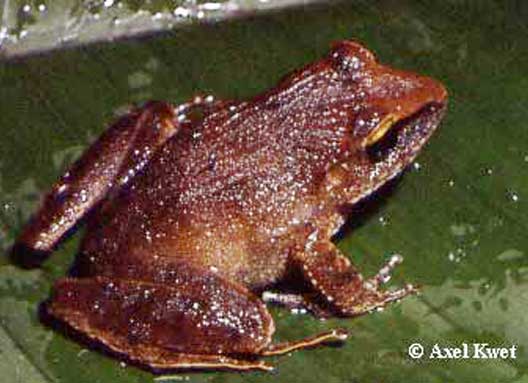
Haddadus binotatus (Information about this image)

Superregnum: Eukaryota
Cladus: Unikonta
Cladus: Opisthokonta
Cladus: Holozoa
Regnum: Animalia
Subregnum: Eumetazoa
Cladus: ParaHoxozoa
Cladus: Bilateria
Cladus: Nephrozoa
Superphylum: Deuterostomia
Phylum: Chordata
Cladus: Olfactores
Subphylum: Vertebrata
Infraphylum: Gnathostomata
Megaclassis: Osteichthyes
Cladus: Sarcopterygii
Cladus: Rhipidistia
Cladus: Tetrapodomorpha
Cladus: Eotetrapodiformes
Cladus: Elpistostegalia
Superclassis: Tetrapoda
Cladus: Batrachomorpha
Classis: Amphibia
Subclassis: Lissamphibia
Superordo: Batrachia
Cladus: Salientia
Ordo: Anura
Superfamilia: Brachycephaloidea

Familia: Craugastoridae
Genus: Haddadus
Species: Haddadus binotatus
Name

Haddadus binotatus (Spix, 1824)

Type locality: Brazil.

Holotype: ZSM 2695/0.
Synonyms

Rana binotata Spix, 1824
Enydrobius abbreviatus — Wagler, 1830
Ololygon abbreviatus — Fitzinger, 1861
Hylodes abbreviatus — Hensel, 1867
Hylodes rugulosus Peters, 1870
Hylodes binotatus — Peters, 1872
Eleutherodactylus binotatus — Stejneger, 1904
Platymantes abbreviata — Luederwaldt, 1929
Eleutherodactylus cinotatus — Luederwaldt, 1929
Eleutherodactylus abbreviatus — Hoogmoed & Gruber, 1983
Eleutherodactylus (Eleutherodactylus) binotatus — Lynch & Duellman, 1997
"Eleutherodactylus" binotatus — Heinicke, Duellman & Hedges, 2007
Haddadus binotatus — Hedges, Duellman & Heinicke, 2008

References

Amaro, R.C., Nunes, I., Canedo, C., Napoli, M.F., Juncá, F.A., Verdade, V.K., Haddad, C.F.B. & Rodrigues, M.T. 2013. A molecular phylogeny recovers Strabomantis aramunha Cassimiro, Verdade and Rodrigues, 2008 and Haddadus binotatus (Spix, 1824) (Anura: Terrarana) as sister taxa. Zootaxa 3741(4): 569–582. DOI: 10.11646/zootaxa.3741.4.7 Paywall Reference page.
Spix, 1824, Animal. Nova Spec. Nov. Test. Ran. Brasil.: 31.
Heinicke, Duellman, and Hedges, 2007, Proc. Natl. Acad. Sci. USA (Suppl. Inform.), 104: Table 2.
Hedges, Duellman, and Heinicke, 2008, Zootaxa, 1737: 45
Moura, M.R.; De Lacerda, J.V.A.; Feio, R.N. 2012: The advertisement call of Haddadus binotatus (Spix, 1824) (Anura; Craugastoridae). Zootaxa, 3224: 67–68. Preview
Frost, D. 2008. Amphibian Species of the World: an Online Reference. Version 5.2 (15 July, 2008). Electronic Database accessible at www.research.amnh.org/herpetology/amphibia. American Museum of Natural History, New York, USA. Haddadus binotatus
2007 IUCN Red List of Threatened Species IUCN: Haddadus binotatus (Least Concern) Downloaded on 16 May 2008.

Vernacular names
English: Clay Robber Frog

Haddadus binotatus (common name: clay robber frog) is a species of frog in the family Craugastoridae. Haddadus binotatus is a very common frog. It inhabits primary and secondary forest and forest edges. It is usually found in the leaf-litter on the forest floor, or on leaves in low vegetation inside the forest.[1]

It is endemic to the Brazilian Atlantic forest and most dominantly found in the states of Rio de Janeiro and Espírito Santo.[2] Haddadus binotatus is a direct-developing frog and the most abundant species in the community.[3]

Female frogs reach 64 mm (2.5 in) snout–vent length.[4] The female of the species were larger than the males, which may result from the production of larger eggs.[2]
References

Monique Van Sluys, Carlos Frederico da Rocha (2010). "Haddadus binotatus". IUCN Red List of Threatened Species. 2010: e.T56463A11469352. doi:10.2305/IUCN.UK.2010-2.RLTS.T56463A11469352.en. Retrieved 14 November 2021.
Coco, L., Borges Júnior, V. N. T., Fusinatto, L. A., Kiefer, M. C., Oliveira, J. C. F., Araujo, P. G., Costa, B. M., van Sluys, M., & Rocha, C. F. D. (2014). Feeding habits of the leaf litter frog Haddadus binotatus (Anura, Craugastoridae) from two Atlantic Forest areas in southeastern Brazil. Anais Da Academia Brasileira de Ciências, 86(1), 239–249. doi:10.1590/0001-37652014113012
Rocha, C. F. D., Vrcibradic, D., Kiefer, M. C., Siqueira, C. C., Almeida-Gomes, M., Borges Júnior, V. N. T., Hatano, F. H., Fontes, A. F., Pontes, J. A. L., Klaion, T., Gil, L. O., & Sluys, M. V. (2011). Parameters from the community of leaf-litter frogs from Estação Ecológica Estadual Paraíso, Guapimirim, Rio de Janeiro State, southeastern Brazil. Anais Da Academia Brasileira de Ciências, 83(4), 1259–1268. doi:10.1590/S0001-37652011005000036
Hedges, S. B.; Duellman, W. E. & Heinicke, M. P (2008). "New World direct-developing frogs (Anura: Terrarana): Molecular phylogeny, classification, biogeography, and conservation" (PDF). Zootaxa. 1737: 1–182. doi:10.11646/zootaxa.1737.1.1. Archived from the original (PDF) on 2010-06-10.

Amphibia Images

Biology Encyclopedia

Retrieved from "http://en.wikipedia.org/"
All text is available under the terms of the GNU Free Documentation License

Home - Hellenica World