Fine Art

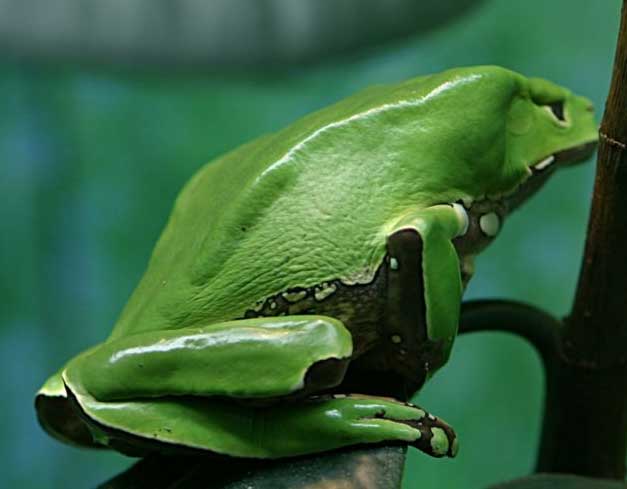
Phyllomedusa bicolor (Information about this image)

Superregnum: Eukaryota
Cladus: Unikonta
Cladus: Opisthokonta
Cladus: Holozoa
Regnum: Animalia
Subregnum: Eumetazoa
Cladus: ParaHoxozoa
Cladus: Bilateria
Cladus: Nephrozoa
Superphylum: Deuterostomia
Phylum: Chordata
Cladus: Olfactores
Subphylum: Vertebrata
Infraphylum: Gnathostomata
Megaclassis: Osteichthyes
Cladus: Sarcopterygii
Cladus: Rhipidistia
Cladus: Tetrapodomorpha
Cladus: Eotetrapodiformes
Cladus: Elpistostegalia
Superclassis: Tetrapoda
Cladus: Batrachomorpha
Classis: Amphibia
Subclassis: Lissamphibia
Superordo: Batrachia
Cladus: Salientia
Ordo: Anura

Familia: Hylidae
Subfamilia: Phyllomedusinae
Genus: Phyllomedusa
Species: Phyllomedusa bicolor
Name

Phyllomedusa bicolor (Boddaert, 1772)

Type locality: "Guinea" or "Surinamo".

Holotype: Not known to exist.
Synonyms

Rana bicolor — Boddaert, 1772
Calamita bicolor— Schneider, 1799
Hyla bicolor — Daudin, 1800
Phyllomedusa bicolor — Wagler, 1830
Rana (Phyllomedusa) bicolor — Guérin-Méneville, 1838
Phyllomedusa boiei — Fitzinger in Steindachner, 1867
Pithecopus scleroderma — Cope, 1868
Phyllomedusa (Phyllomedusa) bicolor — Lutz, 1950

References

Boddaert, 1772, Epist. Rana bicolore: 15.
Lutz, 1950, Mem. Oswaldo Cruz, Rio de Janeiro, 48: 619.
Frost, D.R. 2021. Amphibian Species of the World: an Online Reference. Version 6.1. Electronic Database accessible at https://amphibiansoftheworld.amnh.org/index.php. American Museum of Natural History, New York, USA. DOI: 10.5531/db.vz.0001 Phyllomedusa bicolor . Accessed on 30 Apr 2008.
2007 IUCN Red List of Threatened Species IUCN: Phyllomedusa bicolor (Least Concern) Downloaded on 30 April 2008.

Vernacular names
Deutsch: Riesenmakifrosch
English: Giant Monkey Frog
日本語: フタイロネコメガエル

Phyllomedusa bicolor, the giant leaf frog, bicolor tree-frog, giant monkey frog,[2] or waxy-monkey treefrog,[3] is a species of leaf frog. It can be found in the Amazon basin of Brazil, Colombia (Amazonas), Bolivia, and Peru, and can also be found in the Guianan Region of Venezuela and the Guianas, and in Cerrado of the state of Maranhão in Brazil.[4]
Description
P. bicolor

Males measure 91–103 mm (3.6–4.1 in) and females 111–119 mm (4.4–4.7 in) in snout–vent length. The dorsum is lime green whereas the belly is white to yellow-white or cream. Lower lips, chest and front legs bear sparse white spots with dark frames; these are more dense on the flanks and hind legs. Fingers are transparent brown and have large, green adhesive discs. There is a prominent gland extending from behind each eye over the tympanum. The iris is dark gray.[3]
Distribution and habitat

It is found throughout the Amazon Rainforest in Bolivia, the Guianas, Brazil, Colombia, Venezuela, and Peru. This frog has been found in gallery forest.[1]
Ecology and behaviour
Amplexus. Amapá, Brazil
A giant leaf frog seated.

The giant leaf frog is a nocturnal, arboreal frog. Males call from trees in tropical humid forests. Males fight each other for mating rights by using their heads to attempt to separate another male who is attached to a female. Males fend off rivals using a series of aggressive calls and use their hind legs to push away the rival.[4] During mating season, males may be targeted more by predators as the fights between males are very vocal and can be easily heard by predators. However, to combat this, giant leaf frogs produce peptides in their skin that serves as a chemical defence.[4] Giant leaf frogs reproduce like most frog species through amplexus, where the male climbs onto the female's back to fertilize the eggs.[4] The female and male construct a leaf-nest above forest pools, where the eggs are laid in a gelatinous mass of about 70 cm above the water. The eggs hatch from these nests in approximately 14 days, and the tadpoles fall into the water, where they continue the development into adult frogs. Peak reproduction occurs during the rainy season.[3][4] Eggs of the giant leaf frog are heavily predated and have a predation rate of up to 61%. Species that prey on the eggs include rove beetles, phorid flies, mammals – specifically capuchin monkeys– and other predators, such as snakes. The eggs are predated because they are source of protein for predators.[5]
Conservation

The IUCN endangered species database lists them in the "Least Concern" category, in view of their current wide distribution and large population.[1]
Medicinal use
Main article: Kambo cleanse

The skin secretion of the giant leaf frog is known as Vacina do sapo (frog vaccine) and contains the opioid peptides deltorphin, deltorphin I, deltorphin II and dermorphin.[6][7][8][9] The secretion, known as Kambo or Sapo, has seen increasing popularity in cleansing rituals, where it induces intense vomiting.[10][11]
References

IUCN SSC Amphibian Specialist Group (2023). "Blue-and-Yellow Frog: Phyllomedusa bicolor". IUCN Red List of Threatened Species. 2023. The IUCN Red List of Threatened Species: e.T55841A61405317. doi:10.2305/IUCN.UK.2023-1.RLTS.T55841A61405317.en. Retrieved January 28, 2024.
Frost, Darrel R. (2015). "Phyllomedusa bicolor (Boddaert, 1772)". Amphibian Species of the World: an Online Reference. Version 6.0. American Museum of Natural History. Retrieved 25 August 2015.
"Phyllomedusa bicolor". AmphibiaWeb: Information on amphibian biology and conservation. [web application]. Berkeley, California: AmphibiaWeb. 2015. Retrieved 25 August 2015.
Venâncio, Nathocley; Melo-Sampaio, Paulo (2010). "Reproductive behavior of the giant leaf frog Phyllomedusa bicolor (Anura: Hylidae) in the western Amazon". Phyllomedusa: Journal of Herpetology. 9 (1): 63–67. doi:10.11606/issn.2316-9079.v9i1p63-67.
Neckel-Oliveira, Selvino; Wachlevski, Milena (2004). "Predation on the Arboreal Eggs of Three Species of Phyllomedusa in Central Amazonia". Journal of Herpetology. 38 (2): 244–248. doi:10.1670/162-03A. S2CID 86277566.
Erspamer V, Melchiorri P, Falconieri-Erspamer G, et al. (July 1989). "Deltorphins: a family of naturally occurring peptides with high affinity and selectivity for delta opioid binding sites". Proceedings of the National Academy of Sciences of the United States of America. 86 (13): 5188–92. Bibcode:1989PNAS...86.5188E. doi:10.1073/pnas.86.13.5188. PMC 297583. PMID 2544892.
Lacombe C, Cifuentes-Diaz C, Dunia Iz Auber-Thomay M, Nicolas P, Amiche M (September 2000). "Peptide secretion in the cutaneous glands of South American tree frog Phyllomedusa bicolor: an ultrastructural study". European Journal of Cell Biology. 79 (9): 631–641. doi:10.1078/0171-9335-00085. PMID 11043404.
Melchiorri P, Negri L (1996). "The dermorphin peptide family". General Pharmacology: The Vascular System. 27 (7): 1099–107. doi:10.1016/0306-3623(95)02149-3. PMID 8981054.
Amiche M, Delfour A, Nicolas P (1998). "Opioid peptides from frog skin". D-Amino Acids in Sequences of Secreted Peptides of Multicellular Organisms. Vol. 85. pp. 57–71. doi:10.1007/978-3-0348-8837-0_4 (inactive 1 November 2024). ISBN 978-3-0348-9794-5. PMID 9949868. {{cite book}}: |journal= ignored (help)
Leban, V; Kozelk, G; Brvar, M (2016). "The syndrome of inappropriate antidiuretic hormone secretion after giant leaf frog (Phyllomedusa bicolor) venom exposure". Toxicon. 120: 107–109. Bibcode:2016Txcn..120..107L. doi:10.1016/j.toxicon.2016.07.007. PMID 27421671.
Daly, Max (May 10, 2016). "How Amazonian Tree Frog Poison Became the Latest Treatment for Addiction". Vice. Archived from the original on September 7, 2018. Retrieved October 31, 2018.

Amphibia Images

Biology Encyclopedia

Retrieved from "http://en.wikipedia.org/"
All text is available under the terms of the GNU Free Documentation License

Home - Hellenica World