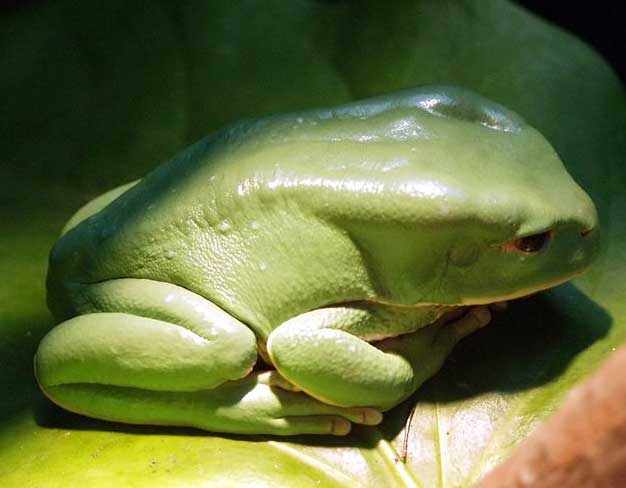
Phyllomedusa boliviana (Information about this image)
Superregnum: Eukaryota
Cladus: Unikonta
Cladus: Opisthokonta
Cladus: Holozoa
Regnum: Animalia
Subregnum: Eumetazoa
Cladus: ParaHoxozoa
Cladus: Bilateria
Cladus: Nephrozoa
Superphylum: Deuterostomia
Phylum: Chordata
Cladus: Olfactores
Subphylum: Vertebrata
Infraphylum: Gnathostomata
Megaclassis: Osteichthyes
Cladus: Sarcopterygii
Cladus: Rhipidistia
Cladus: Tetrapodomorpha
Cladus: Eotetrapodiformes
Cladus: Elpistostegalia
Superclassis: Tetrapoda
Cladus: Batrachomorpha
Classis: Amphibia
Subclassis: Lissamphibia
Superordo: Batrachia
Cladus: Salientia
Ordo: Anura
Familia: Hylidae
Subfamilia: Phyllomedusinae
Genus: Phyllomedusa
Species: Phyllomedusa boliviana
Name
Phyllomedusa boliviana Boulenger, 1902
Type locality: "Chulumani, Bolivia, 2000 metres".
Syntypes: BM 1947.2.22.32-33 (formerly 1901.8.2.49-50).
Synonyms
Phyllomedusa boliviana Boulenger, 1902
Phyllomedusa (Pithecopus) boliviana — Lutz, 1950
Phyllomedusa pailona Shreve, 1959
Pithecopus boliviana — Lutz, 1966
References
Boulenger, 1902, Ann. Mag. Nat. Hist., Ser. 7, 10: 395.
Lutz, 1966, Copeia, 1966: 236.
Frost, D.R. 2021. Amphibian Species of the World: an Online Reference. Version 6.1. Electronic Database accessible at https://amphibiansoftheworld.amnh.org/index.php. American Museum of Natural History, New York, USA. DOI: 10.5531/db.vz.0001 Phyllomedusa boliviana . Accessed on 30 Apr 2008.
2007 IUCN Red List of Threatened Species IUCN: Phyllomedusa boliviana (Least Concern) Downloaded on 30 April 2008.
Vernacular names
English: Red-rimmed Leaf Frog
Phyllomedusa boliviana is a species of frog in the subfamily Phyllomedusinae. It is found in Argentina, Bolivia, and Brazil (west of Mato Grosso and Rondônia States).[2] It has been observed between 200 and 1800 meters above sea level.[3][1]
People have seen this frog on the dry slopes of the Andes Mountains, in forests and in the edges of forests. This frog has shown some tolerance to altered habitats, and it has been seen in human-made ponds, ditches, dams, and cows troughs.[1]
The female frog builds a cone-shaped nest out of a leaf overhanging a temporary body of water.. She lays her eggs in the cone. When the eggs hatch, the tadpoles fall into the water below.[1]
Scientists say this frog is not in danger of extinction because of its large range, though there may be some localized threat from wood collection. Scientists think this might actually be more than one species.[1]
References
IUCN SSC Amphibian Specialist Group (2021). "Rana Mono Yungueña: Pithecopus boliviana". IUCN Red List of Threatened Species. 2021. The IUCN Red List of Threatened Species: e.T55842A61405462. doi:10.2305/IUCN.UK.2023-1.RLTS.T55842A61405462.en. Retrieved January 27, 2024.
Frost, Darrel R. "Phyllomedusa boliviana (Boulenger, 1902)". Amphibian Species of the World, an Online Reference. Version 6.0. American Museum of Natural History. Retrieved September 12, 2021.
"Phyllomedusa boliviana". AmphibiaWeb. University of California, Berkeley. Retrieved September 12, 2021.
Retrieved from "http://en.wikipedia.org/"
All text is available under the terms of the GNU Free Documentation License