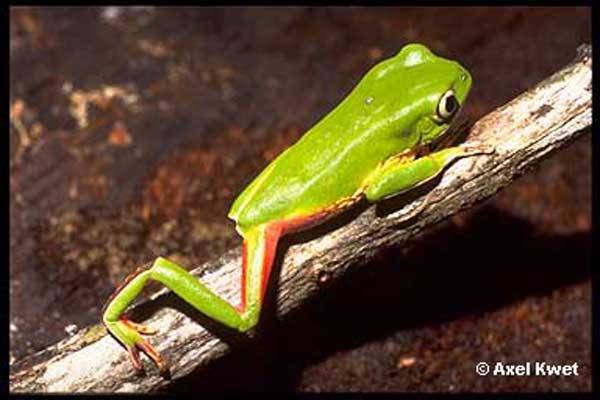
Phyllomedusa distincta (Information about this image)
Superregnum: Eukaryota
Cladus: Unikonta
Cladus: Opisthokonta
Cladus: Holozoa
Regnum: Animalia
Subregnum: Eumetazoa
Cladus: ParaHoxozoa
Cladus: Bilateria
Cladus: Nephrozoa
Superphylum: Deuterostomia
Phylum: Chordata
Cladus: Olfactores
Subphylum: Vertebrata
Infraphylum: Gnathostomata
Megaclassis: Osteichthyes
Cladus: Sarcopterygii
Cladus: Rhipidistia
Cladus: Tetrapodomorpha
Cladus: Eotetrapodiformes
Cladus: Elpistostegalia
Superclassis: Tetrapoda
Cladus: Batrachomorpha
Classis: Amphibia
Subclassis: Lissamphibia
Superordo: Batrachia
Cladus: Salientia
Ordo: Anura
Familia: Hylidae
Subfamilia: Phyllomedusinae
Genus: Phyllomedusa
Species: Phyllomedusa distincta
Name
Phyllomedusa distincta Lutz, 1950
Type locality: "Rio Vermelho", Santa Catarina, Brazil.
Holotype: AL-MNRJ 775.
Synonyms
Phyllomedusa (Pithecopus) burmeisteri distincta Lutz, 1950
Pithecopus burmeisteri distincta — Lutz, 1966
Phyllomedusa distincta — Bokermann, 1966
Pithecopus distincta — Laurent, 1967
References
Lutz, 1950, Mem. Oswaldo Cruz, Rio de Janeiro, 48: 608.
Laurent, 1967, Acta Zool. Lilloana, 22: 232.
Frost, D.R. 2021. Amphibian Species of the World: an Online Reference. Version 6.1. Electronic Database accessible at https://amphibiansoftheworld.amnh.org/index.php. American Museum of Natural History, New York, USA. DOI: 10.5531/db.vz.0001 Phyllomedusa distincta . Accessed on 30 Apr 2008.
2007 IUCN Red List of Threatened Species IUCN: Phyllomedusa distincta (Least Concern) Downloaded on 30 April 2008.
Vernacular names
English: Sao Paulo Leaf Frog
Phyllomedusa distincta is a species of frog in the subfamily Phyllomedusinae, endemic to Brazil.[2] It has been observed as high as 1000 meters above sea level.[1]
This frog has been found in primary forest and in secondary forest. People have seen it on shrubs near standing water. The female frog lays eggs on leaves overhanging permanent bodies of water. When the eggs hatch, the tadpoles fall into the water below.[1]
Scientists do not believe that this frog is in danger of dying out because of its extensive range, but it is in decline. This is because of habitat loss associated with urbanization, small-scale agriculture, silviculture, and logging.[1]
References
IUCN SSC Amphibian Specialist Group; Instituto Boitatá de Etnobiologia e Conservação da Fauna (2023). "Brownbelly Leaf Frog: Pithecopus distincta". IUCN Red List of Threatened Species. 2023. The IUCN Red List of Threatened Species: e.T55849A172209740. doi:10.2305/IUCN.UK.2023-1.RLTS.T55849A172209740.en. Retrieved January 25, 2024.
"Phyllomedusa distincta Lutz, 1950 | Amphibian Species of the World". amphibiansoftheworld.amnh.org. Retrieved 2022-11-30.
Retrieved from "http://en.wikipedia.org/"
All text is available under the terms of the GNU Free Documentation License