Fine Art

Rana dalmatina

Superregnum: Eukaryota
Cladus: Unikonta
Cladus: Opisthokonta
Cladus: Holozoa
Regnum: Animalia
Subregnum: Eumetazoa
Cladus: ParaHoxozoa
Cladus: Bilateria
Cladus: Nephrozoa
Superphylum: Deuterostomia
Phylum: Chordata
Cladus: Olfactores
Subphylum: Vertebrata
Infraphylum: Gnathostomata
Megaclassis: Osteichthyes
Cladus: Sarcopterygii
Cladus: Rhipidistia
Cladus: Tetrapodomorpha
Cladus: Eotetrapodiformes
Cladus: Elpistostegalia
Superclassis: Tetrapoda
Cladus: Batrachomorpha
Classis: Amphibia
Subclassis: Lissamphibia
Superordo: Batrachia
Cladus: Salientia
Ordo: Anura

Familia: Ranidae
Genus: Rana
Species: Rana dalmatina
Name

Rana dalmatina Fitzinger in Bonaparte, 1839

Type locality: "Dalmatien" (now in Croatia).

Holotype: Not designated.
Synonyms

Rana dalmatina Fitzinger in Bonaparte, 1839
Rana agilis Thomas, 1855
Rana gracilis Fatio, 1862
Rana temporaria var. agilis — Schreiber, 1875
Rana temporaria agilis — Bedriaga, 1881
Rana agilis agilis — Cope, 1886
Rana (Crotaphitis) agilis — Schultze, 1891
Rana (Rana) dalmatina — Guibé, 1950
Rana agiloides Brunner, 1951
Rana mülleri Brunner, 1959
Rana (Rana) dalmatina — Dubois, 1987
Rana (Laurasiarana) dalmatina — Hillis & Wilcox, 2005

References

Fitzinger in Bonaparte, 1839, Iconograph. Fauna Ital., 2(Fasc. 26): unnumbered.
Hillis and Wilcox, 2005, Mol. Phylogenet. Evol., 34: 311.
Frost, D.R. 2021. Amphibian Species of the World: an Online Reference. Version 6.1. Electronic Database accessible at https://amphibiansoftheworld.amnh.org/index.php. American Museum of Natural History, New York, USA. DOI: 10.5531/db.vz.0001 Rana dalmatina . Accessed on 05 July 2008.
2007 IUCN Red List of Threatened Species IUCN: Rana dalmatina (Least Concern) Downloaded on 05 July 2008.

Vernacular names
Deutsch: Springfrosch
English: Agile Frog
eesti: Välekonn

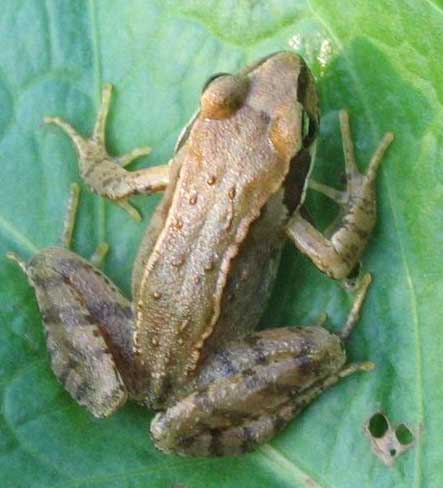
The agile frog (Rana dalmatina) is a European frog in the genus Rana of the true frog family, Ranidae.[2]
Description

This species is fat and has long limbs and a pointy snout. Adult males are rarely larger than 6.5 cm, while females can grow up to 8 cm. Its dorsal surface is light brown, reddish-brown, or light greyish-brown with very little contrast. Triangle-shaped spots reach from the temple to the eardrum, which are dark brown. The underside of the agile frog is white without any spots. During mating season, the males often become dark brown.[3]

The hind legs are unusually long, which allow this species to jump further than other similar frogs - they have been known to jump up to two metres in distance. The pupils are horizontal. The colour of the upper third of the iris (above the pupil) is lighter and gold in coloration. The tympanum is about the size of the diameter of the eye. The gland stripes on the frog's back are not very developed and partially interrupted.
Reproduction
Typically fixed spawn clump under water

The call is a fairly quiet "rog ... rog ... rog", and can last for up to 12 seconds, and almost sounds like a clucking chicken. They often also call under water, so the calls can only be heard from a very short distance by observers. Spawning only lasts a few days, and during this period, the males sometimes gather in large calling groups on the water surface to attract females. In Central Europe, spawning usually occurs in the first 20 days of March, but can also be delayed, depending on the weather. The spawn clumps consist of 450 to 1800 eggs, and are usually attached to tree branches, roots, or plant stems at depths of 5–40 cm (2–16 in). Therefore, they rarely sink to the bottom. Unlike the moor frog (Rana arvalis) and common frog (Rana temporaria), the agile frog does not lay its spawn all in one clump. The diameter of a single egg, not counting the gelatinous shell, is 1.5–2.1 mm (0.06–0.08 in).[3]
Feeding

Adults of agile frog eat arthropods like caterpillars, spiders, millipedes, flies, beetles, cicadas and collembolans.[4][5][6][7] Tadpoles eat plant material.[8]
Habitat

The agile frog prefers light deciduous mixed forests with plentiful water. The open land around a forest is often also populated, as long as it is connected to the forest by shrubs. In dry, warm forests, this species often also lives far away from the water. Of the three Middle European Rana species, this frog likes warmth and dryness the most.[1]
Distribution

The agile frog can be found in France, the Channel Islands, parts of Germany, Denmark, Sweden, Italy, the Czech Republic, Slovakia, Austria, Hungary, on the Balkans, Greece, and by the Black Sea. The species once lived in the Great Britain, during middle Saxon times, with archaeological remains recovered in East Anglia.[9][10] Celtic Reptile & Amphibian have discussed reintroducing the species.[11][12] It has undergone a reintroduction on Jersey, by Durrell Wildlife Conservation Trust, as it was very close to extirpation on the island.[13][14]


References

U?ur Kaya; Sergius Kuzmin; Max Sparreboom; et al. (2009). "Rana dalmatina". IUCN Red List of Threatened Species. 2009: e.T58584A11790570. doi:10.2305/IUCN.UK.2009.RLTS.T58584A11790570.en. Retrieved 19 November 2021.
Frost, Darrel R. (2013). "Rana dalmatina Fitzinger, 1839". Amphibian Species of the World 5.6, an Online Reference. American Museum of Natural History. Retrieved 27 November 2013.
"Rana dalmatina". AmphibiaWeb. Retrieved 16 April 2021.
Cicort-Lucaciu, Alfred-Stefan; Sas, Istvan; Roxin, Maria; Badar, Larisa; Goilean, Camelia (2011). "The feeding study of a Rana dalmatina population from Carei plain" (PDF). South Western Journal of Horticulture, Biology and Environment. 2 (1): 35–46. Retrieved 26 April 2024.
Guidali, Franca; Scali, Stefano; Carettoni, Alessia (1 January 2000). "Diet and trophic niche overlap of two ranid species in northern Italy". Italian Journal of Zoology. 67 (1): 67–72. doi:10.1080/11250000009356297.
Hodisan, Oana Irina; Benchiş, Andrei; Gabrian, Daniel; Badar, Larisa; Toader, Simona (2010). "The trophic spectrum of two brown frog populations (Rana dalmatina and Rana temporaria) from Baia de Fier area, Romania" (PDF). Herpetologia Romanica. 4: 7–16. Retrieved 26 April 2024.
Aszalós, Lilla; Bogdan, Horia; Kovács, Éva-Hajnalka; Peter, Violeta-Ionela (2005). "Food composition of two Rana species on a forest habitat (Livada Plain, Romania)" (PDF). North-Western Journal of Zoology. 1: 25–30. Retrieved 26 April 2024.
Reeder, W. G. (1964). "The digestive tract". In Moore, John A. (ed.). Physiology of Amphibia. New York: Academic Press. pp. 99–149.
Gleed-Owen, Chris Paul (March 2000). "Subfossil records of Rana cf. lessonae, Rana arvalis and Rana cf. dalmatina from Middle Saxon (c. 600-950 AD) deposits in eastern England: Evidence for native status". Amphibia-Reptillia. 21: 57–65. doi:10.1163/156853800507273 – via Research Gate.
Snell, Charles (2006-02-01). "Status of the common tree frog in Britain". British Wildlife. 17: 153–160.
"'Who doesn't love a turtle?' The teenage boys on a mission – to rewild Britain with reptiles". the Guardian. 2021-01-10. Retrieved 2021-10-27.
"Guest blog by Celtic Reptile and Amphibian - Mark Avery". markavery.info. Retrieved 2021-10-27.
"Inside the Islands - Jersey's Agile Frogs". ITV News. 2019-07-21. Retrieved 2021-10-27.
"Agile frog | Durrell Wildlife Conservation Trust". wildlife.durrell.org. Retrieved 2021-10-27.

Amphibia Images

Biology Encyclopedia

Retrieved from "http://en.wikipedia.org/"
All text is available under the terms of the GNU Free Documentation License

Home - Hellenica World