Fine Art

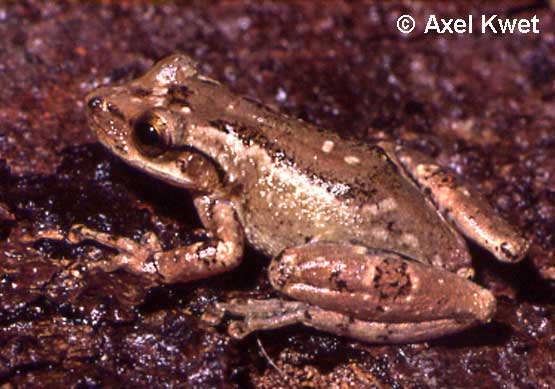
Scinax alter

Scinax alter (Information about this image)

Superregnum: Eukaryota
Cladus: Unikonta
Cladus: Opisthokonta
Cladus: Holozoa
Regnum: Animalia
Subregnum: Eumetazoa
Cladus: ParaHoxozoa
Cladus: Bilateria
Cladus: Nephrozoa
Superphylum: Deuterostomia
Phylum: Chordata
Cladus: Olfactores
Subphylum: Vertebrata
Infraphylum: Gnathostomata
Megaclassis: Osteichthyes
Cladus: Sarcopterygii
Cladus: Rhipidistia
Cladus: Tetrapodomorpha
Cladus: Eotetrapodiformes
Cladus: Elpistostegalia
Superclassis: Tetrapoda
Cladus: Batrachomorpha
Classis: Amphibia
Subclassis: Lissamphibia
Superordo: Batrachia
Cladus: Salientia
Ordo: Anura

Familia: Hylidae
Subfamilia: Scinaxinae
Genus: Scinax
Species: Scinax alter
Name

Scinax alter (Lutz, 1973)

Type locality: "Crubixá, county of Santa Leopoldina, state of Espirito Santo", Brazil. Junior homonym of Hyla arborea orientalis Bedriaga, 1890 "1889".

Holotype: MNRJ 4030.
Synonyms

Hyla rubra orientalis Lutz, 1968
Hyla rubra altera Lutz, 1973
Ololygon altera — Carvalho e Silva and Peixoto, 1991
Scinax altera — Pombal, Haddad, and Kasahara, 1995
Scinax alter — Alves and de Carvalho e Silva, 2002

References

Lutz, 1968, Pearce-Sellards Ser., 10: 15.
Alves and de Carvalho e Silva, 2002, J. Herpetol., 36: 133.
Frost, D.R. 2021. Amphibian Species of the World: an Online Reference. Version 6.1. Electronic Database accessible at https://amphibiansoftheworld.amnh.org/index.php. American Museum of Natural History, New York, USA. DOI: 10.5531/db.vz.0001 Scinax alter . Accessed on 16 Apr 2008.
2007 IUCN Red List of Threatened Species IUCN: Scinax alter (Least Concern) Downloaded on 16 April 2008.

Vernacular names
English: Crubixa Snouted Treefrog

Scinax alter, the Crubixa snouted treefrog, is a species of frog in the family Hylidae endemic to Brazil.[2][4][1][3]
Appearance

The adult male frog measures 22.5 to 31.1 mm long in snout-vent length and the adult female frog 23.9–31.0 mm.[3]

Scientists distinguish this frog from related species by the bright white stripes, lined with dark brown, down the sides of its body. It also has a dark brown intraorbital blotch in the shape of an inverted triangle. It has small dark brown rostral stripes in front of its eyes. The insides of its back legs are lighter brown. The belly is yellow-brown. It has a slender body and protuberant eyes. It has vomerine teeth in its jaw.[3]

The tadpole is 22.9 to 32.0 mm long, with the tail.[3]
Habitat

Its natural habitats are subtropical or tropical moist shrubland, subtropical or tropical seasonally wet or flooded lowland grassland, swamps, intermittent freshwater lakes, freshwater marshes, intermittent freshwater marshes, pastureland, and ponds. Most of these frogs live along the Atlantic Ocean in the east. Some of them live further away from the ocean in the Rio Doce valley in Minas Gerais. Others live higher up in the hills in Espírito Santo.[2] They have been seen on arbustive plants near ponds in the edges of forests or open areas. They can live in habitats with sand dunes if there are tall enough plants growing in them. Scientists have noticed them both on the ground and in trees.[3]
References

Sergio Potsch de Carvalho-e-Silva; Axel Kwet (2010). "Scinax alter". The IUCN Red List of Threatened Species. 3.1: e.T55926A11394633. doi:10.2305/IUCN.UK.2010-2.RLTS.T55926A11394633.en. 55926. Retrieved May 17, 2022.
Frost, Darrel R. "Scinax alter (Lutz, 1973)". Amphibian Species of the World, an Online Reference. Version 6.0. American Museum of Natural History, New York. Retrieved May 17, 2022.
Nunes I; Kwet A; Pombal Jr JP (2012). "Taxonomic revision of the Scinax alter species complex (Anura: Hylidae)" (PDF). Copeia. 2012 (3): 554–569. doi:10.1643/CH-11-088. S2CID 85937435. Retrieved May 26, 2022.
"Scinax alter". AmphibiaWeb. University of California, Berkeley. Retrieved May 17, 2022.

Amphibia Images

Biology Encyclopedia

Retrieved from "http://en.wikipedia.org/"
All text is available under the terms of the GNU Free Documentation License

Home - Hellenica World