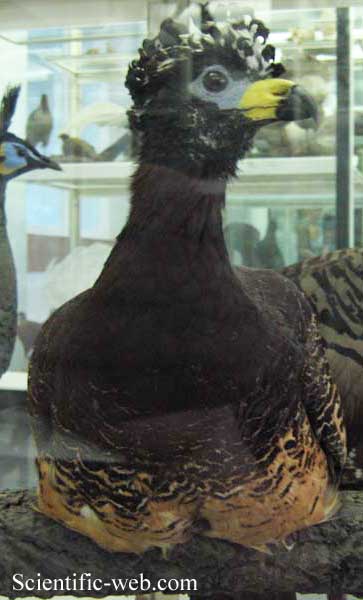
Crax fasciolata, Photo: Michael Lahanas
Superregnum: Eukaryota
Cladus: Unikonta
Cladus: Opisthokonta
Cladus: Holozoa
Regnum: Animalia
Subregnum: Eumetazoa
Cladus: ParaHoxozoa
Cladus: Bilateria
Cladus: Nephrozoa
Superphylum: Deuterostomia
Phylum: Chordata
Cladus: Olfactores
Subphylum: Vertebrata
Infraphylum: Gnathostomata
Megaclassis: Osteichthyes
Cladus: Sarcopterygii
Cladus: Rhipidistia
Cladus: Tetrapodomorpha
Cladus: Eotetrapodiformes
Cladus: Elpistostegalia
Superclassis: Tetrapoda
Cladus: Reptiliomorpha
Cladus: Amniota
Cladus: Sauropsida
Cladus: Reptilia
Cladus: Eureptilia
Cladus: Romeriida
Subclassis: Diapsida
Cladus: Neodiapsida
Cladus: Sauria
Cladus: Archelosauria
Cladus: Archosauromorpha
Cladus: Crocopoda
Cladus: Archosauriformes
Cladus: Eucrocopoda
Cladus: Archosauria
Cladus: Avemetatarsalia
Cladus: Ornithodira
Cladus: Dinosauromorpha
Cladus: Dinosauriformes
Cladus: Dracohors
Cladus: Dinosauria
Cladus: Saurischia
Cladus: Theropoda
Cladus: Neotheropoda
Cladus: Averostra
Cladus: Tetanurae
Cladus: Avetheropoda
Cladus: Coelurosauria
Cladus: Tyrannoraptora
Cladus: Maniraptoromorpha
Cladus: Maniraptoriformes
Cladus: Maniraptora
Cladus: Pennaraptora
Cladus: Paraves
Cladus: Eumaniraptora
Cladus: Avialae
Subclassis: Aves
Cladus: Avebrevicauda
Cladus: Pygostylia
Cladus: Ornithothoraces
Cladus: Ornithuromorpha
Cladus: Carinatae
Cladus: Neornithes
Infraclassis: Neognathae
Cladus: Pangalloanserae
Cladus: Galloanseres
Ordo: Galliformes
Subordo: Craci
Familia: Cracidae
Subfamilia: Cracinae
Genus: Crax
Species: Crax fasciolata
Subspecies: C. f. fasciolata – C. f. grayi – C. f. pinima – C. f. xavieri
Name
Crax fasciolata Spix, 1825
References
Avium species novae, quas in itinere per Brasiliam annis MDCCCXVII-MDCCCXXX 2 p. 48 BHL, pl.62a BHL
Links
IUCN: Crax fasciolata (Vulnerable)
Vernacular names
العربية: قراز عاري الوجه
български: Гололик кракс
català: Hoco caranú
Cymraeg: Cwrasow gyddfddu
English: Bare-faced Curassow
Esperanto: Bendomutuo
español: pavón muitú
euskara: Crax fasciolata
فارسی: کاکلفری لختصورت
français: Hocco à face nue
עברית: הוקו חשוף-פנים
hrvatski: Gololici hoko
magyar: Csupaszarcú hokkó
lietuvių: Plikaskruostis kraksas
Nederlands: Maskerhokko
português: Mutum-de-penacho
svenska: gulnäbbad hocko
The bare-faced curassow (Crax fasciolata) is a species of bird in the family Cracidae, the chachalacas, guans, curassows, etc. It is found in Brazil, Paraguay, and eastern Bolivia, and extreme northeast Argentina, in the cerrado, pantanal, and the southeastern region of the Amazon basin. Its natural habitats are subtropical or tropical dry forest and subtropical or tropical moist lowland forest.
Taxonomy
There are three currently recognized subspecies following the IOC,
C. f. fasciolata (Spix, 1825) – fasciated curassow – lowlands of Brazil to Paraguay and northeast Argentina
C. f. grayi (Ogilvie-Grant, 1893) – eastern Bolivia
C. f. pinima (Pelzeln, 1870) – northeastern Brazil
Description
The bare-faced curassow is a large bird reaching a length of 82 to 92 centimetres (32 to 36 in). The sexes differ in appearance. The male has black upper parts faintly glossed with greenish-olive, with an unfeathered face with yellowish bare skin, a small black crest, and white underparts. The female, on the other hand, has a black head, throat, neck and upper mantle, and a black and white barred crest. The remainder of the upper parts are greenish-black barred with white or ochre. The black tail is tipped with white or ochre and the underparts are black with ochre barring on the breast, paling to a yellowish or ochre belly. The facial skin on females is blackish.[2]
Behaviour
The bare-faced curassow lives in moist, semi-deciduous and gallery forests, often near the fringes of the woodland. It mainly feeds on fruit, but seeds, flowers and small invertebrates are also eaten. Breeding takes place in the summer in the southern part of its range, with the nests being platforms of sticks in trees.[1]
Status
The bare-faced curassow has a wide range and is fairly numerous in parts of its range; however, it is subject to hunting and to the destruction of its habitat and the total population is likely to be declining quite rapidly. The International Union for Conservation of Nature has assessed its conservation status as "vulnerable".[1]
References
BirdLife International (2016). "Crax fasciolata". IUCN Red List of Threatened Species. 2016: e.T45092100A95141387. doi:10.2305/IUCN.UK.2016-3.RLTS.T45092100A95141387.en. Retrieved 16 November 2021.
Emmet Reid Blake (1 July 1977). Manual of Neotropical Birds. University of Chicago Press. p. 433. ISBN 978-0-226-05641-8.
Retrieved from "http://en.wikipedia.org/"
All text is available under the terms of the GNU Free Documentation License