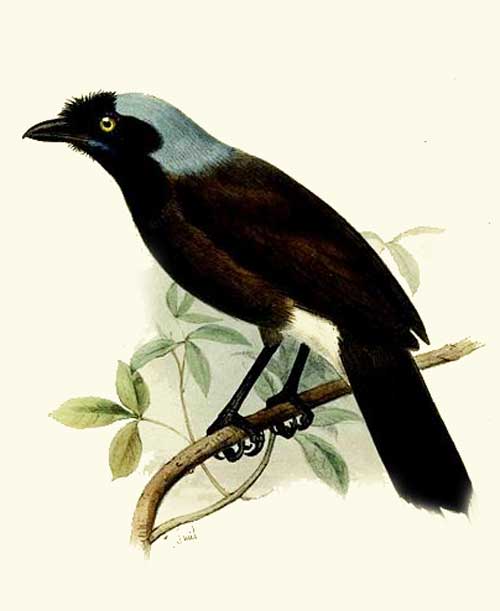
Cyanocorax heilprini
Superregnum: Eukaryota
Cladus: Obazoa
Cladus: Opisthokonta
Cladus: Holozoa
Cladus: Filozoa
Cladus: Choanozoa
Regnum: Animalia
Subregnum: Eumetazoa
Cladus: ParaHoxozoa
Cladus: Bilateria
Cladus: Nephrozoa
Superphylum: Deuterostomia
Phylum: Chordata
Cladus: Olfactores
Subphylum: Vertebrata
Infraphylum: Gnathostomata
Megaclassis: Osteichthyes
Cladus: Sarcopterygii
Cladus: Rhipidistia
Cladus: Tetrapodomorpha
Cladus: Eotetrapodiformes
Cladus: Elpistostegalia
Superclassis: Tetrapoda
Cladus: Reptiliomorpha
Cladus: Amniota
Cladus: Sauropsida
Cladus: Reptilia
Cladus: Eureptilia
Cladus: Romeriida
Subclassis: Diapsida
Cladus: Neodiapsida
Cladus: Sauria
Cladus: Archelosauria
Cladus: Archosauromorpha
Cladus: Crocopoda
Cladus: Archosauriformes
Cladus: Eucrocopoda
Cladus: Archosauria
Cladus: Avemetatarsalia
Cladus: Ornithodira
Cladus: Dinosauromorpha
Cladus: Dinosauriformes
Cladus: Dracohors
Cladus: Dinosauria
Cladus: Saurischia
Cladus: Theropoda
Cladus: Neotheropoda
Cladus: Averostra
Cladus: Tetanurae
Cladus: Avetheropoda
Cladus: Coelurosauria
Cladus: Tyrannoraptora
Cladus: Maniraptoromorpha
Cladus: Maniraptoriformes
Cladus: Maniraptora
Cladus: Pennaraptora
Cladus: Paraves
Cladus: Eumaniraptora
Cladus: Avialae
Subclassis: Aves
Cladus: Avebrevicauda
Cladus: Pygostylia
Cladus: Ornithothoraces
Cladus: Ornithuromorpha
Cladus: Carinatae
Cladus: Neornithes
Infraclassis: Neognathae
Cladus: Neoaves
Cladus: Telluraves
Cladus: Australaves
Ordo: Passeriformes
Subordo: Passeri
Infraordo: Corvida
Superfamilia: Corvoidea
Familia: Corvidae
Subfamilia: Cyanocoracinae
Genus: Cyanocorax
Species: Cyanocorax heilprini
Subspecies: C. h. hafferi – C. h. heilprini
Name
Cyanocorax heilprini A. F. Gentry, 1885
References
Proceedings of the Academy of Natural Sciences of Philadelphia 37: 90.
Cohn-Haft, M., Santos Jr, M. A., Fernandes, A. M. & Ribas, C. C. (2013). A new species of Cyanocorax jay from savannas of the central Amazon. In: del Hoyo, J., Elliott, A., Sargatal, J. & Christie, D.A. (eds.) 2013. Handbook of the Birds of the World. Special Volume: New Species and Global Index. Lynx Edicions, Barcelona. Reference page. P. 48-52 ISBN 978-84-96553-88-0. Full article (PDF)Reference page.
Vernacular names
català: Gaig de clatell blau
čeština: Sojka kolumbijská
Cymraeg: Sgrech warasur
dansk: Azurnakket Blåskade
Deutsch: Azurnacken-Blaurabe
English: Azure-naped Jay
español: Chara nuquiazul
eesti: Ljaano-sininäär
فارسی: جیجاق پسسرلاجوردی
suomi: Sininiskanärhi
français: Geai à calotte azur
magyar: Helprin-indigószajkó
italiano: Ghiandaia nucazzurra
日本語: シロエリルリサンジャク
Nederlands: Azuurnekgaai
norsk: Blånakkeskrike
polski: Modrowronka amazońska
português: Gralha-de-nuca-azul
русский: Сиреневая разноцветная сойка
slovenčina: Kapuciarka orgovánová
svenska: Azurnackad skrika
українська: Пая венесуельська
中文: 蓝枕蓝鸦
The azure-naped jay (Cyanocorax heilprini) is a species of bird in the family Corvidae. It is found in Brazil, Colombia, and Venezuela.
Its natural habitats are subtropical or tropical moist lowland forest and subtropical or tropical dry shrubland.
Taxonomy
The Azure-naped jay was first described by Alan F. Gentry based on a single specimen, marked as a male, from the T. B. Wilson Collection of the Academy of Natural Sciences of Philadelphia.[2]
The genus Cyanocorax comes from the Ancient Greek kuanos (dark blue) and korax (raven). The species epithet heilprini honours Gentry's friend, Professor Angelo Heilprin.[3] There are two identified subspecies:
C. h. heilprini. The nominate subspecies.
C. h. hafferi. This subspecies, Campina Jay, was described as a new species in 2013, but the South American Classification Committee of the American Ornithologists' Union did not support the proposal.[4][5]
Description
The back is dark brown, as are the upper sides of the wings and tail. The rear crown and nape are bright lavender blue. The front and sides of the head are black, with the feathers of the forecrown and forehead curled up and forwards in a short bushy crest. From the chin to the centre of the breast the bird is dark violaceous-grey. The lower breast and belly are violaceous, fading to white on the lower belly and vent. The eyes are pale to yellowish-white and the bill, feet and legs are black.[6]
Distribution and Habitat
This species is a native resident species of the Amazon basin, found from Southeast Colombia to Southwest Venezuela (Amazonas) and extreme northwest Brazil.[7]
It is a bird of the lower tropical zone, found at altitudes of 250m and below. Its preferred habitat is stunted forests, forest edges and second growth on sandy soils in the upper Río Negro basin, as well as in lighter savannah woodland.[6] Two recent surveys of birds Amazon basin found the Azure-naped jay is endemic to areas of white sand forest, and is not found in nearby areas of nearby terra firme forests, seasonally flooded forests and Amazonian savannas.[8][9]
Behaviour
These birds are found in noisy groups that travel slowly, foraging at all levels. They are wary of observers and will utter alarm cries, taking turns to observe an intruder before moving on, or simply disappear into surrounding vegetation.[6]
Status
The azure-naped jay is rated a species of Least Concern by Birdlife International, because it occurs over a very large range and the population, though declining, is not thought to be declining rapidly enough to reach the threshold of Vulnerable status.[7]
Azure-naped Jay
References
BirdLife International (2016). "Cyanocorax heilprini". IUCN Red List of Threatened Species. 2016: e.T22705717A94032327. doi:10.2305/IUCN.UK.2016-3.RLTS.T22705717A94032327.en. Retrieved 12 November 2021.
Gentry, Alan F. (1885). "Description of a New Species of the Genus Cyanocorax". Proceedings of the Academy of Natural Sciences of Philadelphia. 37. Methuen & co., ltd.: 90. Retrieved 24 January 2021.
Jobling, James A. (2010). The Helm dictionary of scientific bird names : from aalge to zusii. London: Christopher Helm. p. 126. ISBN 978-1-4081-2501-4.
Cohn-Haft, Mario; dos Santos Junior, Marcelo A.; Fernandes, Alexandre M.; Ribas, Camila C., in (2013). Handbook of the birds of the world: New Species and Global Index. Barcelona: Lynx Edicions. pp. 48–53. ISBN 978-8496553880. Retrieved 24 January 2021.
Part 9. Oscine Passeriformes, A (Vireonidae to Sturnidae). "A classification of the bird species of South America". www.museum.lsu.edu. South American Classification Committee. Retrieved 24 January 2021.
Restall, Robin L.; Rodner, Clemencia; Lentino, Miguel (2007). Birds of northern South America : an identification guide. New Haven: Yale University Press. pp. 576–577. ISBN 978-0-300-10862-0.
"Species factsheet: Cyanocorax heilprini". BirdLife International (2021). Retrieved 24 January 2021.
Borges, Sérgio Henrique; Whittaker, Andrew; Almeida, Ricardo Afonso Machado de (August 2014). "Bird diversity in the Serra do Aracá region, northwestern Brazilian Amazon: preliminary check-list with considerations on biogeography and conservation". Zoologia (Curitiba). 31 (4): 358. doi:10.1590/S1984-46702014000400006. ISSN 1984-4670.
Borges, Sérgio Henrique; Cornelius, Cintia; Ribas, Camila; Almeida, Ricardo; Guilherme, Edson; Aleixo, Alexandre; Dantas, Sidnei; Santos, Marcos Pérsio Dos; Moreira, Marcelo (June 2016). "What is the avifauna of Amazonian white-sand vegetation?". Bird Conservation International. 26 (2): 6. doi:10.1017/S0959270915000052. S2CID 88411073.
Retrieved from "http://en.wikipedia.org/"
All text is available under the terms of the GNU Free Documentation License