
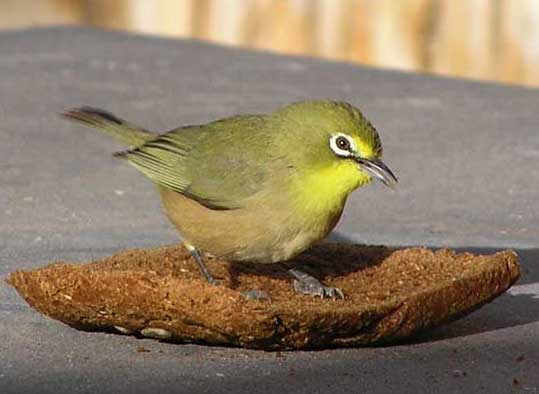
Zosterops pallidus (*)
Superregnum: Eukaryota
Regnum: Animalia
Subregnum: Eumetazoa
Cladus: Bilateria
Cladus: Nephrozoa
Superphylum: Deuterostomia
Phylum: Chordata
Cladus: Craniata
Subphylum: Vertebrata
Infraphylum: Gnathostomata
Superclassis: Tetrapoda
Cladus: Reptiliomorpha
Cladus: Amniota
Classis: Reptilia
Cladus: Eureptilia
Cladus: Romeriida
Subclassis: Diapsida
Cladus: Sauria
Infraclassis: Archosauromorpha
Cladus: Crurotarsi
Divisio: Archosauria
Subsectio: Ornithodira
Subtaxon: Dinosauromorpha
Cladus: Dinosauria
Ordo: Saurischia
Cladus: Theropoda
Cladus: Neotheropoda
Infraclassis: Aves
Ordo: Passeriformes
Subordo: Passeri
Infraordo: Passerida
Superfamilia: Sylvioidea
Familia: Zosteropidae
Genus: Zosterops
Species: Zosterops pallidus
Subspecies: Z. p. atmorii - Z. p. caniviridis - Z. p. capensis - Z. p. pallidus - Z. p. sundevalli - Z. p. virens
Name
Zosterops pallidus Swainson, 1838
References
Animals in Menageries, in The cabinet cyclopedia p. 294
Vernacular names
English: Cape White-eye
suomi: Eteläafrikanrilli
------------
The Cape White-eye, Zosterops pallidus, is a small passerine bird in the white-eye family.
Taxonomy
Ssp. virens upper, capensis lower
There are six subspecies. Traditionally, the western nominate group and the eastern capensis group have been treated as separate species; the Orange River White-eye (Z. pallidus) and the Cape White-eye (Z. capensis). The latter can be further divided into two subgroups, the south-western capensis subgroup and the eastern virens subgroup (the so-called Green White-eye). All subspecies interbreed where they come into contact (including members of the nominate group with members of the capensis group of both subgroups in Free State), but some authorities (e.g. IOC) maintain the Cape and Orange River White-eyes as separate species.
Identification
This species is about 12 cm long with rounded wings, strong legs, and a conspicuous ring of white feathers round the eyes. The upperparts are green, and the throat and vent are bright yellow. The members of the nominate group have a pale yellow central belly with peach coloured flanks. The members of the capensis subgroup have a grey breast and belly, while the virens subgroup have a greenish-yellow breast and belly.
They are very vocal, and constantly keep in touch with soft trilled pee, pree or pirreee callnotes. The song consists of repeated long jerky phrases of sweet reedy notes, varying in pitch, volume and temp, usually starting off with teee teee or pirrup pirrup notes, then becoming a fast rambled jumble of notes, which may incorporate mimicked phrases of other birdcalls.
Behaviour
This is a sociable species forming large flocks outside the breeding season. It builds a cup nest in a tree and lays 2-3 unspotted pale blue eggs. The eggs hatch in 11–12 days, and fledging occurs in another 12–13 days. The peak breeding season is September to December.
The Cape White-eye feeds mainly on insects, but also soft fleshy flowers, nectar, fruit and small grains. It readily comes to bird feeders.
Distribution
It is found in a wide range of densely to lightly wooded habitats in South Africa, Namibia, Botswana, Mozambique, Lesotho and Swaziland. Most populations are resident, but some perform minor seasonal movements.
References
* Sinclair, Hockey and Tarboton, SASOL Birds of Southern Africa, ISBN 1-86872-721-1
Retrieved from "http://en.wikipedia.org/"
All text is available under the terms of the GNU Free Documentation License

