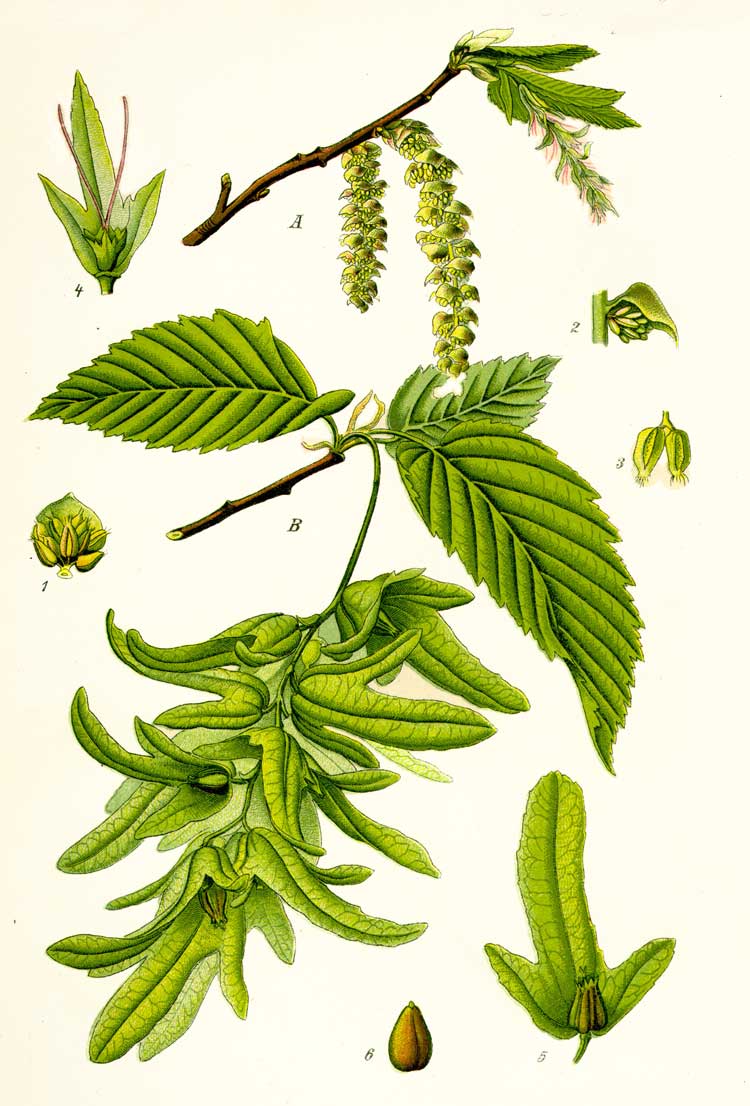
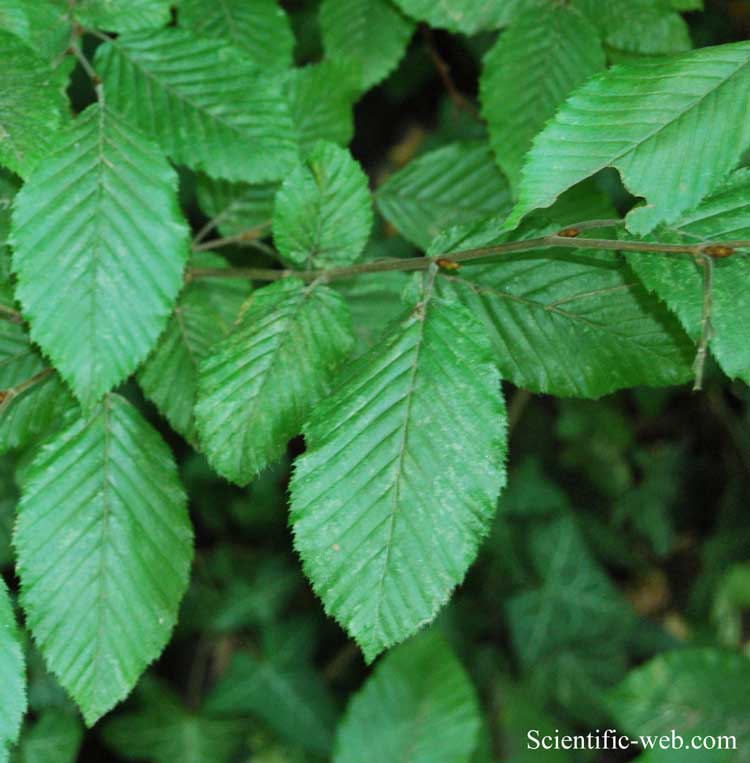
Carpinus betulus, Photo: Michael Lahanas
Classification System: APG IV
Superregnum: Eukaryota
Regnum: Plantae
Cladus: Angiosperms
Cladus: Eudicots
Cladus: Core eudicots
Cladus: Rosids
Cladus: Eurosids I
Ordo: Fagales
Familia: Betulaceae
Subfamilia: Coryloideae
Genus: Carpinus
Species: Carpinus betulus
Name
Carpinus betulus L., Sp. Pl. 2: (1753).
Synonyms
Homotypic
Carpinus betulus var. typica Koehne, Deut. Dendrol.: 116 (1893), nom. inval.
Carpinus nervata Dulac, Fl. Hautes-Pyr.: 141 (1867), nom. superfl.
Carpinus sepium Lam., Fl. Franç. 2: 212 (1779), nom. superfl.
Carpinus ulmifolia Salisb., Prodr. Stirp. Chap. Allerton: 392 (1796), nom. superfl.
Carpinus ulmoides Gray, Nat. Arr. Brit. Pl. 2: 245 (1821), nom. superfl.
Heterotypic
Carpinus betulus f. albovariegata C.K.Schneid., Ill. Handb. Laubholzk. 1: 140 (1940).
Carpinus betulus f. aureovariegata C.K.Schneid., Ill. Handb. Laubholzk. 1: 140 (1940).
Carpinus betulus f. columnaris (Beissn.) Späth ex Schelle in L.Beissner, E.Schelle & H.Zabel, Handb. Laubh.-Ben.: 48 (1903).
Carpinus betulus f. cucullata H.J.P.Winkl. in H.G.A.Engler (ed.), Pflanzenr., IV, 61: 31 (1904).
Carpinus betulus f. fastigiata (G.Nicholson) Schelle in L.Beissner, E.Schelle & H.Zabel, Handb. Laubh.-Ben.: 48 (1903).
Carpinus betulus f. horizontalis Simon-Louis, Preisverw., Herbst 1902–1903 (1902).
Carpinus betulus f. incisa Aiton, Hort. Kew., 3: 362 (1789), as "β".
Carpinus betulus f. obtusifolia Petz. & G.Kirchn., Arbor. Muscav.: 667 (1864).
Carpinus betulus f. pendula (Massé) H.J.P.Winkl. in H.G.A.Engler (ed.), Pflanzenr., IV, 61: 31 (1904).
Carpinus betulus f. purpurea K.Koch, Dendrologie 2(3): 3 (1873).
Carpinus betulus f. pyramidalis Dippel, Handb. Laubholzk. 2: 140 (1891).
Carpinus betulus f. quercifolia (A.DC.) C.K.Schneid., Ill. Handb. Laubholzk. 1: 140 (1904).
Carpinus betulus f. variegata Dippel, Handb. Laubholzk. 2: 140 (1891).
Carpinus betulus subsp. carpinizza (Kil.) O.Schwarz, Mitt. Thüring. Bot. Ges., 1: 96 (1949).
Carpinus betulus subsp. serrata (Beck) O.Schwarz, Mitt. Thüring. Bot. Ges. 1: 96 (1949).
Carpinus betulus var. carpinizza (Kil.) Neilr., Nachtr. Maly Enum.: 76 (1861).
Carpinus betulus var. carpinizza f. incisa (Aiton) C.K.Schneid., Ill. Handb. Laubh., 1: 140, fig. 76d (1904).
Carpinus betulus var. columnaris Beissn., Mitt. Deutsch. Dendrol. Ges. 1899: 133 (1899).
Carpinus betulus var. fastigiata G.Nicholson, Garden, 24: 419 (1883).
Carpinus betulus var. incisa Aiton, Hort. Kew. 3: 362 (1789).
Carpinus betulus var. obtusifolia G.Kirchn. in E.A.Petzold & G.Kirchner, Arbor. Muscav.: 667 (1864).
Carpinus betulus var. pendula (Massé) G.Kirchn. in E.A.Petzold & G.Kirchner, Arbor. Muscav.: 667 (1864).
Carpinus betulus var. provincialis Gay ex Gren. & Godr., Fl. France 3: 121 (1855).
Carpinus betulus var. pyramidalis Möhl, Gartenfl., 39: 51 (1890).
Carpinus betulus var. quercifolia A.DC. in A.P.de Candolle, Prodr. 16(2): 126 (1864).
Carpinus betulus var. serrata Beck, Fl. Nieder-Österreich: 266 (1890).
Carpinus carpinizza Kil. in N.T.Host, Fl. Austr. 2: 626 (1831).
Carpinus caucasica Grossh., Izv. Azerbajdzansk. Fil., 1940(5) : 34 (1940).
Carpinus compressus Gilib., Exerc. Phyt. 2: 399 (1792), opus utiq. oppr.
Carpinus incisa (Aiton) Borkh. (1803).
Carpinus intermedia Wierzb. ex Rchb., Ic. Fl. Germ. 12: 4. t. 633 (1850).
Carpinus pendula Massé, Rev. Hort. (Paris) 1853: 271 (1853).
Carpinus quercifolia Desf. ex Steud., Nomencl. Bot. (Steudel), ed. 2. 1: 300 (1840).
Carpinus quercifolia Colla, Herb. Pedem. 5: 176 (1836), pro syn., nom. inval., nom. superfl.
Carpinus vulgaris Mill., Gard. Dict., ed. 8 : n° 1 (1768).
Distribution
Native distribution areas:
Continental: Europe
Regional: Northern Europe
Denmark, Great Britain, Sweden.
Regional: Middle Europe
Austria, Belgium, Czechoslovakia, Germany, Hungary, Netherlands, Poland, Switzerland.
Regional: Southwestern Europe
France, Spain.
Regional: Southeastern Europe
Albania, Bulgaria, Greece, Italy, Romania, Turkey-in-Europe, Yugoslavia.
Regional: Eastern Europe
Belarus, Baltic States, Central European Russia, South European Russia, Ukraine.
Continental: Asia-Temperate
Regional: Caucasus
North Caucasus, Transcaucasus
Regional: Western Asia
Iran, Turkey.
Continental: Northern America
Regional: Northeastern U.S.A.
New York (introduced).
References: Brummitt, R.K. 2001. TDWG – World Geographical Scheme for Recording Plant Distributions, 2nd Edition
References
Primary references
Linnaeus, C. 1753. Species Plantarum. Tomus II: 998. Reference page.
Links
Govaerts, R. et al. 2023. Carpinus betulus in Kew Science Plants of the World Online. The Board of Trustees of the Royal Botanic Gardens, Kew. Published online. Accessed: 2023 Jul 27. Reference page.
Tropicos.org 2023. Carpinus betulus. Missouri Botanical Garden. Published online. Accessed: 27 Jul 2023.
International Plant Names Index. 2023. Carpinus betulus. Published online. Accessed: 27 Jul 2023. Reference page.
Hassler, M. 2023. World Plants. Synonymic Checklist and Distribution of the World Flora. . Carpinus betulus. Accessed: 27 Jul 2023.
Euro+Med 2006 onwards: Carpinus betulus in Euro+Med PlantBase – the information resource for Euro-Mediterranean plant diversity. Published online. Accessed: 2023 Jul 27.
USDA, ARS, Germplasm Resources Information Network. Carpinus betulus in the Germplasm Resources Information Network (GRIN), U.S. Department of Agriculture Agricultural Research Service. Accessed: 07-Oct-06.
Vernacular names
беларуская: Граб звычайны
български: Обикновен габър
čeština: Habr obecný
dansk: Almindelig Avnbøg
Deutsch: Hainbuche
English: European Hornbeam
Esperanto: Eŭropa karpeno
español: Carpe blanco
eesti: Harilik valgepöök
suomi: Euroopanvalkopyökki
français: Charme commun
hrvatski: Obični grab
hornjoserbsce: Wšědny hrab
magyar: Közönséges gyertyán
italiano: Carpino bianco
Lëtzebuergesch: Hobich
lietuvių: Paprastasis skroblas
македонски: Обичен габер
Nederlands: Haagbeuk
norsk nynorsk: Agnbøk
norsk: Agnbøk
polski: Grab pospolity
română: Carpen
русский: Граб обыкновенный
srpskohrvatski / српскохрватски: Obični grab
shqip: Shkoza e bardhë
svenska: Avenbok
Türkçe: Adi gürgen
українська: Граб звичайний

Carpinus betulus
Carpinus betulus, the European or common hornbeam, is a species of tree in the birch family Betulaceae, native to Western Asia and central, eastern, and southern Europe, including southern England.[1] It requires a warm climate for good growth, and occurs only at elevations up to 1,000 metres (3,281 ft). It grows in mixed stands with oak, and in some areas beech, and is also a common tree in scree forests. Hornbeam was also known as yoke elm.[2] Together with Carpinus orientalis and Carpinus austrobalcanica, it is one of the three hornbeams founded in Europe.
Description
Hornbeam seed clusters
Bark of a mature tree
It is a deciduous small to medium-size tree reaching heights of 15–25 metres (49–82 ft), rarely 30 m (98 ft), and often has a fluted and crooked trunk. The bark is smooth and greenish-grey, even in old trees. The buds, unlike those of the beech, are 10 mm (0.39 in) long at the most, and pressed close to the twig. The leaves are alternate, 4–9 cm (1.6–3.5 in) long, with prominent veins giving a distinctive corrugated texture, and a serrated margin. It is monoecious, and the wind-pollinated male and female catkins appear in early summer after the leaves. The fruit is a small 7–8 mm (0.28–0.31 in) long nut, partially surrounded by a three-pointed leafy involucre 3–4 cm (1.2–1.6 in) long; it matures in autumn.
Distribution
Hornbeam is considered native from Western Asia and throughout Europe.[1] The species prefers a warm climate, and only naturally occurs below 1,000 metres (3,281 ft) in elevation. It is a common tree in scree forests.[2]
Hornbeam was frequently coppiced and pollarded in the past in England. It is still infrequently managed using these traditional methods, but mainly for non-commercial conservation purposes. As a woodland tree traditionally managed in this way, it is particularly frequent in the ancient woodlands of south Essex, Hertfordshire and north Kent where it typically occupies more than half of most ancient woods and wood pastures.[3]
There are a number of notable forests where C. betulus is a dominant tree species, among which include Epping Forest in the United Kingdom, and Halltorps hage in Öland, Sweden.
Fossil record
Three fossil fruits of Carpinus betulus have been extracted from borehole samples of the Middle Miocene fresh water deposits in Nowy Sacz Basin, West Carpathians, Poland.[4]
Ecology
Old hornbeam coppice stools left uncut for at least 100 years. Coldfall Wood, London
In England, trees appear to prefer soils with a pH from 3.6 to 4.6 but tolerate up to 7.6. They are found on soils with moderate clay content and avoid soils with particularly high or low clay content.[3] Carpinus betulus likes full sun or partial shade,[5] moderate soil fertility and moisture. It has a shallow, wide-spreading root system and is marked by the production of stump sprouts when cut back.
The seeds often do not germinate until the spring of the second year after sowing. The hornbeam is a prolific seeder and is marked by vigorous natural regeneration.
Associated species
Hornbeam grows in mixed stands with oak, and in some areas beech.[2] The leaves provide food for some animals, including Lepidoptera such as the case-bearer moth Coleophora anatipennella.
This tree has been associated with the poisonous mushroom Amanita phalloides, better known as the death-cap mushroom, which grow around the trunk after hornbeams mature. When ingested, death-cap mushrooms can cause extreme medical conditions and death. Death-cap mushrooms can be mistaken for other edible mushrooms (Amanita princeps).[6]
Cultivation and uses
Carpinus betulus 'Fastigiata' in Dublin, Ireland where it is a common street tree
Mature Carpinus betulus 'Fastigiata' in Eindhoven, Netherlands
Carpinus betulus is widely cultivated as an ornamental tree, for planting in gardens and parks throughout north west Europe. Because it stands up well to cutting back and has dense foliage, it has been much used in landscape gardening, mainly as tall hedges and for topiary. It was the classic tree used in French formal gardens for hedges in bosquets, as in the Gardens of Versailles, and in their English equivalent, the garden wilderness.
There are several cultivars, notably 'Fastigiata' or 'Pyramidalis', a fastigiate tree when young, which has become a popular urban street tree in the United Kingdom and other countries. 'Frans Fontaine' is a similar fastigiate cultivar.[7] Both the species C. betulus and the cultivar 'Fastigiata' have gained the Royal Horticultural Society's Award of Garden Merit.[5][8]
As early as Roman times, but also during the Thirty Years' War, defensive hedges (Landwehr) in Central Europe were largely planted from hornbeams. The bushes were chopped down with axes and broken down. The trees would then grow together with blackberries, dog roses, and other thorny bushes into impenetrable hedges. In the 11th century, for example, the Electorate of Mainz set up a large defensive forest called the Rheingauer Gebück [de]. Many place names with the endings -hagen and -hain refer to such landwehrs.[9]
Hildegard of Bingen wrote of hornbeam being used as a plant in traditional medicine to treat vitiligo. The heated hornbeam chips were pressed onto the affected skin areas.[10] Hornbeam is used in Bach flower remedies as a treatment for exhaustion.[9]
The wood is heavy and hard, and is used for tools and building constructions. It also burns hot and slowly, making it very suitable for firewood.[11] This was the reason for lopping and hence indirectly the saving of Epping Forest, where the hornbeam was a favoured pollarding tree. The wood has a very high calorific value of around 2,300 kWh/RM.[12]
Notable examples
The Last Tree - The only tree that survived the devastation of the Battle of Delville Wood in 1916. It is preserved as part of the Delville Wood South African National Memorial near Longueval.[13]
Lincoln's Hornbeam - Planted by President Lincoln at the United States Botanic Garden in the Capitol grounds, Washington D.C.[14]
References
"Native flora recorded from postal district NR6 (Norwich) | Natural History Museum". Archived from the original on 2012-10-15.
Brown, John (1816). Encyclopaedia Perthensis. Vol. 23. p. 364.
Rackham, Oliver (2003). Ancient Woodland; its history, vegetation and uses in England (New ed.). Castlepoint Press. ISBN 1-897604-27-0.
Łańcucka-Środoniowa M.: Macroscopic plant remains from the freshwater Miocene of the Nowy Sącz Basin (West Carpathians, Poland) [Szczątki makroskopowe roślin z miocenu słodkowodnego Kotliny Sądeckiej (Karpaty Zachodnie, Polska)]. Acta Palaeobotanica 1979 20 (1): 3-117.
"RHS Plant Selector - Carpinus betulus". Retrieved 15 April 2020.
Childs, Craig (February 1, 2019). "DEATH-CAP MUSHROOMS ARE SPREADING ACROSS NORTH AMERICA". The Atlantic. Retrieved 13 October 2023.
"RHS Plant Selector - Carpinus betulus 'Frans Fontaine'". Retrieved 5 September 2018.
"RHS Plant Selector - Carpinus betulus 'Fastigiata'". Retrieved 15 April 2020.
Laudert, Doris (2004). Mythos Baum: Geschichte, Brauchtum, 40 Baumporträts (6., durchges. Aufl ed.). München Wien Zürich: blv. pp. 129–131. ISBN 3-405-16640-3.
Hertzka, Gottfried; Strehlow, Wighard (2017). Große Hildegard-Apotheke (17. Auflage ed.). Kissleg-Immenried: Christiana-Verlag im FE-Medienverlag. ISBN 978-3-7171-1119-1.
Hornbeam Tree - Gardening Central Archived 2018-08-07 at the Wayback Machine
Matthieson, Ben (17 July 2022). "Brennholz aus der Hainbuche: Vorteile und Lagerung". Gartenjournal.net (in German). Retrieved 27 November 2023.
"The South Africa (Delville Wood) National Memorial, Longueval". www.greatwar.co.uk. Retrieved 12 February 2021.
"ARBOR DAY FINDS OLD TREES LUSTY; Washington's Elm, Lincoln's Hornbeam, and the Oak From the Tomb of Confucius Still Flourish In Capital -- Other Famous Trees (Published 1926)". Section XX. The New York Times. 25 April 1926. p. 13. Retrieved 12 February 2021.
Retrieved from "http://en.wikipedia.org/"
All text is available under the terms of the GNU Free Documentation License