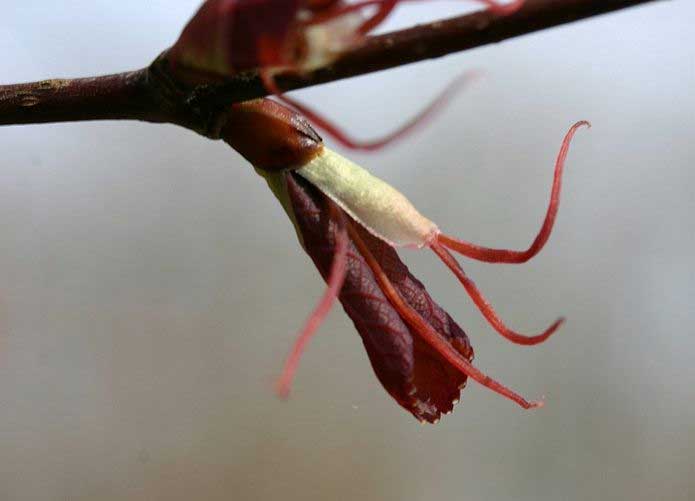
Cercidiphyllum magnificum , Female flower (Information about this image)
Classification System: APG IV
Superregnum: Eukaryota
Regnum: Plantae
Cladus: Angiosperms
Cladus: Eudicots
Cladus: Core eudicots
Ordo: Saxifragales
Familia: Cercidiphyllaceae
Genus: Cercidiphyllum
Species: Cercidiphyllum magnificum
Name
Cercidiphyllum magnificum (Nakai) Nakai Cat. sem. spor. hort. bot. Univ. Imp. Tokyo 35 (1920)
Synonyms
Basionym
Cercidiphyllum japonicum var. magnificum Nakai, Bot. Mag. (Tokyo) 33: 198 (1919).
Distribution
Native distribution areas:
Continental: Asie
Regional: Eastern Asie
Japan (Honshu)
References: Brummitt, R.K. 2001. TDWG – World Geographical Scheme for Recording Plant Distributions, 2nd Edition
References
Primary references
Nakai, T., 1920. Index Seminum (TI, Tokyo) 1919-1920: 35.
Nakai, T. 1919. Notulae ad plantas Japoniae et Coreae. XX. Botanical Magazine, Tokyo 33(387): 41–61. BHL Reference page.
Links
Govaerts, R. et al. 2023. Cercidiphyllum magnificum in Kew Science Plants of the World Online. The Board of Trustees of the Royal Botanic Gardens, Kew. Published online. Accessed: 2023 May 25. Reference page.
International Plant Names Index. 2023. Cercidiphyllum magnificum. Published online. Accessed: May 25 2023. Reference page.
Tropicos.org 2023. Cercidiphyllum magnificum. Missouri Botanical Garden. Published online. Accessed: 25 May 2023.
USDA, ARS, Germplasm Resources Information Network. Cercidiphyllum magnificum in the Germplasm Resources Information Network (GRIN), U.S. Department of Agriculture Agricultural Research Service. Accessed: 25-May-23.
Vernacular names
Cercidiphyllum magnificum, known as the large-leaf katsura[2] or magnificent katsura tree,[3] is a species of flowering tree in the family Cercidiphyllaceae native to Honshu, Japan. It is sometimes called caramel tree for the light, sweet smell it emits during leaf fall, sometimes compared to cotton candy (candyfloss) or "freshly baked biscuits and bread".[4] It is grown as an ornamental tree for its heart shaped leaves that in autumn turn a mixture of bright yellow, pink and orange-red.
Description
Cercidiphyllum magnificum is a small deciduous tree, growing to no more than 10 m in height and pyramidal to broadly conical in shape. The tree has a smooth bark. The twigs bear leaves that are dimorphic with both short and long shoots. The short shoots bear large cordate (heart-shape) or reniform (kidney shaped) leaves with palmate venation and crenate margins, while the long shoots have leaves that are elliptic to broadly ovate with entire or finely serrate margins. The leaves are up to 8 cm (3.1 in) long and 5.5 cm (2.2 in) broad, and are initially bronze coloured, but in autumn turn a mixture of bright pink, violet and yellow, giving off a scent of burnt sugar when they fall, hence the name "caramel tree".
The species is dioecious, having separate male and female trees, with small inconspicuous flowers appearing early in spring that are wind pollinated. The flowers lack petals, the male being reddish and the female greenish. The female trees produce woody, pod-like fruit in clusters of 2–4, each about 1–2 cm (0.4–0.8 in) long. The pods contain many small flattened seeds that are winged at both ends.[3][2][5]
It is similar to Cercidiphyllum japonicum, but can be distinguished by a combination of the following characteristics: C. magnificum is a smaller tree that typically has only a single main trunk (vs. large, canopy-forming, with multiple trunks); the leaves are more deeply crenated; the follicles are partially dehiscent, with slightly recurved tips (vs. follicles fully dehiscing and strongly recurving tips); grows at a higher elevation, rarely co-occurring with C. japonicum.[4]
Taxonomy
Cercidiphyllum magnificum is, along with C. japonicum, one of only two members of the genus Cercidiphyllum and family Cercidiphyllaceae. It was first described as a variety, C. japonicum var. magnificum, in 1919 by Japanese botanist Takenoshin Nakai,[4] then separated into a different species the following year in his Catalogus seminum et sporarum Hortus Botanicus Universitatis Imperialis Tokyoensis.[6][7] The type locality is from Honshu, Japan in the Ashio Mountains (Mount Nikkō-Shirane and Mount Konsei.[4]
Distribution and habitat
Cercidiphyllum magnificum is endemic to the central, forested mountainous areas of Honshu.[1][3]
Uses
The katsura wood is soft and light and used for cabinetry and paneling.[5]
References
Oldfield, S. (2021). "Cercidiphyllum magnificum". IUCN Red List of Threatened Species. 2021: e.T169596997A174890875. doi:10.2305/IUCN.UK.2021-1.RLTS.T169596997A174890875.en. Retrieved 2 August 2023.
"Cercidiphyllum magnificum magnificent Katsura tree". Plants. RHS. Retrieved 24 December 2019.
"Cercidiphyllum magnificum - large-leaf katsura". Finland: Mustila Arboretum. Retrieved 22 December 2019.
Crane, Peter R.; DuVal, Ashley (October 2013). "766. Cercidophyllum magnificum - Systematic placement and fossil history of Siebold & Zuccarini". Curtis's Botanical Magazine. 30 (3): 177–192. doi:10.1111/curt.12043.
"Cercidiphyllum magnificum (Katsura)". Friends of Te Henui: Trees & Shrubs. Taranaki, New Zealand: Taranaki Educational Resource: Research, Analysis and Information Network. 2019. Retrieved 25 December 2019.
"Cercidiphyllum magnificum (Nakai) Nakai". Plants of the World Online. Royal Botanic Gardens, Kew. Retrieved 25 December 2019.
"Cercidiphyllum magnificum Nakai [sic]". ipni.org. International Plant Names Index. Retrieved 26 December 2019.
Retrieved from "http://en.wikipedia.org/"
All text is available under the terms of the GNU Free Documentation License