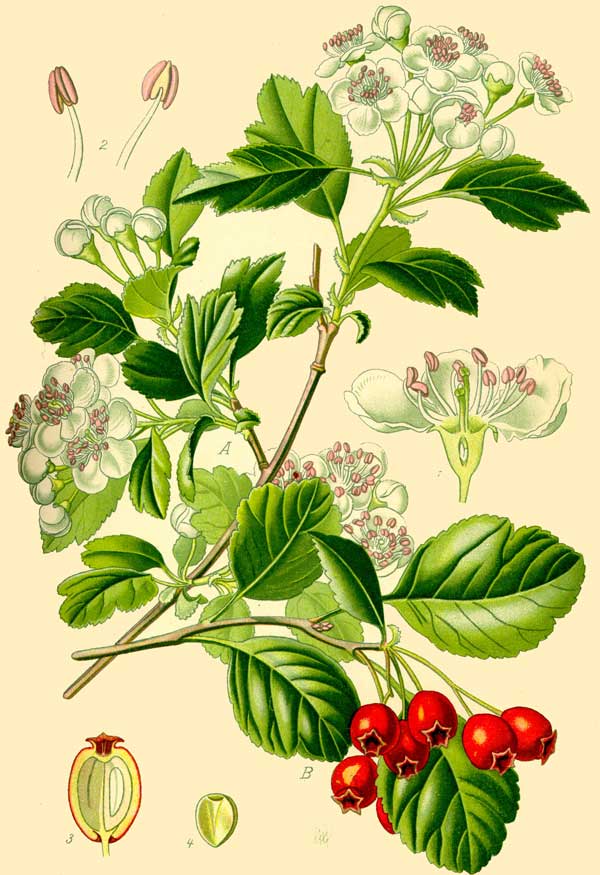
Crataegus laevigata (*)
Classification System: APG IV
Superregnum: Eukaryota
Regnum: Plantae
Cladus: Angiosperms
Cladus: Eudicots
Cladus: Core eudicots
Cladus: Rosids
Cladus: Eurosids I
Ordo: Rosales
Familia: Rosaceae
Subfamilia: Amygdaloideae
Tribus: Maleae
Subtribus: Malinae
Genus: Crataegus
Species: Crataegus laevigata
Name
Crataegus laevigata (Poir.) DC.
Synonyms
Crataegus oxyacantha auct. non L., nom. rej.
Hybrids
C. × lobata – C. × media
References
Prodr. 2: 630 (1825).
Crataegus laevigata at the Euro+Med PlantBase
USDA, ARS, Germplasm Resources Information Network. Crataegus laevigata in the Germplasm Resources Information Network (GRIN), U.S. Department of Agriculture Agricultural Research Service. Accessed: 07-Oct-06.
Vernacular names
български: Черен глог
kaszëbsczi: Dwaseminnô mąkùszka
čeština: Hloh obecný
Cymraeg: Draenen wen Lefn
dansk: Almindelig Hvidtjørn
Deutsch: Zweigriffeliger Weißdorn
English: Midland Hawthorn
Esperanto: Dustilusa kratago
español: Espino navarro
euskara: Hegoaldeko elorri zuri
suomi: Pyöröorapihlaja
Nordfriisk: Haageduurn
français: Aubépine épineuse
hornjoserbsce: Dwupěstkaty hłohonc
magyar: Cseregalagonya
հայերեն: Սզնի
íslenska: Hvítþyrnir
italiano: Biancospino
日本語: セイヨウサンザシ
lietuvių: Grauželinė gudobelė
эрзянь: Бояронь умарина
Nederlands: Tweestijlige meidoorn
norsk: Parkhagtorn
polski: Głóg dwuszyjkowy
português: Pilriteiro
русский: Боярышник обыкновенный
slovenčina: Hloh krivokališný
slovenščina: Navadni glog
српски / srpski: Црвени глог
svenska: Rundhagtorn
Crataegus laevigata, known as the Midland hawthorn,[3] English hawthorn,[3] woodland hawthorn,[3] or mayflower, is a species of hawthorn native to western and central Europe, from Great Britain (where it is typically found in ancient woodland and old hedgerows[4]) and Spain, east to Romania and Ukraine. The species name is sometimes spelt C. levigata,[5] but the original orthography is C. lævigata.[6][7]
Description
It is a large shrub or small tree growing to 8 m (26 ft) or rarely to 12 m (39 ft) tall, with a dense crown. The leaves are 2–6 cm (0.79–2.4 in) long and 2–5 cm (0.79–2.0 in) broad, with two or three shallow, forward-pointing lobes on each side of the leaf. The hermaphrodite flowers are produced in corymbs of 6 to 12, each flower with five white or pale pink petals and two or sometimes three styles. The flowers are pollinated by insects. The fruit is a dark red pome 6–10 mm (0.2–0.4 in) diameter, slightly broader than long, containing two or three nutlets.
Crataegus laevigata (fruits)
+
Flowers - It flowers in May to June (UK) in rather lax clusters. The flowers are normally white but can be pink. Flowers are up to 2.4 cm in diameter, with 2 - 3 styles and stigmas and more than 20 stamens. They have 5 triangular sepals which are obtuse. The petals can be slightly velvety on the inside.[8]
Identification
It is distinguished from the closely related common hawthorn, C. monogyna, in the leaves being only shallowly lobed, with forward-pointing lobes, without hair tufts in the vein axils, and in the flowers having more than one style. Each style produces a seed, so its fruits also have more than one seed and these make them slightly oval, in contrast with the single-seeded and therefore round fruits of common hawthorn. The two species hybridise, giving rise to C. × media.
Taxonomy
In the past, Midland hawthorn was widely but incorrectly known by the name C. oxyacantha, a name that has now been rejected as being of uncertain application. In 1753, Linnaeus introduced the name C. oxyacantha for the single species of which he was aware, but described it in such a way that the name became used for various species, including both the Midland and the common hawthorn. In 1775, Jacquin formally separated the common hawthorn, naming it C. monogyna,[9] and in 1946, Dandy showed that Linnaeus had actually observed a different plant, C. oxyacantha. By this time, though, confusion over the true identity of C. oxyacantha was so great that Byatt proposed[10] that the name should be formally rejected as ambiguous, and this proposal was accepted by the International Botanical Congress,[11] although the name continues to be used informally.
The Midland hawthorn was described botanically as a separate species as long ago as 1798 by Poiret, whose name Mespilus laevigata referred to this hawthorn. Poiret's name is reflected in the revised formal botanical name of Midland hawthorn: Crataegus laevigata (Poir.) DC.
Cultivars
'François Rigaud' has yellow fruit.[12]
'Paul's Scarlet'[13] (double red flowers), 'Punicea'[14] (pink and white) and 'Rosea Flore Pleno'[15] (double pink flowers) have gained the Royal Horticultural Society's Award of Garden Merit. These cultivars are considered by taxonomists to be derived from hybrids between C. laevigata and C. monogyna, within the named hybrid species C. × media.[12]
Parasites
The hawthorn button-top gall on Midland hawthorn is caused by the dipteran gall-midge Dasineura crataegi.
References
Rivers, M.C. & Khela, S. (2017). "Crataegus laevigata". IUCN Red List of Threatened Species. 2017: e.T203425A68082745. doi:10.2305/IUCN.UK.2017-3.RLTS.T203425A68082745.en. Retrieved 31 May 2024.
Christensen, K.I. (1992). "Revision of Crataegus sect. Crataegus and nothosect. Crataeguineae (Rosaceae-Maloideae) in the Old World". Systematic Botany Monographs. 35: 1–199. doi:10.2307/25027810. JSTOR 25027810.
"Crataegus laevigata". Germplasm Resources Information Network. Agricultural Research Service, United States Department of Agriculture. Retrieved 1 January 2018.
Online Atlas of the British and Irish Flora: Crataegus laevigata
Gutermann, W. (2011). "Notulae nomenclaturales 41-45. (New names in Cruciata, Kali, and some small corrections)". Phyton: Annales Rei Botanicae. 51 (1): 95–102.
Poiret, J.L.M. (1798). "Néflier; Mespilus". In J.B.A.P.d.M. De Lamarck (ed.). Encyclopédie Méthodique. Botanique. Vol. 4. Paris: H. Agasse. pp. 437–447.
Christensen, K.I.; Talent, N. (2013). "Crataegus laevigata or C levigata – a Paleographic Analysis". Phyton: Annales Rei Botanicae. 52 (2): 195–201.
Streeter, David (2019). Collins Wild Flower Guide. London: HarperCollins. ISBN 978-0-00-815674-9.
Jacquin, N.J. 1775. Florae Austriacae sive Plantarum Selectarum in Austriæ archiducatu: sponte crescentium icones, ad vivum coloratæ, et descriptionibus, ac synonymis illustratæ.
Byatt, J. (1974). Bot. J. Linn. Soc. 69: 15–20.
Brummitt, R. K. (1986). Taxon 35: 556–563.
Phipps, J.B.; O'Kennon, R.J.; Lance, R.W. 2003. Hawthorns and medlars. Royal Horticultural Society, Cambridge, U.K.
"RHS Plant Selector - Crataegus laevigata 'Paul's Scarlet'". Retrieved 15 April 2020.
"Crataegus laevigata 'Punicea'". RHS. Retrieved 5 May 2020.
"RHS Plant Selector - Crataegus laevigata 'Rosea Flore Pleno'". Retrieved 20 July 2013.
Further reading
Wikimedia Commons has media related to Crataegus laevigata.
Flora Europaea: Crataegus
Bean, W. J. (1976). Trees and Shrubs Hardy in the British Isles, eighth edition, revised. John Murray.
UCConn Plant Database — copyright Mark Brand.
Retrieved from "http://en.wikipedia.org/"
All text is available under the terms of the GNU Free Documentation License