Fine Art

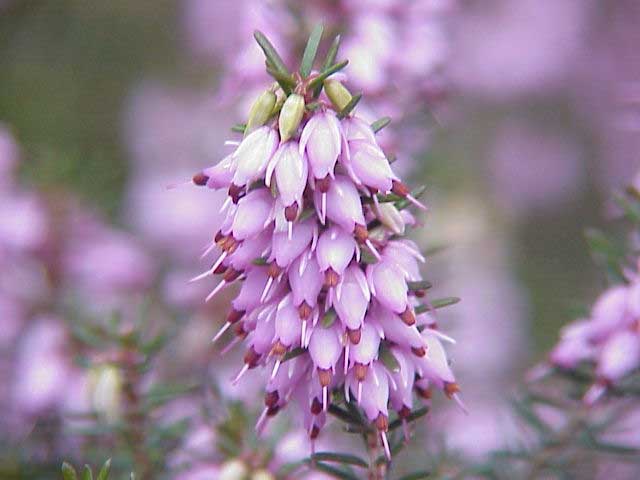
Erica carnea (Information about this image)

Life-forms

Classification System: APG IV

Superregnum: Eukaryota
Regnum: Plantae
Cladus: Angiosperms
Cladus: Eudicots
Cladus: Core eudicots
Cladus: Asterids
Ordo: Ericales

Familia: Ericaceae
Subfamilia: Ericoideae
Tribus: Ericeae
Genus: Erica
Subgenus: E. subg. Ectasis
Sectio: E. sect. Callicodon
Species: Erica carnea
Name

Erica carnea L. (1753), nom. cons.
Synonyms

Homotypic
Gypsocallis purpurascens (L.) D.Don, Edinburgh New Philos. J. 17: 153. 1834.

Heterotypic
Erica bracteata Moench, Meth. : 50. 1794, nom. illeg. non Thunb. (1785).
Erica herbacea L., Sp. Pl. 1: 352. 1753, nom. rej.
Erica herbacea f. alba (André) D.C.McClint.
Erica lugubris Salisb., Prodr. Stirp. Chap. Allerton 295. 1796.
Erica mediterranea L., Mant. Pl. 2: 229. 1771.
Erica mediterranea Rchb. ex Nyman, Consp. Fl. Eur. 489 1879, nom. illeg. non L. (1771).
Erica purpurascens L., Sp. Pl., ed. 2, 503. 1762.
Erica saxatilis Salisb., Prodr. Stirp. Chap. Allerton 295. 1796.
Ericoides herbaceum (L.) Kuntze, Revis. Gen. Pl. 2: 963. 1891.
Gypsocallis mediterranea (L.) D.Don, Edinburgh New Philos. J. 17: 153. 1834.
Gypsocallis purpurascens (L.) D.Don, Edinburgh New Philos. J. 17: 153. 1834.

Hybrids

Erica × darleyensis Bean
Erica × krameri D.C.McClint.
Erica × oldenburgensis D.C.McClint.

Distribution
Native distribution areas:

Continental: Europe
Albania, Austria, Czech Republic, France, Germany, Switzerland, Italy, Slovenia, Croatia, Bosnia & Hercegovina, Macedonia, Serbia & Kosovo, ?Montenegro, ?Romania, Greece

References: Brummitt, R.K. 2001. TDWG – World Geographical Scheme for Recording Plant Distributions, 2nd Edition
References
Primary references

Linnaeus, C. 1753. Species plantarum, exhibentes plantas rite cognitas, ad genera relatas, cum differentiis specificis, nominibus trivialibus, synonymis selectis, locis natalibus, secundum systema sexuale digestas. Tomus I. Pp. [I–XII], 1–560. Impensis Laurentii Salvii, Holmiae [Stockholm]. BHL Reference page. : 355.

Links

Hassler, M. 2020. Erica carnea. World Plants: Synonymic Checklists of the Vascular Plants of the World In: Roskovh, Y., Abucay, L., Orrell, T., Nicolson, D., Bailly, N., Kirk, P., Bourgoin, T., DeWalt, R.E., Decock, W., De Wever, A., Nieukerken, E. van, Zarucchi, J. & Penev, L., eds. 2020. Species 2000 & ITIS Catalogue of Life. Published online. Accessed: 2020 Apr 29. Reference page.
Govaerts, R. et al. 2020. Erica carnea in Kew Science Plants of the World Online. The Board of Trustees of the Royal Botanic Gardens, Kew. Published online. Accessed: 2020 Apr 29. Reference page.
International Plant Names Index. 2020. Erica carnea. Published online. Accessed: Apr 29 2020. Reference page.
Tropicos.org 2020. Erica carnea. Missouri Botanical Garden. Published online. Accessed: 29 Apr 2020.
USDA, ARS, Germplasm Resources Information Network. Erica carnea in the Germplasm Resources Information Network (GRIN), U.S. Department of Agriculture Agricultural Research Service. Accessed: 07-Oct-06.

Vernacular names
Deutsch: Schneeheide, Winterheide, Frühlingsheidekraut
English: Winter Heath, Winter Flowering Heather, Spring Heath
español: Brezo de Invierno, Brezo de Floración Invernal, Brezo de Primavera
eesti: Punane eerika
suomi: Lumikellokanerva
français: Bruyère des Alpes, Bruyère des Neiges
magyar: Alpesi hanga, havasi hanga
italiano: Erica Carnicina
polski: Wrzosiec Krwisty
српски / srpski: Црњуша / Crnjuša, Ерика / Erika

Erica carnea, the winter heath,[1] winter-flowering heather, spring heath or alpine heath, is a species of flowering plant in the family Ericaceae, native to mountainous areas of central, eastern and southern Europe, where it grows in coniferous woodlands or stony slopes.
Description

It is a low-growing, spreading subshrub reaching 10–25 centimetres (4–10 inches) tall, with evergreen needle-like leaves 4–8 millimetres (1⁄8–3⁄8 in) long, borne in whorls of four. The flowers are produced in racemes in late winter to early spring, often starting to flower while the plant is still covered in snow; the individual flower is a slender bell-shape, 4–6 mm (3⁄16–1⁄4 in) long, dark reddish-pink, rarely white.
Taxonomy

The first published name for the species was Erica herbacea; however, the name E. carnea (published three pages later in the same book) is so widely used, and the earlier name so little, that a formal proposal to conserve the name E. carnea over E. herbacea was accepted by the International Botanical Congress in 1999.

The Latin specific epithet carnea means "flesh pink".[2]
Cultivation
Cultivar series Springwood
A close-up of the flower and leaf

Erica carnea was being cultivated in the United Kingdom as early as 1763.[3] It is very widely grown as an ornamental plant for its winter flowering; over 100 cultivars have been selected for variation in flower and leaf colour. Unlike most species of Erica, which are typically calcifuges, it tolerates mildly alkaline as well as acidic soils, making it easier to grow in many areas. Like other species within the genus Erica it is often seen as groundcover amongst plantings of dwarf conifers.[4]

The following cultivars, forms and hybrids have gained the Royal Horticultural Society's Award of Garden Merit:[5]

'Adrienne Duncan'[6]
'Ann Sparkes' [7]
'Challenger'[8]
'Eva' [9]
'Loughrigg'[10]
'March Seedling' [11]
'Myretoun Ruby'[12]
'Nathalie'[13]
'Pink Spangles'[14]
'Rosalie'[15]
'Vivellii'[16]
'Wintersonne' [17]
E. carnea f. alba (white-flowered):
'Golden Starlet'[18]
'Ice Princess'[19]
'Isabell'[20]
'Springwood White'[21]
E. carnea f. aureifolia (golden-leaved):
'Foxhollow'[22]
'Westwood Yellow'[23]
E. × darleyensis (E. carnea × E. erigena)[4]
'Jenny Porter'[24]

References

BSBI List 2007 (xls). Botanical Society of Britain and Ireland. Archived from the original (xls) on 2015-06-26. Retrieved 2014-10-17.
Harrison, Lorraine (2012). RHS Latin for gardeners. United Kingdom: Mitchell Beazley. p. 224. ISBN 9781845337315.
Brian Proudley; Valerie Proudley (1989). Heathers in Colour (2nd ed.). Blandford Press. p. 15. ISBN 0713714204. "Heathers as garden plants have a surprisingly long history. The valuable winter-flowering Erica carnea was, according to the Royal Horticultural Society's Dictionary of Gardening, introduced into cultivation in this country as long ago as 1763"
RHS A-Z encyclopedia of garden plants. United Kingdom: Dorling Kindersley. 2008. p. 1136. ISBN 978-1405332965.
"AGM Plants - Ornamental" (PDF). Royal Horticultural Society. July 2017. p. 35. Retrieved 6 February 2018.
"RHS Plant Selector - Erica carnea 'Adrienne Duncan'". Retrieved 7 June 2020.
"Erica carnea 'Ann Sparkes'". RHS. Retrieved 7 June 2020.
"RHS Plant Selector - Erica carnea 'Challenger'". Retrieved 7 June 2020.
"Erica carnea 'Eva'". RHS. Retrieved 7 June 2020.
"RHS Plant Selector - Erica carnea 'Loughrigg'". Retrieved 7 June 2020.
"Erica carnea 'March Seedling'". RHS. Retrieved 7 June 2020.
"RHS Plant Selector - Erica carnea 'Myretoun Ruby'". Retrieved 7 June 2020.
"RHS Plant Selector - Erica carnea 'Nathalie'". Retrieved 7 June 2020.
"RHS Plant Selector - Erica carnea 'Pink Spangles'". Retrieved 7 June 2020.
"RHS Plant Selector - Erica carnea 'Rosalie'". Retrieved 7 June 2020.
"RHS Plant Selector - Erica carnea 'Vivellii'". Retrieved 7 June 2020.
"Erica carnea 'Wintersonne'". RHS. Retrieved 7 June 2020.
"RHS Plant Selector - E. carnea f. alba 'Golden Starlet'". Retrieved 7 June 2020.
"RHS Plant Selector - E. carnea f. alba 'Ice Princess'". Retrieved 7 June 2020.
"RHS Plant Selector - E. carnea f. alba 'Isabell'". Retrieved 7 June 2020.
"RHS Plant Selector - E. carnea f. alba 'Springwood White'". Retrieved 7 June 2020.
"RHS Plant Selector - E. carnea f. aureifolia 'Foxhollow'". Retrieved 18 June 2013.[permanent dead link]
"RHS Plant Selector - E. carnea f. aureifolia 'Westwood Yellow'". Retrieved 7 June 2020.
"RHS Plant Selector - Erica × darleyensis 'Jenny Porter'". Retrieved 7 June 2020.

Plants Images

Biology Encyclopedia

Retrieved from "http://en.wikipedia.org/"
All text is available under the terms of the GNU Free Documentation License

Home - Hellenica World