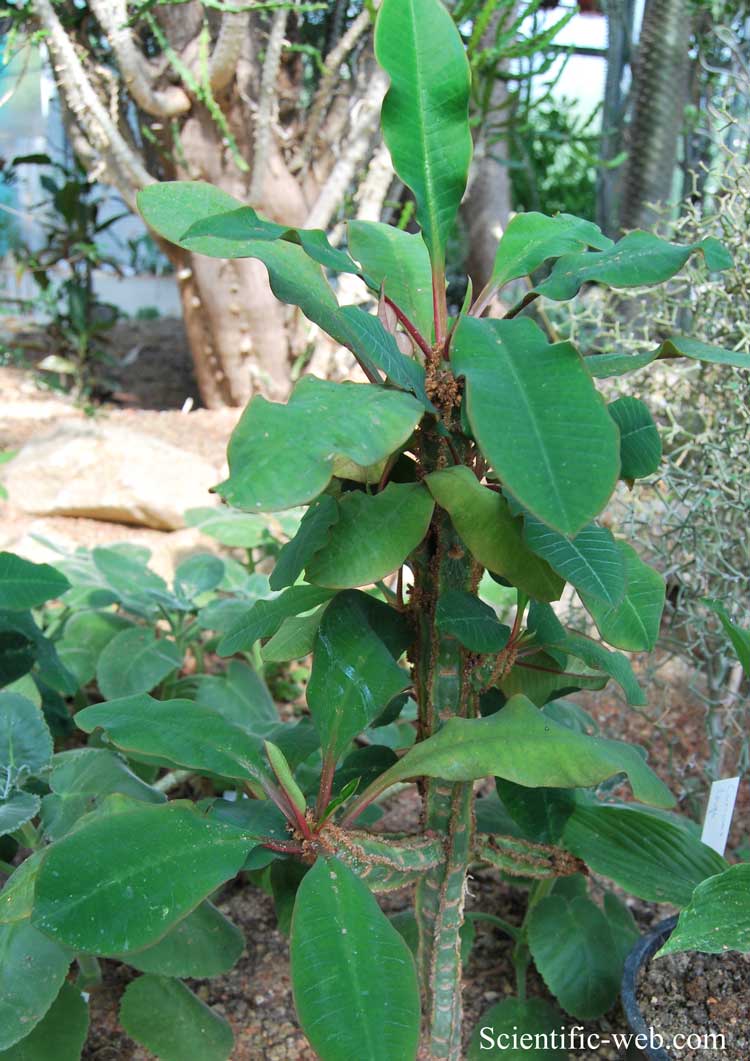
Euphorbia leuconeura, Photo: Michael Lahanas
Classification System: APG IV
Superregnum: Eukaryota
Regnum: Plantae
Cladus: Angiosperms
Cladus: Eudicots
Cladus: Core eudicots
Cladus: Rosids
Cladus: Eurosids I
Ordo: Malpighiales
Familia: Euphorbiaceae
Subfamilia: Euphorbioideae
Tribus: Euphorbieae
Subtribus: Euphorbiinae
Genus: Euphorbia
Subgenus: E. subg. Euphorbia
Sectio: E. sect. Goniostema
Species: Euphorbia leuconeura
Name
Euphorbia leuconeura Boiss., Prodr. [A. P. de Candolle] 15(2.1): 78. (1862)
Synonyms
Heterotypic
Euphorbia fournieri Rebut, Lyon-Hort. & Hort. Nouv. 15: 22. (1893)
Distribution
Native distribution areas:
Continental: Africa
Regional: Eastern Africa
References: Brummitt, R.K. 2001. TDWG – World Geographical Scheme for Recording Plant Distributions, 2nd Edition
References
Primary references
Boissier, P.E. in DC. 1862. Prodromus Systematis Naturalis Regni Vegetabilis ... (DC.) 15(2): 78.
Govaerts, R. et al. 2018. Euphorbia leuconeura in Kew Science Plants of the World Online. The Board of Trustees of the Royal Botanic Gardens, Kew. Published online. Accessed: 2018 Apr. 16. Reference page.
International Plant Names Index. 2018. Euphorbia leuconeura. Published online. Accessed: Apr. 14 2018. Reference page.
Vernacular names
English: Madagascar Jewel
suomi: Nukkatyräkki
한국어: 귀소각
svenska: Skvättiväg
中文: 白条麒麟
Euphorbia leuconeura is a species of flowering plant in the family Euphorbiaceae.[3] Its common name is Madagascar jewel. It is endemic to Madagascar where its natural habitat is forest undergrowth in rocky areas. It can grow to a height of 1.8 m (6 ft), as a branching small tree, and propagates by shooting its seeds several feet into the air. It is threatened by habitat loss.[1]
Taxonomy
The specific epithet leuconeura is derived from the two ancient greek words λευκός (leukós), meaning "bright, white", and νευρά (neurá), meaning "nerve".[4][5]
Cultivation
The Madagascar Jewel is grown as a houseplant for its attractive foliage: dark green leaves, with white veins when young. Unlike many succulents, E. leuconeura is less susceptible to overwatering. It grows best in partial shade but tolerates full shade and is relatively easy to care for providing it is not exposed to cold drafts.
Toxicity
When damaged, the plant secretes a white fluid which is toxic and can cause severe skin irritation. This is typical of most Euphorbia species.
Close-up on the white veins
Fotos of Euphorbia leuconeura flowering stalk before (top) and after (middle) seed disperal. The capsule fruit have a pinkish tint and open with tension propelling the seed wide through the air. Seed (bottom) has the size of a pinhead is round with a slightly pointed tip and a rough dark brown shell that is easily squished so careful handling is necessary.
Euphorbia leuconeura flowering stalk before (top) and after seed disperal. Seed compared in size to a pinhead (bottom).
References
Wikimedia Commons has media related to Euphorbia leuconeura.
Haevermans, T. (2004). "Euphorbia leuconeura". IUCN Red List of Threatened Species. 2004: e.T44372A10896588. doi:10.2305/IUCN.UK.2004.RLTS.T44372A10896588.en. Retrieved 15 November 2021.
"Appendices | CITES". cites.org. Archived from the original on 2017-12-05. Retrieved 2024-01-17.
"Euphorbia leuconeura Boiss". Plants of the World Online. The Trustees of the Royal Botanic Gardens, Kew. n.d. Archived from the original on July 7, 2020. Retrieved September 4, 2020.
Bailly, Anatole (1981-01-01). Abrégé du dictionnaire grec français. Paris: Hachette. ISBN 978-2010035289. OCLC 461974285.
Bailly, Anatole. "Greek-french dictionary online". www.tabularium.be. Archived from the original on March 18, 2022. Retrieved December 17, 2017.
Retrieved from "http://en.wikipedia.org/"
All text is available under the terms of the GNU Free Documentation License