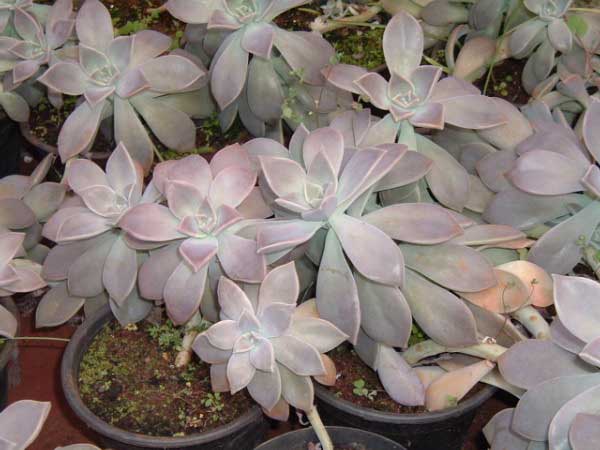
Graptopetalum paraguayense (Information about this image)
Classification System: APG IV
Superregnum: Eukaryota
Regnum: Plantae
Cladus: Angiosperms
Cladus: Eudicots
Cladus: Core eudicots
Ordo: Saxifragales
Familia: Crassulaceae
Subfamilia: Sempervivoideae
Tribus: Sedeae
Genus: Graptopetalum
Subgenus: G. subg. Graptopetalum
Sectio: G. sect. Byrnesia
Series: G. ser. Paraguayensia
Species: Graptopetalum paraguayense
Name
Graptopetalum paraguayense (N.E.Br.) E.Walther, Cact. Succ. J. (Los Angeles) 9: 108. 1938.
Synonyms
Basionym
Cotyledon paraguayensis N.E.Br., Bull. Misc. Inform. Kew 1914(6): 208. 1914.
Homotypic
Echeveria paraguayensis (N.E.Br.) Poelln., Repert. Spec. Nov. Regni Veg. 39: 263. 1936, comb. inval.
Sedum paraguayense (N.E.Br.) Bullock, Bull. Misc. Inform. Kew 1937(4): 276. 1937.
Heterotypic
Byrnesia weinbergii (T.B.Shepherd) Rose, Addisonia 7: 37, pl. 243. 1922.
Echeveria arizonica Rose, Addisonia, 7: 37. 1922, nom. inval.
Echeveria weinbergii T.B.Shepherd, Descript. Cat. 37. 1912.
Graptopetalum weinbergii (T.B.Shepherd) E.Walther, J. Cact. Succ. Soc. Amer. 1: 184. 1930.
Sedum weinbergii (T.B.Shepherd) A.Berger, Nat. Pflanzenfam., ed. 2 [Engler & Prantl] 18a: 446. 1930.
References
Walther, E. 1938. Cactus and Succulent Journal (Los Angeles) 9: 108.
Additional references
Byalt, V.V. 2012. A new system of the genus Graptopetalum Rose (Crassulaceae) [in Russian]. Novosti Sistematiki Vysshikh Rastenii 43: 70–83. Full issue PDF. Reference page.
Links
Hassler, M. 2019. Graptopetalum paraguayense. World Plants: Synonymic Checklists of the Vascular Plants of the World In: Roskovh, Y., Abucay, L., Orrell, T., Nicolson, D., Bailly, N., Kirk, P., Bourgoin, T., DeWalt, R.E., Decock, W., De Wever, A., Nieukerken, E. van, Zarucchi, J. & Penev, L., eds. 2019. Species 2000 & ITIS Catalogue of Life. Published online. Accessed: 2019 Dec 05. Reference page.
International Plant Names Index. 2019. Graptopetalum paraguayense. Published online. Accessed: Dec 05 2019. Reference page.
Govaerts, R. et al. 2019. Graptopetalum paraguayense in Kew Science Plants of the World Online. The Board of Trustees of the Royal Botanic Gardens, Kew. Published online. Accessed: 2019 Dec 05. Reference page.
Tropicos.org 2019. Graptopetalum paraguayense. Missouri Botanical Garden. Published online. Accessed: 05 Dec 2019.
USDA, ARS, Germplasm Resources Information Network. Graptopetalum paraguayense in the Germplasm Resources Information Network (GRIN), U.S. Department of Agriculture Agricultural Research Service. Accessed: 07-Oct-06.
Graptopetalum paraguayense is a species of succulent plant in the jade plant family, Crassulaceae, that is native to Tamaulipas, Mexico.[2] Common names include mother-of-pearl-plant and ghost plant.[1] This is not to be confused with Monotropa uniflora which is also referred to as the “Ghost plant”. G. paraguayense has white flowers which have a form of a star.[2] The Graptopetalum paraguayense is called the ghost plant because of the residue on the leaves making it look like a ghost.
Description
The plant has a spreading and creeping habit that reaches 20 cm high by 60 cm wide. Its appearance may vary depending on the soil and the exposure. The hanging rod can reach up to 2 m in length and a thickness of 2 cm. Green to light grey leaves can be up to 7 cm long and 3 cm wide. Thick and fleshy, they are arranged in a spiral around the stem and are very easily detached from the rosette, that is why this plant has been nicknamed "porcelain succulent".
Its flowers appearing in spring have five white petals spotted with red.
Cultivation
This hardy plant stands temperatures down to −10 °C. If it is sheltered from rain and too much humidity, it is easy to grow in temperate climates. It is readily propagated by cutting leaves or stems. It supports both full sun and partial shade. Watering should be avoided in the event of excessive heat. It is often used as an ornamental plant in gardens.
References
"Graptopetalum paraguayense". Germplasm Resources Information Network. Agricultural Research Service, United States Department of Agriculture. Retrieved 2011-10-24.
"Botanica. The Illustrated AZ of over 10000 garden plants and how to cultivate them", pp. 410-411. Könemann, 2004. ISBN 3-8331-1253-0
"Ghosty '고스티'".
Retrieved from "http://en.wikipedia.org/"
All text is available under the terms of the GNU Free Documentation License