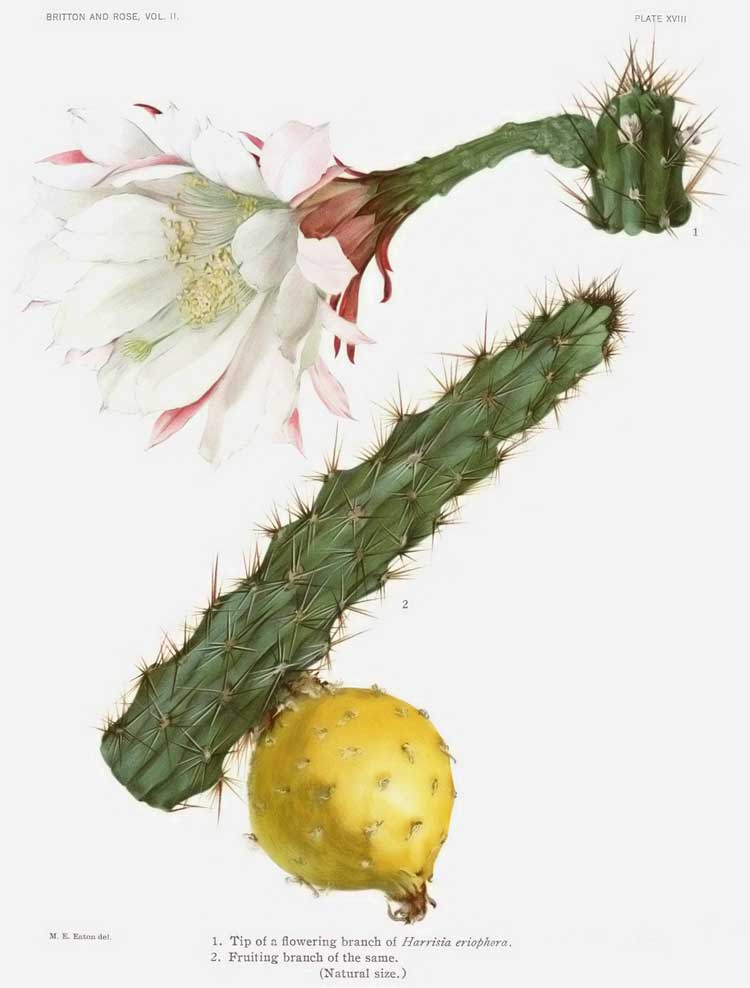
Harrisia eriophora
Classification System: APG IV
Superregnum: Eukaryota
Regnum: Plantae
Cladus: Angiosperms
Cladus: Eudicots
Cladus: Core eudicots
Ordo: Caryophyllales
Familia: Cactaceae
Subfamilia: Cactoideae
Tribus: Cereeae
Subtribus: Trichocereinae
Genus: Harrisia
Subgenus: H. subg. Harrisia
Sectio: H. sect. Harrisia
Series: H. ser. Harrisia
Species: Harrisia eriophora
Name
Harrisia eriophora (Pfeiff.) Britton, Bull.Torrey Bot. Club 35: 562 (1908 publ. 1909).
Neotype: Pfeiffer & Otto, Abbild. Beschr. Cact., Tab. 22 (1843). Design. A.R.Franck (2012)
Synonyms
Cereus eriophorus Pfeiff., Enum. Diagn. Cact.: 94. 1837, nom. cons. prop., syn. sec. Franck 2016
Distribution
Native distribution areas:
Continental: Southern America
Regional: Caribbean
Cuba
References: Brummitt, R.K. 2001. TDWG – World Geographical Scheme for Recording Plant Distributions, 2nd Edition
References
Primary references
Britton, N.L. 1908 publ. 1909. Bulletin of the Torrey Botanical Club 35: 562. New York.
Additional references
Anderson, E.F. 2001. The Cactus Family. Timber Press, ISBN 0-88192-498-9.
Acevedo-Rodríguez, P. & Strong, M.T.. 2007. Catalogue of the seed plants of the West Indies Website. 2010 Mar 08 [1]
Franck, A.R. 2012. Systematics of Harrisia (Cactaceae) (168!). Graduate School Theses and Dissertations [2].
Korotkova, N., Aquino, D., Arias, S., Eggli, U., Franck, A. , Gómez-Hinostrosa, C., Guerrero, P.C., Hernández, H.M., Kohlbecker, A., Köhler, M., Luther, K., Majure, L.C., Müller, A., Metzing, D., Nyffeler, R., Sánchez, D., Schlumpberger, B. & Berendsohn, W.G. 2021. Cactaceae at Caryophyllales. org–a dynamic online species-level taxonomic backbone for the family. Willdenowia 51(2): 251–270. DOI: 10.3372/wi.51.51208 Open access Reference page.
Links
Korotkova, N. et al. 2021. Harrisia eriophora in Cactaceae at Caryophyllales.org. A global synthesis of species diversity in the angiosperm order Caryophyllales. Published online. Accessed: 2021 Nov 07. Reference page.
Govaerts, R. et al. 2021. Harrisia eriophora in Kew Science Plants of the World Online. The Board of Trustees of the Royal Botanic Gardens, Kew. Published online. Accessed: 2021 Apr 29. Reference page.
International Plant Names Index. 2021. Harrisia eriophora. Published online. Accessed: Apr 29 2021. Reference page.
Tropicos.org 2021. Harrisia eriophora. Missouri Botanical Garden. Published online. Accessed: 29 Apr 2021.
Hassler, M. 2021. Harrisia eriophora. World Plants: Synonymic Checklists of the Vascular Plants of the World In: Roskovh, Y., Abucay, L., Orrell, T., Nicolson, D., Bailly, N., Kirk, P., Bourgoin, T., DeWalt, R.E., Decock, W., De Wever, A., Nieukerken, E. van, Zarucchi, J. & Penev, L., eds. 2021. Species 2000 & ITIS Catalogue of Life. Published online. Accessed: 2021 Apr 29. Reference page.
Hassler, M. 2021. World Plants. Synonymic Checklist and Distribution of the World Flora. . Harrisia eriophora. Accessed: 29 Apr 2021.
Vernacular names
español: Jijira, Pitahaya
Harrisia eriophora is a species of cactus found in Cuba.
Description
Harrisia eriophora grows shrubby and often forms dense groups with upright, arching or spreading shoots with heights of 3 to 5 meters. The initially bright green shoots later become dark green. They have diameters of up to 4 centimeters and more. There are eight to twelve prominent ribs, which are deeply indented between them. The six to 13 needle-like, light brown, gray or yellow spines have a darker tip and are 2 to 4 centimeters long.
The flowers reach a length of 12 to 18 centimeters. Its flower tube is covered with a few scales and long, white hairs. The obovate to spherical, yellow to dull red fruits are edible. They have a diameter of up to 6 centimeters[2]
Distribution
Harrisia eriophora is widespread in the United States in the state of Florida and in Cuba.
Taxonomy
The first description as Cereus eriophorus was made in 1837 by Ludwig Georg Karl Pfeiffer.[3] The specific epithet eriophora means 'wool-bearing'. Nathaniel Lord Britton placed the species in the genus Harrisia in 1909.[4]
References
Kew), Nigel Taylor (RBG; Nacional, Duniel Barrios (Jardín Botánico; Habana, Universidad de La (2011-07-25). "The IUCN Red List of Threatened Species". IUCN Red List of Threatened Species. Retrieved 2023-11-28.
Anderson, Edward F.; Eggli, Urs (2005). Das grosse Kakteen-Lexikon (in German). Stuttgart (Hohenheim): Ulmer. p. 338. ISBN 3-8001-4573-1.
Pfeiffer, Ludwig Georg Karl (1837). Enumeratio diagnostica cactearum hucusque cognitarum /auctore Ludovico Pfeiffer. Berolini: L. Oehmigke. doi:10.5962/bhl.title.15207.
Club., Torrey Botanical (1908). "Bulletin of the Torrey Botanical Club". Torrey Botanical Club. Retrieved 2023-11-28.
Retrieved from "http://en.wikipedia.org/"
All text is available under the terms of the GNU Free Documentation License