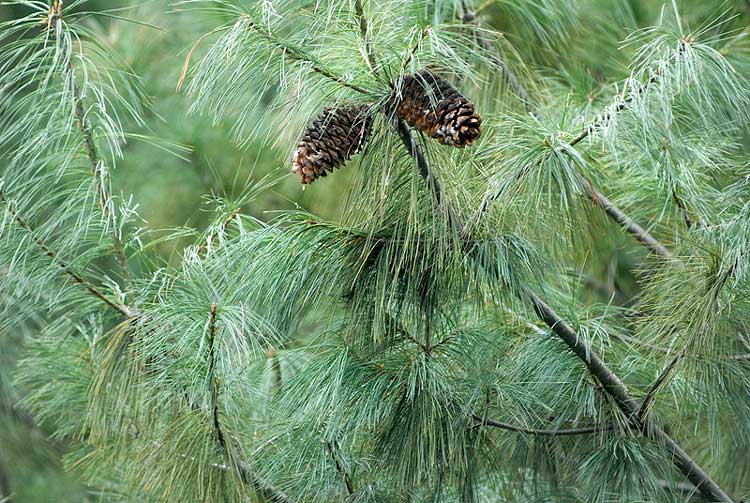
Pinus armandii (Information about this image)
Superregnum: Eukaryota
Regnum: Plantae
Divisio: Tracheophyta
Divisio: Pinophyta
Classis: Pinopsida
Ordo: Pinales
Familia: Pinaceae
Genus: Pinus
Subgenus: P. subg. Strobus
Sectio: P. sect. Quinquefoliae
Subsectio: P. subsect. Strobus
Species: Pinus armandii
Varietates: P. a. var. armandii – P. a. var. dabeshanensis – P. a. var. mastersiana
Name
Pinus armandii Franch., Nouv. Arch. Mus. Hist. Nat., sér. 2, 7: 95 (1884).
Distribution
Native distribution areas:
Continental: Asia-Temperate
Regional: China
China South-Central (Guizhou, Hubei, Sichuan, Yunnan), Hainan, China North-Central (Gansu, Shaanxi, Shanxi), China Southeast (Anhui, Henan), Tibet.
Regional: Eastern Asia
Taiwan.
Continental: Asia-Tropical
Regional: Indo-China
Myanmar.
References: Brummitt, R.K. 2001. TDWG – World Geographical Scheme for Recording Plant Distributions, 2nd Edition
References
Primary references
Franchet, A.R. 1884. Plantæ Davidianæ ex Sinarum Imperio (Suite 1). Nouvelles archives du Muséum d'histoire naturelle sér. 2, 7: 55–200, pl. 6–14. BHL Reference page. : 95, t. 12.
Additional references
Fu, L.-K., Li, N. & Elias, T.S. 1999. Pinus. Pp. 12–25 in Wu, Zh.Y. & Raven, P.H. (eds.), Flora of China. Volume 4: Cycadaceae through Fagaceae. Science Press, Beijing & Missouri Botanical Garden Press, St. Louis, ISBN 0-915279-70-3. efloras PDF Reference page.
Businský, R. 2008. The genus Pinus L., pines: contribution to knowledge. A monograph with cone drawings of all species of the world by Ludmila Businská. Acta Pruhoniciana 88: 1–126. PDF (Text) Photos 1–32 Photos 33–42 Figures 1–73Reference page.
Farjon, A. 2010. A Handbook of the World's Conifers. 2 vols., pp. 1–526 + 527–1111, Koninklijke Brill, Leiden, Boston. ISBN 978-90-04-17718-5. Reference page.
Links
Farjon, A. 2013. Pinus armandii. The IUCN Red List of Threatened Species 2013. IUCN Red List Category: Least Concern . DOI: 10.2305/IUCN.UK.2013-1.RLTS.T42342A2973993.en.
Govaerts, R. et al. 2023. Pinus armandii in Kew Science Plants of the World Online. The Board of Trustees of the Royal Botanic Gardens, Kew. Published online. Accessed: 2023 March 7. Reference page.
International Plant Names Index. 2023. Pinus armandii. Published online. Accessed: March 7 2023. Reference page.
Hassler, M. 2023. World Plants. Synonymic Checklist and Distribution of the World Flora. . Pinus armandii. Accessed: 7 March 2023.
Hassler, M. 2023. Pinus armandii. World Plants: Synonymic Checklists of the Vascular Plants of the World In: Roskovh, Y., Abucay, L., Orrell, T., Nicolson, D., Bailly, N., Kirk, P., Bourgoin, T., DeWalt, R.E., Decock, W., De Wever, A., Nieukerken, E. van, Zarucchi, J. & Penev, L., eds. 2023. Species 2000 & ITIS Catalogue of Life. Published online. Accessed: 2023 March 7. Reference page.
Vernacular names
العربية: صنوبر أرمندي
čeština: Borovice Armandova
Deutsch: Armands Kiefer
English: Chinese White Pine
español: Pino chino de Armand
français: Pin d'Armand
перем коми: Китайись чочком пожум
мокшень: Китаень акша пиче
кырык мары: Китай ош йӓктӹ
polski: Sosna Armanda
русский: Сосна белая китайская
Türkçe: Çin beyaz çamı
удмурт: Китайысь тӧдьы пужым
Tiếng Việt: Thông trắng Trung Quốc
中文: 华山松
Pinus armandii, the Armand pine[2] or Chinese white pine, is a species of pine native to China,[3] occurring from southern Shanxi west to southern Gansu and south to Yunnan, with outlying populations in Anhui. It grows at altitudes of 2200–3000 m in Taiwan, and it also extends a short distance into northern Burma.[4] In Chinese it is known as "Mount Hua pine" (华山松).
It grows at 1,000–3,300 m altitude, with the lower altitudes mainly in the northern part of the range. It is a tree reaching 35 m (115 ft) height, with a trunk up to 1 m (3 ft 3 in) in diameter.[5]
Description
Juvenile cone
It is a member of the white pine group, Pinus subgenus Strobus, and like all members of that group, the leaves ('needles') are in fascicles (bundles) of five, with a deciduous sheath. They are 8–20 cm (3+1⁄4–7+3⁄4 in) long. The cones are 9–22 cm (3+1⁄2–8+3⁄4 in) long and 6–8 cm (2+1⁄4–3+1⁄4 in) broad, with stout, thick scales. The seeds are large, 10–16 mm (0.39–0.63 in) long and have only a vestigial wing; they are dispersed by spotted nutcrackers. The cones mature in their second year, this is a juvenile female cone:
Varieties
The species has two or three varieties:
Pinus armandii var. armandii. All the range except for the populations below.
Pinus armandii var. mastersiana. Mountains of central Taiwan.
Pinus armandii var. dabeshanensis. The Dabie Mountains on the Anhui-Hubei border. Alternatively, this variety may be treated as a separate species, Pinus dabeshanensis (Dabie Mountains pine). To add further confusion, Flora of China lists this as P. fenzeliana var. dabeshanensis.[6]
IUCN has listed var. dabeshanensis (assessed as Pinus dabeshanensis)[7] as vulnerable and var. mastersiana as endangered.[8]
Pinus armandii has also been reported in the past from Hainan off the south coast of China, and two islands off southern Japan, but these pines differ in a number of features and are now treated as distinct species, Hainan white pine (Pinus fenzeliana) and Yakushima white pine (Pinus amamiana) respectively.
Uses
Pinus armandii seeds are harvested and sold as pine nuts. Research indicates that these nuts can cause pine mouth syndrome.[9] The wood is used for general building purposes; the species is important in forestry plantations in some parts of China. It is also grown as an ornamental tree in parks and large gardens in Europe and North America. The scientific name commemorates the French missionary and naturalist Armand David, who first introduced it to Europe.
Problems
19 different Pestalotiopsis species (a genus of ascomycete fungi) have been found as endophytes from bark and needles of Pinus armandii in China.[10]
Chinese culture
The tree, because of its evergreen foliage, is considered by the Chinese as an emblem of longevity and immortality. Its resin is considered an animated soul-substance, the counterpart of blood in men and animals. In ancient China, Taoist seekers of immortality consumed much of the tree's resin, hoping thereby to prolong life. Legend says that Qiu Sheng (仇生) who lived at the time of King Chengtang of Shang (商成汤王) (reigned 1675–1646 BCE), founder of the Shang dynasty, was indebted for his longevity to pine-resin.[11] The Shouxing, Chinese god of longevity (寿星), is usually represented standing at the foot of a pine, while a fairy-crane perches on a branch of the tree. In traditional pictures of "happiness, honor and longevity" (福禄寿三星), the pine-tree represents longevity, in the same manner as the bat symbolizes good fortune due to its homonymic association with the Chinese character for good luck (福). A fungus, that the Chinese call Fu Ling grows on the root of the pine-tree, and is believed by the Chinese to suppress all sensations of hunger, cure various diseases, and lengthen life.[11]
References
Farjon, A. (2013). "Pinus armandii". IUCN Red List of Threatened Species. 2013: e.T42342A2973993. doi:10.2305/IUCN.UK.2013-1.RLTS.T42342A2973993.en. Retrieved 12 November 2021.
NRCS. "Pinus armandii". PLANTS Database. United States Department of Agriculture (USDA). Retrieved 4 October 2015.
Astifan, William (2012). "Pinus armandii: Chinese White Pine" (PDF). Haverford College Arboretum Association. 37 (4). Archived from the original (PDF) on 19 October 2013.
Critchfield, William Burke; Little, Elbert L. (1966). Geographic distribution of the pines of the world. United States Forest Service.
Fu, Liguo; Li, Nan; Elias, Thomas S.; Mill, Robert R. "Pinus armandii". Flora of China. Vol. 4. Retrieved 2 October 2012 – via eFloras.org, Missouri Botanical Garden, St. Louis, MO & Harvard University Herbaria, Cambridge, MA.
Fu, Liguo; Li, Nan; Elias, Thomas S.; Mill, Robert R. "Pinus fenzeliana var. dabeshanensis". Flora of China. Vol. 4. Retrieved 2 October 2012 – via eFloras.org, Missouri Botanical Garden, St. Louis, MO & Harvard University Herbaria, Cambridge, MA.
Conifer Specialist Group (1998). "Pinus dabeshanensis". IUCN Red List of Threatened Species. 1998. Retrieved 2 October 2012.
Farjon, A. (2013). "Pinus armandii var. mastersiana". IUCN Red List of Threatened Species. 2013: e.T34181A2849535. doi:10.2305/IUCN.UK.2013-1.RLTS.T34181A2849535.en. Retrieved 12 November 2021.
Destaillats F, et al. (2011). "Identification of the Botanical Origin of Commercial Pine Nuts Responsible for Dysgeusia by Gas-Liquid Chromatography Analysis of Fatty Acid Profile" (PDF). Journal of Toxicology. 2011: 1–7. doi:10.1155/2011/316789. PMC 3090612. PMID 21559093. Archived (PDF) from the original on 25 July 2018. Retrieved 2 October 2012.
Hu, H.; Jeewon, R.; Zhou, D.; Zhou, T.; Hyde, K.D. (2007). "Phylogenetic diversity of endophytic Pestalotiopsis species in Pinus armandii and Ribes spp.: Evidence from rDNA and β-Tubulin gene phylogenies". Fungal Divers. 24: 1–22.
De Groot, J.J.M. (2003). The Religious System of China. Vol. IV. Kessinger Publishing. ISBN 978-0-7661-3354-9. pp 297,300
Retrieved from "http://en.wikipedia.org/"
All text is available under the terms of the GNU Free Documentation License