Fine Art

Pinus brutia

Pinus brutia (Information about this image)

Life-forms

Superregnum: Eukaryota
Regnum: Plantae
Divisio: Tracheophyta
Divisio: Pinophyta
Classis: Pinopsida
Ordo: Pinales

Familia: Pinaceae
Genus: Pinus
Subgenus: P. subg. Pinus
Sectio: P. sect. Pinaster
Species: Pinus brutia
Subspecies: P. b. subsp. brutia – P. b. subsp. eldarica
Varietates: P. b. var. pendulifolia – P. b. var. pityusa – P. b. var. stankewiczii
Name

Pinus brutia Ten., Fl. Napol. 1(Prodr.): LXXII (PDF) (1815, "brutius", orth. err.).

Lectotypus (designated by Frankis 1999: 180) Italy, Reggio Calabria, Aspromonte [ancient Brutium] (naturalised population), Tenore s.n., sheet T2 (Lectotypus: NAP),

Synonyms

Homotypic
Pinus halepensis var. brutia (Ten.) A.Henry in H.J.Elwes & A.Henry, Trees Great Britain 5: 1100 (1910).
Pinus halepensis subsp. brutia (Ten.) Holmboe, Stud. Veg. Cyprus: 29 (1914).

Distribution
Native distribution areas:

Europe
Southeastern Europe
Bulgaria (extreme SE, rare), Greece (Kiklades, Northeast; widely planted elsewhere), Italy (Calabria, introduced), Kriti, Turkey-in-Europe.
Eastern Europe
Krym.
Africa
Northern Africa
Algeria, Morocco (introduced).
Asia-Temperate
Caucasus
North Caucasus, Transcaucasus (Azerbaijan)
Western Asia
Afghanistan (probably introduced but possibly native), Cyprus, East Aegean Islands, Iran (introduced), Iraq, Lebanon-Syria (Lebanon, Syria)), Palestine (introduced), Turkey.
Australasia
Australia
Western Australia (introduced).

References: Brummitt, R.K. 2001. TDWG – World Geographical Scheme for Recording Plant Distributions, 2nd Edition
References
Primary references

Tenore, M. 1811–1815. Flora Napolitana, ossia descrizione delle piante indigene del regno di Napoli, e delle più rare specie di piante esotiche coltivate ne' giardini. Vol. I. lxxii + 324 pp., Tipografia del Giornale Enciclopedico, Stamperia Francese, Napoli. PDFReference page.

Additional references

Farjon, A. 2010. A Handbook of the World's Conifers. 2 vols., pp. 1–526 + 527–1111, Koninklijke Brill, Leiden, Boston. ISBN 978-90-04-17718-5. Reference page. (pp. 641–643)
Frankis, M.P. 1999. Pinus brutia. Curtis's Botanical Magazine 16(3): 173–184, Plate 367. DOI: 10.1111/1467-8748.00216 Paywall JSTOR Hybrid open access journal Reference page.
Frankis, M.P. 2000. Pinaceae. Pp. 5–7 in Güner, A., Özhatay, N., Ekim, T. & Başer, K.H.C. (eds.), Flora of Turkey and the East Aegean Islands. Vol. 11 (Supplement 2). 656 pp., Edinburgh University Press, Edinburgh, ISBN 0-7486-1409-5. Reference page.
Dobignard, A. & Chatelain, C. 2010. Index synonymique de la flore d'Afrique du Nord. Volume 1: Pteridophyta, Gymnospermae, Monocotyledoneae. Conservatoire et jardin botaniques, Genève, ISBN 978-2-8277-0120-9, 455 pp. PDF Reference page.
Dimopoulos, P., Raus, Th., Bergmeier, E., Constantinidis, Th., Iatroú, G., Kokkini, S., Strid, A. & Tzanoudakis, D. 2013. Vascular Plants of Greece: An Annotated Checklist. Englera 31: 1–368. JSTOR PDF Reference page.

Links

Earle, C.J. 2021. Pinus brutia in The Gymnosperm Database. Accessed Mar. 1 2021.

Farjon, A. 2013. Pinus brutia. The IUCN Red List of Threatened Species 2013. IUCN Red List Category: Least Concern . DOI: 10.2305/IUCN.UK.2013-1.RLTS.T42347A2974345.en.
Govaerts, R. et al. 2023. Pinus brutia in Kew Science Plants of the World Online. The Board of Trustees of the Royal Botanic Gardens, Kew. Published online. Accessed: 2023 Feb 24. Reference page.
Tropicos.org 2023. Pinus brutia. Missouri Botanical Garden. Published online. Accessed: 24 Feb 2023.
Hassler, M. 2023. World Plants. Synonymic Checklist and Distribution of the World Flora. . Pinus brutia. Accessed: 24 Feb 2023.
Euro+Med 2006 onwards: Pinus brutia in Euro+Med PlantBase – the information resource for Euro-Mediterranean plant diversity. Published online. Accessed: 2023 Feb 24.
International Plant Names Index. 2021. Pinus brutia. Published online. Accessed: 8 March 2021.

Vernacular names
العربية: صنوبر بروتي
català: Pi de Turquia
dansk: Calabrisk Fyr
Deutsch: Kalabrische Kiefer
Ελληνικά: Τραχεία πεύκη
English: Turkish Pine
Esperanto: Malgrandazia pino
español: Pino de Chipre
فارسی: کاج ایتالیایی
suomi: Turkinmänty
français: Pin de Calabre
עברית: אורן קפריסאי
magyar: Kalábriaifenyő
հայերեն: Սոճի էլդարյան
italiano: Pino calabro
ქართული: ელდარის ფიჭვი
перем коми: Тюркияись пожум
македонски: Брутски бор
монгол: Туркийн нарс
Nederlands: Turkse den
norsk: Kalabrisk furu
polski: Sosna kalabryjska
پنجابی: بروٹی چیڑ
русский: Сосна калабрийская
Türkçe: Türk kızılçamı
удмурт: Турциысь пужым
中文: 土耳其松

Pinus brutia, commonly known as the Turkish pine and Calabrian pine, is a species of pine native to the eastern Mediterranean region. The bulk of its range is in Turkey, but certain varieties are naturalized as far east as Afghanistan.[2] It is also known as East Mediterranean pine, Afghan pine, and Brutia pine. The name "Calabrian pine" comes from an introduced grove in the Calabria region of southern Italy; historically this region was called Bruttium, which is likely where the specific epithet "brutia" comes from.[2] Pinus brutia bears many similarities with other, closely related species such as Pinus halepensis and Pinus canariensis. Turkish pine forms a species complex with the former.[3]
Description

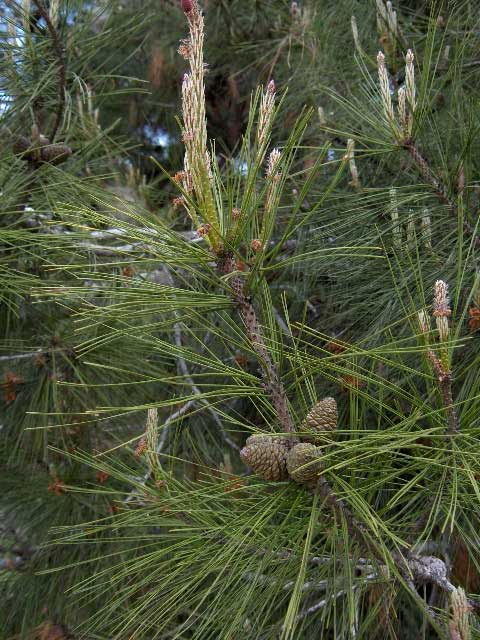
Pinus brutia is a medium-size tree, reaching 20–35 metres (66–115 feet) tall with a trunk diameter of up to 1 m (3+1⁄2 ft), exceptionally 2 m (6+1⁄2 ft). The young bark is thin and red-orange, maturing to grey-brown to orange in color, fissured to flaky in texture. The leaves are needle-like, slender, 10–16 centimetres (4–6+1⁄4 inches) long, dark green to yellow-green.[2][4] The needles come in fascicles of two and rarely three,[2][5] the latter specimens showing similarities in cone structure to the related Pinus canariensis.[5]

The male cones are squat, 15–20 mm (0.59–0.79 in) long.[4][6] The female cones are short, with rigid, woody scales, 5–10 cm (2.0–3.9 in) long, 5–7 cm (2.0–2.8 in) broad, maturing from green to red-orange.[6][5] They most often appear in whorls of 3 to 4, and generally open within two years of fertilization.[2][6] The seeds are usually wind dispersed, dropping from the cones after they open, but some trees have been observed with cones that do not open enough to facilitate wind dispersal. Frankis believes Krüper's nuthatch assists these trees in dispersal.[2]

Varieties

Pinus brutia is closely related to Pinus halepensis, and female P. brutia cones have been shown to accept and hybridize with P. halepensis pollen. In the past it has been considered a variety or subspecies of P. halepensis.[5] The species is now treated as distinct, and forms a species complex across the Mediterranean with P. halepensis.[3]
Lush, green needles on orange stems.
P. brutia var. eldarica specimen in Las Vegas.

Pinus brutia var. brutia: Typical form, with longer needles, 10–18 cm (3.9–7.1 in). Found across Eastern Mediterranean.[6]
Pinus brutia var. pityusa: Found in smaller stands along the eastern Black Sea coast, near Pitsunda. Very similar to var. brutia.[5][6]
Pinus brutia var. pendulifolia: Muğla, Turkey.[6] Exceptionally long needles, 24–29 cm (9.4–11.4 in), that hang in pendules similar to P. canariensis.[2]
Pinus brutia var. eldarica, Afghan Pine: native to Azerbaijan and Georgia and naturalized in Afghanistan and Pakistan.[2] Smaller cones, 5–8 cm (2.0–3.1 in).[6][7] Sometimes treated as a subspecies of P. brutia or a species of its own. Due to its tolerance of drought and poor soil, it is widely planted as an ornamental in both southwestern US and Europe.[6][8]

Taxonomy

Italian botanist Michele Tenore described the species in 1811. While Tenore did not provide an explanation for the specific epithet, Frankis believes Tenore named it after the historical region of Brutium, now Calabria, where an introduced population has become naturalized.[2]
Distribution and habitat
Pinus brutia on the coast of Thasos, Greece

The bulk of its range is in Turkey, but it also extends to southeasternmost Bulgaria,[9] the East Aegean Islands of Aegean Sea, Crete, Crimea, Iran, Georgia, Azerbaijan, northern Iraq, western Syria, Lebanon and Cyprus.[10] It generally occurs at low altitudes, mostly from sea level to 600 m (2,000 ft), up to 1,200 m (3,900 ft) in the south of its range.[citation needed]
Ecology

Pinus brutia is a diagnostic species of the vegetation class Pinetea halepensis.[11]

The Krüper's nuthatch, a rare nuthatch, is largely restricted to forests of Turkish pine and depends heavily on it for feeding; the ranges of the two species are largely coincident.[citation needed]

P. brutia is resistant to the Israeli pine bast scale insect Matsucoccus josephi and is a major host for Thaumetopoea caterpillars.

The species covers 175,000 hectares (430,000 acres) in Cyprus, roughly ~90% of all woodland coverage on the island.[12] It forms ectomycorrhizal associations with numerous species of fungi, and its logs and branches are excellent substrates for many kinds of decomposing organisms.
Uses
Pinus brutia on the mountains near Aleppo
Honey

Turkish pine is host to a sap-sucking aphid Marchalina hellenica. Under normal circumstances, this insect does no significant damage to the pine, but is of great importance for the excess sugar it secretes. This sugar, "honeydew", is collected by honey bees which make it into a richly flavoured and valuable honey, "pine honey" (Turkish, çam balı), with reputed medicinal benefits.
Landmark

The "Lone Pine", a prominent landmark tree at an ANZAC First World War battle at Gallipoli, was this species. Cones from the battlefield were taken home to Australia, and plants sourced from the seeds were planted as living memorials.

"Lone Pine" memorials, based on cones brought back from Gallipoli, may use this species or Aleppo pine. Some memorials utilise other species altogether.[13]
Forestry

It is widely planted for timber, both in its native area (it is the most important tree in forestry in Turkey and Cyprus) and elsewhere in the Mediterranean region east to Pakistan. The timber is used for many purposes including carpentry, industry, general constructions, firewood and pulp.[14] In Israel it is sometimes preferred to the wider-used Pinus halepensis (Aleppo pine) because of its resistance to Matsucoccus josephi. It is also known for being well suited to recreational sites.
Cultivation

Pinus brutia is a popular ornamental tree, extensively planted in parks and gardens in hot dry areas (such as southern California, Utah, New Mexico and Nevada, as well as throughout Arizona and central Texas in the United States), where its considerable heat and drought tolerance is highly valued. The subspecies eldarica is the most drought tolerant form, used in Afghanistan, Iran and more recently in the Southwestern United States. In this region, P. brutia subsp. eldarica is referred to as "Eldarica pine", "Afghan pine" or "Mondell pine" (after Mondell Bennett, a commercial tree grower in New Mexico who popularized the species starting in 1969).[15]
References

Farjon, A. (2013). "Pinus brutia". IUCN Red List of Threatened Species. 2013: e.T42347A2974345. doi:10.2305/IUCN.UK.2013-1.RLTS.T42347A2974345.en. Retrieved 19 November 2021.
Frankis, Michael (1999). "367. PINUS BRUTIA: Pinaceae". Curtis's Botanical Magazine. 16 (3): 173–184. doi:10.1111/1467-8748.00216. ISSN 1355-4905. JSTOR 45065380.
Olsson, Sanna; Lorenzo, Zaida; Zabal-Aguirre, Mario; Piotti, Andrea; Vendramin, Giovanni G.; González-Martínez, Santiago C.; Grivet, Delphine (2021-07-01). "Evolutionary history of the mediterranean Pinus halepensis-brutia species complex using gene-resequencing and transcriptomic approaches". Plant Molecular Biology. 106 (4): 367–380. doi:10.1007/s11103-021-01155-7. hdl:10261/288206. ISSN 1573-5028. PMID 33934278.
"Pinus brutia Ten". The World Flora Online. Retrieved 11 December 2023.
"Pinus brutia". The Gymnosperm Database. Retrieved 11 December 2023.
"Pinus brutia - Trees and Shrubs Online". www.treesandshrubsonline.org. Retrieved 2023-12-11.
"Afghan Pine | Woody Plant Finder | Comprehensive Landscape Plant Directory | Plant Finders | Plant Resources Home | TTU". www.depts.ttu.edu. Retrieved 2023-12-11.
"Texas A&M Forest Service - Trees of Texas - List of Trees". texastreeid.tamu.edu. Retrieved 2023-12-11.
"Pinus brutia". Red Book of Bulgaria. Retrieved 10 January 2018.
"Pinus brutia". Germplasm Resources Information Network. Agricultural Research Service, United States Department of Agriculture. Retrieved 14 April 2011.
Bonari, Gianmaria; Fernández-González, Federico; Çoban, Süleyman; Monteiro-Henriques, Tiago; Bergmeier, Erwin; Didukh, Yakiv P.; Xystrakis, Fotios; Angiolini, Claudia; Chytrý, Kryštof; Acosta, Alicia T.R.; Agrillo, Emiliano (January 2021). Ewald, Jörg (ed.). "Classification of the Mediterranean lowland to submontane pine forest vegetation". Applied Vegetation Science. 24 (1). Bibcode:2021AppVS..24E2544B. doi:10.1111/avsc.12544. hdl:10400.5/21923. ISSN 1402-2001. S2CID 228839165.
Loizides, Michael (2021-07-23). "Basidiomycete diversity within Calabrian pine (Pinus brutia) ecosystems on the island of Cyprus". Mycotaxon. 136 (2): 543. doi:10.5248/136.543. S2CID 238789537.
Wilcox, Mike; Spencer David (May 2007). "Stand up for the real Anzac Lone Pine Of Gallipoli" (PDF). New Zealand Journal of Forestry: 3–9. Retrieved 29 March 2012.
Fady, B.; Semerci, H. & Vendramin, G.G. (2003). "Aleppo and Brutia pines - Pinus halepensis/Pinus brutia" (PDF). EUFORGEN Technical Guidelines for Genetic Conservation and Use.

Widmoyer, Fred B. (1984-05-11). "History of Pinus Eldarica in the United States" (PDF). Southwest Christmas Tree Industry Research Needs and Commercial Opportunities: Proceedings of the Symposium held May 11, 1984, Tucson, Arizona. New Mexico State University. Retrieved 5 May 2012.

Further reading

Shayanmehr, F., Jalali, S. G., Ghanati, F., & Kartoolinejad, D. (2008). Discrimination of Pinus eldarica MEDW. and its two new species by epicuticular wax, lignin content, electrophoretic isozyme and activity of peroxidase. Feddes Repertorium, 119(7‐8), 644–654. http://onlinelibrary.wiley.com/doi/10.1002/fedr.200811188/full
Shayanmehr, F., Jalali, S. G., Ghanati, F., Kartoolinejad, D., & Apple, M. E. (2009). Two new morphotypes of Pinus eldarica: Discrimination by macromorphological and anatomical traits. Dendrobiology, 61, 27–36. http://onlinelibrary.wiley.com/doi/10.1002/fedr.200811188/full
Frankis, M. P. (1999). Pinus brutia. Curtis's Botanical Magazine 16: 173–184.

Plants, Fine Art Prints

Plants Images

Biology Encyclopedia

Retrieved from "http://en.wikipedia.org/"
All text is available under the terms of the GNU Free Documentation License

Home - Hellenica World