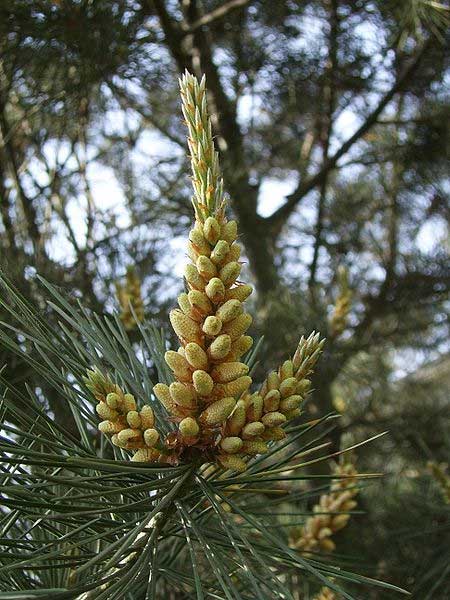
Pinus bungeana (Information about this image)
Superregnum: Eukaryota
Regnum: Plantae
Divisio: Tracheophyta
Divisio: Pinophyta
Classis: Pinopsida
Ordo: Pinales
Familia: Pinaceae
Genus: Pinus
Subgenus: P. subg. Strobus
Sectio: P. sect. Gerardia
Subsectio: P. subsect. Gerardianae
Species: Pinus bungeana
Name
Pinus bungeana Zucc. ex Endl., Syn. Conif.: 166 (1847).
Synonyms
Heterotypic
Pinus excorticata Lindl. & Gordon, J. Hort. Soc. London 5: 217 (1850).
Distribution
Native distribution areas:
Asia-Temperate
China
China North-Central, China South-Central, China Southeast, Inner Mongolia.
References: Brummitt, R.K. 2001. TDWG – World Geographical Scheme for Recording Plant Distributions, 2nd Edition
References
Primary references
Endlicher, S. 1847. Synopsis coniferarum 166: 1-382. BHL
Additional references
Fu, L.-K., Li, N. & Elias, T.S. 1999. Pinus. Pp. 12-25 in Wu, Zh.Y. & Raven, P.H. (eds.), Flora of China. Volume 4: Cycadaceae through Fagaceae. Science Press, Beijing & Missouri Botanical Garden Press, St. Louis, ISBN 0-915279-70-3. efloras PDF Reference page.
Farjon, A. 2001. World Checklist and Bibliography of Conifers. 2. ed., 309 pp. The Royal Botanic Gardens, Kew. ISBN 1-84246-025-0 Reference page.
Businský, R. 2008. The genus Pinus L., pines: contribution to knowledge. A monograph with cone drawings of all species of the world by Ludmila Businská. Acta Pruhoniciana 88: 1–126. PDF (Text) Photos 1–32 Photos 33–42 Figures 1–73Reference page.
Farjon, A. 2010. A Handbook of the World's Conifers. 2 vols., pp. 1–526 + 527–1111, Koninklijke Brill, Leiden, Boston. ISBN 978-90-04-17718-5. Reference page.
Links
Luscombe, D. 2013. Pinus bungeana. The IUCN Red List of Threatened Species 2013. IUCN Red List Category: Least Concern . DOI: 10.2305/IUCN.UK.2013-1.RLTS.T39602A2930000.en.
Govaerts, R. et al. 2023. Pinus bungeana in Kew Science Plants of the World Online. The Board of Trustees of the Royal Botanic Gardens, Kew. Published online. Accessed: 2023 March 4. Reference page.
International Plant Names Index. 2023. Pinus bungeana. Published online. Accessed: March 4 2023.
Hassler, M. 2023. World Plants. Synonymic Checklist and Distribution of the World Flora. . Pinus bungeana. Accessed: 4 March 2023.
Hassler, M. 2023. Pinus bungeana. World Plants: Synonymic Checklists of the Vascular Plants of the World In: Roskovh, Y., Abucay, L., Orrell, T., Nicolson, D., Bailly, N., Kirk, P., Bourgoin, T., DeWalt, R.E., Decock, W., De Wever, A., Nieukerken, E. van, Zarucchi, J. & Penev, L., eds. 2023. Species 2000 & ITIS Catalogue of Life. Published online. Accessed: 2023 March 4. Reference page.
Vernacular names
dansk: Bunge-Fyr
Deutsch: Bunges Kiefer
English: Lacebark Pine
español: Pino chino de Bunges
eesti: Bunge mänd
فارسی: کاج چینی
français: Pin Napoléon
magyar: Tarkakérgű fenyő
日本語: シロマツ
한국어: 백송
norsk: Trevlebarkfuru
polski: Sosna plamistokora
русский: Сосна Бунге
svenska: Vitbarkig kinesisk tall
Tiếng Việt: Thông vỏ trắng Trung Hoa
中文: 白皮松
Pinus bungeana (Chinese: 白皮松; pinyin: báipísōng; Japanese: シロマツ; Korean: 백송; RR: baeksong), also known by the common names Bunge's pine,[2] lacebark pine and white-barked pine, is a pine tree native to northeastern and central China.[3][4] It is a slow-growing tree that can grow to heights of 15–25 metres (49–82 ft) is frost hardy down to below −26 °C (−15 °F). Its smooth, grey-green bark gradually sheds in round scales to reveal patches of pale yellow, which turn olive-brown, red and purple on exposure to light.
Lacebark pine at Kew Gardens, London, England
Description
The lacebark pine's trunk can grow either monopodial, as a single growth upwards, or sympodial, forked. Its crown is loosely shaped like a pyramid or umbrella. It has 5–10 centimetres (2.0–3.9 in) long needles in groups of three. Each needles' cross-sections are shaped like a triangular semicircle. The lacebark pine produces cones that turn yellowish brown as they mature and are roughly egg-shaped and 5–7 centimetres (2.0–2.8 in) long. They contain seeds that are grey-brown, slightly egg-shaped, and 10 millimetres (0.39 in) long.[3]
Closeup of multiple stems
Taxonomy
P. bungeana is synonymous with the name Pinus excorticata, attributed to Lindley and Gordon in William Dallimore's Handbook of Coniferae and Ginkgoaceae. Its name is derived from the surname "Bunge", as one of its early identifications was by botanist Alexander von Bunge in 1831 near Beijing.
P. bungeana is closely related to Pinus gerardiana, another pine species with flaking bark, but P. bungeana has stiffer needles and smaller cones.[5]
Distribution and habitat
Pinus bungeana is native to temperate forests in the mountains of China, but it is also widely cultivated as an ornamental tree, especially for its metallic bark.[1] It grows in the provinces of Shanxi, west Henan, south Gansu, south Hebei, north Sichuan, Shaanxi, west Shandong, and Hubei. It occurs in the wild on limestone rocks and south-facing slopes at relatively high elevations of 500–2,150 metres (1,640–7,050 ft), but has also been planted at lower elevations. In the northern portion of its range, it also occurs in acidic soil. As a light-demanding species, it usually grows in sites less suitable for other tree species.[1]
It was introduced to England in 1843.[1]
Closeup of bark
Ecology
Pollination of the lacebark pine occurs in the months of April and May, while seeds mature in October and November of the second year.[3]
Uses
In China and Korea, the lacebark pine is traditionally planted near temples and cemeteries.[1] It is also grown as an ornamental tree in classical gardens seeking to imitate Chinese gardens, in which it symbolizes longevity. It can also be seen in botanic gardens and often grows with multiple stems.[citation needed]
The wood of the lacebark pine is not commercially used as timber, but it is used locally by populations in northeast China for construction, furniture, and transport structures like pallets. The lacebark pine has edible seeds used in traditional Chinese medicine to provide relief for respiratory ailments.[1]
Bark and foliage
Cultural significance
In 2009, P. bungeana was named the city tree of Baoji, China.[6]
References
Luscombe, D (2013). "Pinus bungeana". IUCN Red List of Threatened Species. 2013: e.T39602A2930000. doi:10.2305/IUCN.UK.2013-1.RLTS.T39602A2930000.en. Retrieved 13 November 2021.
NRCS. "Pinus bungeana". PLANTS Database. United States Department of Agriculture (USDA). Retrieved 4 October 2015.
Fu, Liguo; Li, Nan; Elias, Thomas S.; Mill, Robert R. "Pinus bungeana". Flora of China. Vol. 4. Retrieved 16 August 2018 – via eFloras.org, Missouri Botanical Garden, St. Louis, MO & Harvard University Herbaria, Cambridge, MA.
Earle, Christopher J., ed. (2018). "Pinus bungeana". The Gymnosperm Database.
Dallimore, William; Jackson, Albert Bruce (1923). "Pinus". A handbook of Coniferae, including Ginkgoaceæ (1 ed.). New York: Longmans, Green & Co. pp. 375–377. doi:10.5962/bhl.title.15657.
张红平 (26 April 2009). "海棠花成为宝鸡市市花" [Asiatic apple flower becomes city flower of Baoji] (in Chinese). Sina Corporation. Retrieved 14 February 2023.
Further reading
Li, B. & W. C. Gu (2002). "A study on phenotypic diversity of seeds and cones characteristics in Pinus bungeana". Biodiversity Science. 10 (2): 181–188. doi:10.17520/biods.2002023.
Sujuan, Guo; Ling Hongqin & Li Fenglan. "Physiological and biochemical basis of rooting of Pinus bungeana cuttings". Journal of Beijing Forestry University. 2004 (2).
Retrieved from "http://en.wikipedia.org/"
All text is available under the terms of the GNU Free Documentation License