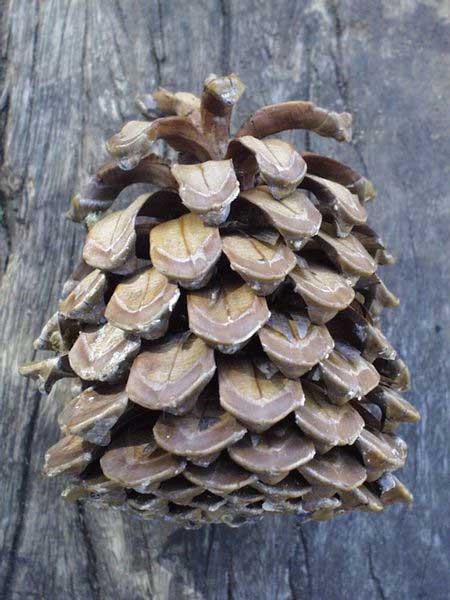
Pinus canariensis (*)
Superregnum: Eukaryota
Regnum: Plantae
Divisio: Tracheophyta
Divisio: Pinophyta
Classis: Pinopsida
Ordo: Pinales
Familia: Pinaceae
Genus: Pinus
Subgenus: P. subg. Pinus
Sectio: P. sect. Pinaster
Subsectio: P. subsect. Pinaster
Species: Pinus canariensis
Name
Pinus canariensis C.Sm., in C.L.von Buch, Phys. Beschr. Canar. Ins.: 159 (1828).
Distribution
Native distribution areas:
Africa
Macaronesia
Canary Islands.
References: Brummitt, R.K. 2001. TDWG – World Geographical Scheme for Recording Plant Distributions, 2nd Edition
References
Additional references
Businský, R. 2008. The genus Pinus L., pines: contribution to knowledge. A monograph with cone drawings of all species of the world by Ludmila Businská. Acta Pruhoniciana 88: 1–126. PDF (Text) Photos 1–32 Photos 33–42 Figures 1–73Reference page.
Farjon, A. 2010. A Handbook of the World's Conifers. 2 vols., pp. 1–526 + 527–1111, Koninklijke Brill, Leiden, Boston. ISBN 978-90-04-17718-5. Reference page.
Links
Thomas, P. 2017. Pinus canariensis. The IUCN Red List of Threatened Species 2017. IUCN Red List Category: Least Concern . DOI: 10.2305/IUCN.UK.2017-2.RLTS.T39603A84061236.en.
Govaerts, R. et al. 2023. Pinus canariensis in Kew Science Plants of the World Online. The Board of Trustees of the Royal Botanic Gardens, Kew. Published online. Accessed: 2023 March 7. Reference page.
International Plant Names Index. 2023. Pinus canariensis. Published online. Accessed: March 17 2023.
Hassler, M. 2023. World Plants. Synonymic Checklist and Distribution of the World Flora. . Pinus canariensis. Accessed: 7 March 2023.
Hassler, M. 2023. Pinus canariensis. World Plants: Synonymic Checklists of the Vascular Plants of the World In: Roskovh, Y., Abucay, L., Orrell, T., Nicolson, D., Bailly, N., Kirk, P., Bourgoin, T., DeWalt, R.E., Decock, W., De Wever, A., Nieukerken, E. van, Zarucchi, J. & Penev, L., eds. 2023. Species 2000 & ITIS Catalogue of Life. Published online. Accessed: 2023 March 7. Reference page.
Vernacular names
العربية: صنوبر كناري
azərbaycanca: Kanar şamı
català: Pi canari
dansk: Kanarie-Fyr
Deutsch: Kanarische Kiefer
Ελληνικά: Κανάριος πεύκη
English: Canary Island Pine
Esperanto: Kanaria pino
español: Pino canario
euskara: Kanariar pinu
suomi: Kanarianmänty
français: Pin des Canaries
galego: Piñeiro das Canarias
magyar: Kanári fenyő
перем коми: Канарісь пожум
монгол: Канарын арлын нарс
Nederlands: Canarische den
norsk: Kanarifuru
polski: Sosna kanaryjska
پنجابی: کناری جزیرہ چیڑ
português: Pinheiro-das-Canárias
русский: Сосна канарская
svenska: Kanarietall
удмурт: Канар пужым
中文: 加那利松
Pinus canariensis, the Canary Island pine, is a species of gymnosperm in the conifer family Pinaceae. It is a large, evergreen tree, native and endemic to the outer Canary Islands of the Atlantic Ocean.
Description
Pinus canariensis is a large evergreen tree, growing to 30–40 metres (98–131 feet) tall and 100–120 centimetres (39–47 inches) diameter at breast height,[3] exceptionally up to 56 m (184 ft) tall and 988 cm (389 in) girth (314 cm diameter).[4] The green to yellow-green leaves are needle-like, in bundles of three, 20–30 cm (8–12 in) long,[3] with finely toothed margins and often drooping. A characteristic of the species is the occurrence of epicormic shoots with single (not in threes) glaucous (bluish-green) juvenile leaves growing from the lower trunk, but in its natural area this only occurs as a consequence of fire or other damage. The cones are 10–18 cm (4–7 in) long, 5 cm (2 in) wide,[3] glossy chestnut-brown in colour and frequently remaining closed for several years (serotinous cones). Its closest relatives are the chir pine (P. roxburghii) from the Himalayas, the Mediterranean pines P. pinea, P. halepensis, P. pinaster and P. brutia from the eastern Mediterranean.
Taxonomy
Pinus canariensis was first described in 1825 by Augustin Pyramus de Candolle, who attributed the name to Christen Smith.[2][5] It has been placed in subsection Pinaster of subgenus Pinus, section Pinus. The other species in the subsection are mainly Mediterranean in distribution, with one species (P. roxburghii) from the Himalayas.[6]
Distribution and habitat
The species is native and endemic to the outer Canary Islands (Gran Canaria, Tenerife, El Hierro and La Palma).[3] It is a subtropical pine and does not tolerate low temperatures or hard frost, surviving temperatures down to about −6 to −10 °C (21 to 14 °F). Within its natural area, it grows under extremely variable rainfall regimes, from less than 300 millimetres (12 in) to several thousands, mostly due to differences in mist-capturing by the foliage. Under warm conditions, this is one of the most drought-tolerant pines, living even with less than 200 mm (8 in) of rainfall per year.
The native range has been somewhat reduced due to over-cutting so that only the islands of Tenerife, La Palma, and Gran Canaria still have large forests, with extensive replanting of deforested areas since 1940.[7] Really big trees are rare due to past over-cutting.[1] It is the tallest tree in the Canary Islands, with the tallest specimen, 'Pino de las Dos Pernadas' near Vilaflor on Tenerife, being 56.7 m tall.[8]
Fossil record
Fossils of Pinus canariensis have been described from the fossil flora of Kızılcahamam district in Turkey which is of early Pliocene age.[9] Fossil cones including seeds of Pinus canariensis are known from the late Miocene of Abkhazia, from the Vienna Basin and the Canary Islands. Numerous cone casts including seeds of Pinus canariensis from the early Pleistocene, were recovered on Kallithea, Rhodes.[10]
Ecology
This pine is one of the most fire-resistant conifers in the world, due to several beneficial adaptations.[11][12][13] In particular, Pinus canariensis is one of the few pine species that can epicormically resprout after losing its needles in a fire.[14]
Uses
The tree's long needles make a significant contribution to the islands' water supply, trapping large amounts of cloud droplets as fog drip. This comes from the moist air coming off the Atlantic with the prevailing north eastern wind (locally called "alisios" or "tiempo norte"); the fog drip measured under trees can be up to 20 times the rainfall measured in the open away from trees at the same site. The condensation after dropping to the ground is quickly absorbed by the soil, and percolates down to the underground aquifers.[15]
The aromatic wood, especially the heartwood, is among the finest of pine woods, being hard, strong and durable.[16] The wood of the Canary island pine is now becoming popular as a tonewood for soundboards for guitars and other string instruments.
Pinus canariensis is a popular ornamental tree in warmer climates, such as in private gardens, public landscapes, and as street trees. In mainland Spain, South Africa, Sicily, Australia, and California, it has become a naturalised species from original landscape uses.
In culture
It is the vegetable symbol of the island of La Palma.[17]
See also
List of animal and plant symbols of the Canary Islands
References
Thomas, P. (2017). "Pinus canariensis". IUCN Red List of Threatened Species. 2017: e.T39603A84061236. doi:10.2305/IUCN.UK.2017-2.RLTS.T39603A84061236.en. Retrieved 2021-11-19.
"Pinus canariensis C.Sm. ex DC.". The International Plant Names Index. Retrieved 2021-08-26.
C.A.B. International (4 April 2002). Pines of Silvicultural Importance: Compiled from the Forestry Compendium, CAB International. CABI. p. 35. ISBN 978-0-85199-539-7.
"The thickest, tallest, and oldest Canary Island Pines (Pinus canariensis)". Monumental Trees. Retrieved 2024-10-19.
"Pinus canariensis C. Sm. ex DC.". Tropicos. Missouri Botanical Garden. Retrieved 2021-08-26.
Gernandt, D. S.; López, G. G.; García, S. O.; Liston, A. (2005). "Phylogeny and classification of Pinus". Taxon. 54 (1): 29–42. doi:10.2307/25065300. JSTOR 25065300.
Ashmole, Myrtle; Ashmole, Philip (1989). Natural History Excursions in Tenerife. Peebles, Scotland: Kidston Mill Press. p. 36. ISBN 0-9514544-0-4.
"Canary Island Pine 'Pino de las Dos Pernadas' along the Ctra General Vilaflor, Vilaflor, Canary Islands, Spain". Monumental Trees. 9 October 2013. Retrieved 2024-10-19.
Kasaplıgil, Baki (1977). "Ankara, Kızılcahamam yakınındaki Güvem köyü civarında bulunan son tersiyer kozalaklı-yeşil yapraklı ormanı" [A Late-Tertiary Conifer-Hardwood Forest From the Vicinity of Güvem Village, Near Kızılcahamam, Ankara] (PDF). Bulletin of the Mineral Research and Exploration (in Turkish and English). 88. Ankara: General Directorate of Mineral Research and Exploration: 94–102.
Fossil seed cones of Pinus L. (Sect. Pinus, subsect. Pinaster LOUDON, Sula group) from the late Neogene and early Pleistocene of Europe, Palaeontographica, Abteilung B: Palaeobotany, Palaeophytology Article Vol. 291, Issues 1–6: 131–164, September 2014 E. Schweizerbart’sche Verlagsbuchhandlung, Stuttgart, Germany - DOI:10.1127/palb/291/1994/131 by Zlatko Kvacek, Vasilis Teodoridi, Petr Mazouch and Paul Roiron
"The most fire-resistant pine in the world • Forest Monitor". Forest Monitor. 9 January 2017. Retrieved 2022-09-23.
Starexcursions; Starexcursions (26 December 2016). "The canary island pine resists fire: how is it possible?". StarExcursions. Retrieved 2022-09-23.
Domingo M. Molina-Terrén; Danny L. Fry; Federico F. Grillo; Adrián Cardil; Scott L. Stephens (2016). "Fire history and management of Pinus canariensis forests on the western Canary Islands Archipelago, Spain" (PDF). Forest Ecology and Management. 384: 184–192.
Clarke, P. J.; Lawes, M. J.; Midgley, J. J.; Lamont, B. B.; Ojeda, F.; Burrows, G. E.; Enright, N. J.; Knox, K. J. E. (January 2013). "Resprouting as a key functional trait: how buds, protection and resources drive persistence after fire". New Phytologist. 197 (1): 19–35. doi:10.1111/nph.12001. ISSN 0028-646X. PMID 23110592.
Ashmole, Myrtle; Ashmole, Philip (1989). Natural History Excursions in Tenerife. Peebles, Scotland: Kidston Mill Press. p. 21–23. ISBN 0-9514544-0-4.
Dallimore, William; Jackson, Albert Bruce (1966). A handbook of Coniferae, including Ginkgoaceae (4 ed.). London: Edward Arnold. pp. 387, 411.
Símbolos de la naturaleza para las Islas Canarias [Natural Symbols for the Canary Islands] (Ley 7/1991) (in Spanish). Vol. 151. 30 April 1991. pp. 20946–20497 – via BOE.
Retrieved from "http://en.wikipedia.org/"
All text is available under the terms of the GNU Free Documentation License