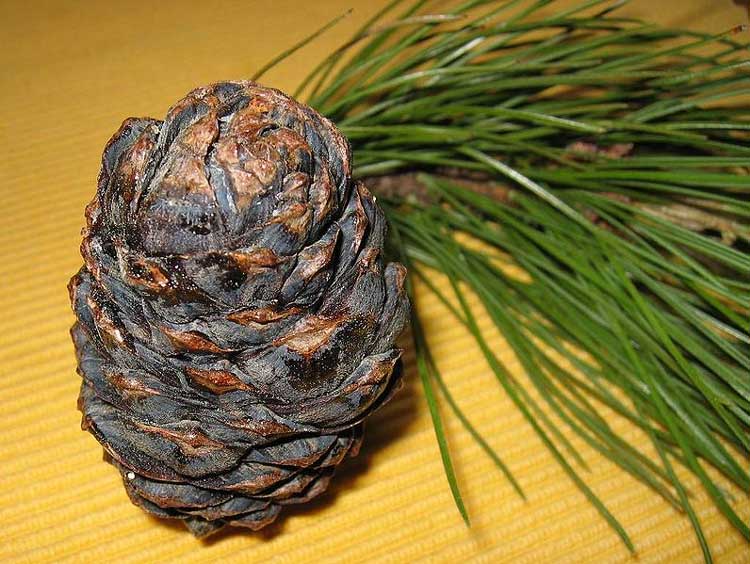
Pinus cembra, Photo: Michael Lahanas
Superregnum: Eukaryota
Regnum: Plantae
Divisio: Tracheophyta
Divisio: Pinophyta
Classis: Pinopsida
Ordo: Pinales
Familia: Pinaceae
Genus: Pinus
Subgenus: P. subg. Strobus
Sectio: P. sect. Quinquefoliae
Subsectio: P. subsect. Strobus
Species: Pinus cembra
Name
Pinus cembra L., Sp. Pl.: 1000 (1753).
Synonyms
Homotypic
Pinus montana Salisb., Prodr. Stirp. Chap. Allerton: 398 (1796), nom. superfl.
Pinus cembra var. helvetica Lodd. ex Loudon, Arbor. Frutic. Brit. 4: 2276 (1838), nom. inval.
Pinus cembra subsp. communis Endl., Syn. Conif.: 142 (1847), nom. inval.
Pinea cembra (L.) Opiz, Oekon. Neuigk. Verh. 1839: 526 (1839).
Apinus cembra (L.) Neck. ex Rydb., Bull. Torrey Bot. Club 32: 597 (1905).
Strobus cembra (L.) Moldenke, Revista Sudamer. Bot. 6: 30 (1939).
Heterotypic
Pinus montana Lam., Fl. Franç., éd. 2, 3: 651 (1795), nom. illeg.
Cembra montana Opiz, Seznam: 27 (1852).
Pinus cembra var. pendula J.Nelson, Pinaceae: 107 (1866).
Pinus humistrata Carrière, Traité Gén. Conif., ed. 2: 388 (1867), nom. inval.
Pinus cembra columnaris Hellm. ex Beissn., Mitt. Deutsch. Dendrol. Ges. 6: 57 (1897).
Pinus cembra f. columnaris (Hellm. ex Beissn.) Rehder, Bibliogr. Cult. Trees: 33 (1949).
Distribution
Native distribution areas:
Continental: Europe
Regional: Northern Europe
Norway (introduced).
Regional: Middle Europe
Austria, Czechoslovakia, Germany, Poland, Switzerland.
Regional: Southwestern Europe
France.
Regional: Southeastern Europe
Italy, Romania, Yugoslavia.
Regional: Eastern Europe
Ukraine.
References: Brummitt, R.K. 2001. TDWG – World Geographical Scheme for Recording Plant Distributions, 2nd Edition
References
Primary references
Linnaeus, C. 1753. Species Plantarum. Tomus II: 1000. Reference page.
Additional references
Richardson, D.M. (ed.). (1998). Ecology and Biogeography of Pinus. Cambridge University Press.
Links
Govaerts, R. et al. 2023. Pinus cembra in Kew Science Plants of the World Online. The Board of Trustees of the Royal Botanic Gardens, Kew. Published online. Accessed: 2023 Feb 21. Reference page.
Tropicos.org 2023. Pinus cembra. Missouri Botanical Garden. Published online. Accessed: 21 Feb 2023.
International Plant Names Index. 2023. Pinus cembra. Published online. Accessed: 21 Feb 2023.
Hassler, M. 2023. World Plants. Synonymic Checklist and Distribution of the World Flora. . Pinus cembra. Accessed: 21 Feb 2023.
Euro+Med 2006 onwards: Pinus cembra in Euro+Med PlantBase – the information resource for Euro-Mediterranean plant diversity. Published online. Accessed: 2023 Feb 21.
Vernacular names
Boarisch: Zirwékiafer
Deutsch: Zirbelkiefer
English: Swiss Pine
Esperanto: Cembro
eesti: Euroopa seedermänd
suomi: Sembramänty
français: Pin cembro
magyar: Cirbolyafenyő
italiano: Cembro, cirmolo
polski: Limba
română: Zâmbru
русский: Европейская кедровая сосна
slovenščina: Cemprin
Türkçe: İsviçre fıstık çamı

Pinus cembra (Information about this image)
Pinus cembra, also known as Swiss pine, Swiss stone pine, Arolla pine, Austrian stone pine, or just stone pine, is a species of pine tree in the subgenus Strobus.
Description
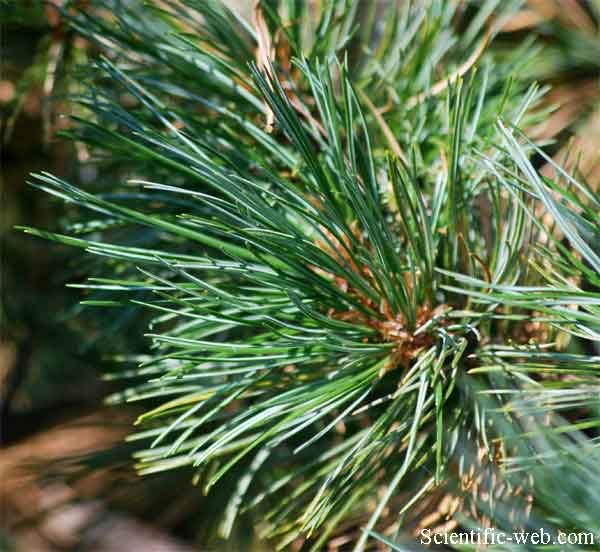
The Swiss pine is a member of the white pine group, Pinus subgenus Strobus, and like all members of that group, the leaves ('needles') are in fascicles (bundles) of five, with a deciduous sheath. The mature size is typically between 25 metres (82 ft) and 35 metres (115 ft) in height, and the trunk diameter can be up to 1.5 metres (4.9 ft). However, it grows very slowly and it may take 30 years for the tree to reach 1.3 metres (4.3 ft).[citation needed] The cones, which contain the seeds (or nuts), of the Swiss pine are 4 centimetres (1.6 in) to 8 centimetres (3.1 in) long. Cones take 2 years (24 months) to mature. The 8 millimetres (0.31 in) to 12 millimetres (0.47 in) long seeds have only a vestigial wing and are dispersed by spotted nutcrackers. The species is long-lasting and can reach an age between 500 and 1000 years.[2]
In its natural environment, this tree usually reaches reproductive maturity at the age of 50 years (even 80 years, if the conditions are more extreme).
The very similar Siberian pine (Pinus sibirica) is treated as a variety or subspecies of Swiss pine by some botanists. The Siberian pine differs in having slightly larger cones, being more massive (taller, wider trunk), having a faster growth rate and needles with three resin canals instead of two as in the Swiss pine.
Bark of middle-aged Pinus cembra
Distribution and habitat
The Swiss pine grows in the Alps and Carpathian Mountains of central Europe, in Poland (Tatra Mountains), Switzerland, France, Italy, Austria, Germany, Slovenia, Slovakia (Tatra Mountains), Ukraine and Romania. It typically grows at 1,200 metres (3,900 ft) to 2,300 metres (7,500 ft) altitude. It often reaches the alpine tree line in this area.
Ecology
Swiss pine associates with numerous species of mycorrhizal fungi from a young age, usually from the genus Suillus.[3] This symbiosis improves the tree's growth and survival rate.
Uses
Swiss pine is a popular ornamental tree in parks and large gardens, giving steady though not fast growth on a wide range of sites where the climate is cold. It is very tolerant of severe winter cold, hardy down to at least −50 °C (−58 °F), and also of wind exposure. The seeds are also harvested and sold as pine nuts. When cultivated, it will likely start producing cones after the age of 12 years, much faster than in the wild. This depends on the climate, soil type, mycorrhizal fungi etc. To make the tree bear cones faster, the tree can be inoculated with ectomycorrhizal fungi, such as Suillus luteus, Suillus americanus, Suillus placidus etc. These are the most effective.
Seeds with and without their shell, with a one-euro coin for scale (23.25mm diameter)
Pine cones cut into slices are used to flavor schnapps, which is then sold as "Zirbenschnaps" or "Zirbeler" schnapps.
The wood is the most used for carvings in Val Gardena since the 17th century.
The cone of the Swiss pine was the field sign of the Roman legion stationed in Rhaetia in 15 BC, and hence it is used as the heraldic charge (known as Zirbelnuss in German) in the coat of arms of the city of Augsburg, the site of the Roman fort Augusta Vindelicorum.
It is also a species that is often used in bonsai.
Pinus cembra can be found in the uppermost forest belt where it helps to minimize the risk of avalanches and soil erosion. Due to this ability, the tree is valued as a stabilizing factor for afforestation projects at high elevations.[2]
Like other European and Asian white pines, Swiss pine is very resistant to white pine blister rust (Cronartium ribicola). This fungal disease was accidentally introduced from Europe into North America, where it has caused severe mortality in the American native white pines in many areas, notably, Western white pine and the closely related whitebark pine. Swiss pine is of great value for research into hybridization to develop rust resistance in these species.
References
Farjon, A. (2017). "Pinus cembra". IUCN Red List of Threatened Species. 2017: e.T42349A95684563. doi:10.2305/IUCN.UK.2017-2.RLTS.T42349A95684563.en. Retrieved 19 November 2021.
Ulber, M.; Gurgerli, F. & Bozic, G. (2004), Swiss stone pine - Pinus cembra: Technical guidelines for genetic conservation and use, European Forest Genetic Resources Programme, p. 6
Rainer, Georg; Kuhnert, Regina; Unterholzer, Mara; Dresch, Philipp; Gruber, Andreas; Peintner, Ursula (2015-04-30). "Host-Specialist Dominated Ectomycorrhizal Communities of Pinus cembra are not Affected by Temperature Manipulation". Journal of Fungi. 1 (1): 55–75. doi:10.3390/jof1010055. ISSN 2309-608X. PMC 5770009. PMID 29376899.
Retrieved from "http://en.wikipedia.org/"
All text is available under the terms of the GNU Free Documentation License