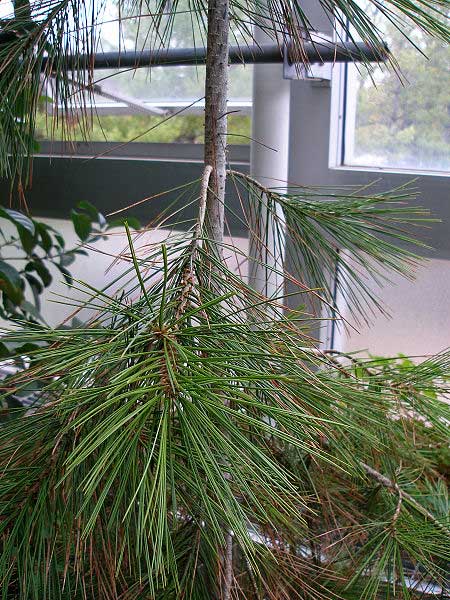
Pinus gerardiana (Information about this image)
Superregnum: Eukaryota
Regnum: Plantae
Divisio: Tracheophyta
Divisio: Pinophyta
Classis: Pinopsida
Ordo: Pinales
Familia: Pinaceae
Genus: Pinus
Subgenus: P. subg. Strobus
Sectio: P. sect. Gerardia
Subsectio: P. subsect. Gerardianae
Species: Pinus gerardiana
Name
Pinus gerardiana Wall. ex D.Don, in A.B.Lambert, Descr. Pinus, ed. 3, 2: 144 bis (1832).
Synonyms
Heterotypic
Pinus aucklandii Lodd. ex Gordon & Glend., Pinetum: 195 (1858), not validly publ.
Pinus chilghoza Knight, Syn. Conif. Pl.: 30 (1850), not validly publ.
Pinus gerardii J.Forbes, Hort. Woburn.: 210 (1833), orth. var.
Pinus neosa Gouan ex W.H.Baxter in J.C.Loudon, Hort. Brit., ed. 3: 658 (1839), not validly publ.
Distribution
Native distribution areas:
Asia-Temperate
Western Asia
Afghanistan.
China
Tibet.
Asia-Tropical
Indian Subcontinent
Pakistan, West Himalaya.
References: Brummitt, R.K. 2001. TDWG – World Geographical Scheme for Recording Plant Distributions, 2nd Edition
References
Additional references
Fu, L.-K., Li, N. & Elias, T.S. 1999. Pinus. Pp. 12-25 in Wu, Zh.Y. & Raven, P.H. (eds.), Flora of China. Volume 4: Cycadaceae through Fagaceae. Science Press, Beijing & Missouri Botanical Garden Press, St. Louis, ISBN 0-915279-70-3. efloras PDF Reference page.
Farjon, A. 2001. World Checklist and Bibliography of Conifers. 2. ed., 309 pp. The Royal Botanic Gardens, Kew. ISBN 1-84246-025-0 Reference page.
Businský, R. 2008. The genus Pinus L., pines: contribution to knowledge. A monograph with cone drawings of all species of the world by Ludmila Businská. Acta Pruhoniciana 88: 1–126. PDF (Text) Photos 1–32 Photos 33–42 Figures 1–73Reference page.
Farjon, A. 2010. A Handbook of the World's Conifers. 2 vols., pp. 1–526 + 527–1111, Koninklijke Brill, Leiden, Boston. ISBN 978-90-04-17718-5. Reference page.
Links
Farjon, A. 2013. Pinus gerardiana. The IUCN Red List of Threatened Species 2013. IUCN Red List Category: Near Threatened . DOI: 10.2305/IUCN.UK.2013-1.RLTS.T34189A2850009.en.
Govaerts, R. et al. 2023. Pinus gerardiana in Kew Science Plants of the World Online. The Board of Trustees of the Royal Botanic Gardens, Kew. Published online. Accessed: 2023 March 4. Reference page.
International Plant Names Index. 2023. Pinus gerardiana. Published online. Accessed: March 4 2023.
Hassler, M. 2023. World Plants. Synonymic Checklist and Distribution of the World Flora. . Pinus gerardiana. Accessed: 4 March 2023.
Hassler, M. 2023. Pinus gerardiana. World Plants: Synonymic Checklists of the Vascular Plants of the World In: Roskovh, Y., Abucay, L., Orrell, T., Nicolson, D., Bailly, N., Kirk, P., Bourgoin, T., DeWalt, R.E., Decock, W., De Wever, A., Nieukerken, E. van, Zarucchi, J. & Penev, L., eds. 2023. Species 2000 & ITIS Catalogue of Life. Published online. Accessed: 2023 March 4. Reference page.
Vernacular names
English: Chilgoza Pine
فارسی: کاج چلغوزه
polski: Sosna Gerarda
پنجابی: چلغوزہ
پښتو: جلغوزه
اردو: چلغوزہ
Tiếng Việt: Thông Chilgoza
中文: 西藏白皮松

Pinus gerardiana, commonly known as the chilghoza pine or neja, is a pine species native to parts of central and southern Asia, including the western Himalayas. The International Union for Conservation of Nature (IUCN) listed it as near threatened in 2011. The pine nuts are locally collected for consumption.
Description
The trees are 15–25 metres (49–82 ft) tall with usually deep, wide and open crowns with long, erect branches. However, crowns are narrower and shallower in dense forests. The bark is very flaky, peeling to reveal light greyish-green patches. The branchlets are smooth and olive-green. The leaves are needle-like, in groups of three, 6–10 centimetres (2+1⁄2–4 in) long, and spread stiffly. They are glossy green on the outer surface, with blue-green stomatal lines on the inner face; their sheaths fall in the first year. The cones are 10–18 cm (4–7 in) long and 9–11 cm (3+1⁄2–4+1⁄2 in) wide when open, with wrinkled, reflexed apophyses and an umbo curved inward at the base. The seeds (pine nuts) are 17–23 millimetres (5⁄8–7⁄8 in) long and 5–7 mm (3⁄16–1⁄4 in) broad, with a thin shell and a rudimentary wing.[3]
Cones and leaves
Cones and leaves
Similar species
P. gerardiana is similar to the closely related lacebark pine (Pinus bungeana), another pine with flaking bark. However, P. gerardiana has denser, longer, and more slender needles, as well as larger cones than P. bungeana.[4]
Taxonomy
The scientific name commemorates Captain Patrick Gerard, a British army officer of the Bengal Native Infantry.[4] who collected it during a 1823–25 military survey in India.[3]
It was first published in A.B.Lambert, Descr. Pinus, ed. 3, 2: 144 bis in 1832.[2]
Distribution and habitat
P. gerardiana is native to Afghanistan, Pakistan, Jammu and Kashmir, and Tibet.[2] It grows at elevations of 1,800–3,350 m (5,910–10,990 ft).[1] It inhabits valley floors in the Himalayas, tending to grow among open vegetation on dry, sunny slopes.[1]
Ecology
It often occurs in association with Cedrus deodara,[3] and Pinus wallichiana.
Since their seeds do not have a wing capable of enabling effective dispersal by wind, the seeds of P. gerardiana are dispersed by birds.[1] The Eurasian nutcracker (Nucifraga caryocatactes subsp. multipunctata) is one such species that does so.[3]
P. gerardiana is also a secondary host for Himalayan dwarf mistletoe.[5]
Conservation
In 2011, this species was listed as near threatened on the IUCN Red List of Threatened Species. It was previously listed as Lower Risk/near threatened in 1998. P. gerardina forests have declined by an estimated 30% due to conversion of pine forests to farmland, intensive grazing, and overharvesting of the seed cones and timber for firewood.[1] The Himachal Pradesh State Forest Department has tried artificial regeneration of chilgoza pine at many places. However, performance of seedlings was found to be very poor.[citation needed]
Uses
Older trees that do not produce enough cones to harvest pine nuts from are felled for firewood. The wood is also used for local light construction and carpentry.[1]
Food
Further information: Pine nut
Chilghoza seeds, or pine nuts, are harvested for consumption in autumn and early winter by knocking the cones off of the trees. The trees and seed harvesting rights are owned by local mountain clans and villages in some areas, from which they may be exported to markets in the northern Indian plains. In traditional harvesting practices, enough seeds are left behind for the forest to regenerate, but in areas controlled by private contractors, all cones are harvested.[1]
Chilgoza pine nuts are rich in carbohydrates and proteins. The seeds are locally referred to and marketed as "chilgoza", "neja" (singular) or "neje" (plural). Chilghoza is one of the most important cash crops of Afghanistan,[6][7][8] as well as of Kinnaur and Pangi Valley of Chamba district of Himachal Pradesh, India.[9] They are sold at approximately $20–$53 per kilograms in India.[citation needed]
References
Farjon, A. (2013). "Pinus gerardiana". IUCN Red List of Threatened Species. 2013: e.T34189A2850009. doi:10.2305/IUCN.UK.2013-1.RLTS.T34189A2850009.en. Retrieved 15 February 2023.
"Pinus gerardiana Wall. ex D.Don | Kew Science". Plants of the World Online. Retrieved 30 October 2023.
Earle, Christopher J., ed. (2018). "Pinus gerardiana". The Gymnosperm Database.
Dallimore, William; Jackson, Albert Bruce (1923). "Pinus". A handbook of Coniferae, including Ginkgoaceæ (1 ed.). New York: Longmans, Green & Co. pp. 357–470 [396–397]. doi:10.5962/bhl.title.15657.
Hawksworth, Frank G.; Wiens, Delbert (April 1998). Dwarf Mistletoes. DIANE Publishing. pp. 264–265. ISBN 978-0-7881-4201-7. Retrieved 16 April 2022.
ZS (6 November 2022). "Pine Nuts Export Hike Increase in World Market". Bakhtar News Agency. Kabul, Afghanistan. Retrieved 3 January 2023.
"Afghanistan Exports At Least 5,000 Tons of Pine Nuts". TOLOnews. 4 January 2023. Retrieved 4 January 2023.
"China largest importer of Afghan pine nuts: MoCI". Pajhwok Afghan News. Kabul, Afghanistan. 3 January 2023. Retrieved 3 January 2023.
"Challenge to save Chilgoza & wild mushrooms in HP". United News of India. 22 June 2018. Retrieved 14 February 2023.
Retrieved from "http://en.wikipedia.org/"
All text is available under the terms of the GNU Free Documentation License