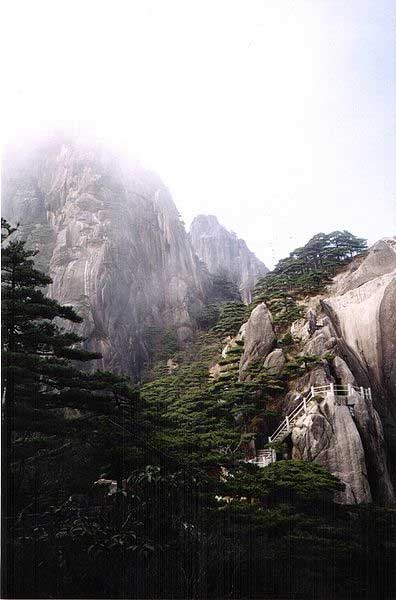
Pinus hwangshanensis (Information about this image)
Superregnum: Eukaryota
Regnum: Plantae
Divisio: Tracheophyta
Divisio: Pinophyta
Classis: Pinopsida
Ordo: Pinales
Familia: Pinaceae
Genus: Pinus
Subgenus: P. subg. Pinus
Sectio: P. sect. Pinus
Subsectio: P. subsect. Pinus
Species: Pinus hwangshanensis
Name
Pinus hwangshanensis W.Y.Hsia, Contr. Inst. Bot. Natl. Acad. Peiping 4: 155 (1936).
Synonyms
Homotypic
Pinus luchuensis var. hwangshanensis (W.Y.Hsia) C.L.Wu, Acta Phytotax. Sin. 5(3): 158 (1956).
Pinus luchuensis subsp. hwangshanensis (W.Y.Hsia) D.Z.Li, Edinburgh J. Bot. 54: 341 (1997).
Heterotypic
Pinus luchuensis var. shenkanensis Silba, J. Int. Conifer Preserv. Soc. 6: 26 (1999).
Pinus luchuensis subsp. shenkanensis (Silba) Silba, J. Int. Conifer Preserv. Soc. 16: 25 (2009).
Pinus hwangshanensis subsp. transfluminea Businský, Bot. Jahrb. Syst. 125: 7 (2003).
Misapplied names
Pinus tabuliformis auct. non Carrière
Pinus taiwanensis auct. non Hayata
Distribution
Native distribution areas:
Continental: Asia-Temperate
Regional: China
China South-Central (Guizhou, Hubei, Yunnan), China Southeast (Anhui, Fujian, Guangxi, Henan, Hunan, Jiangsu, Jiangxi, Zhejiang).
References: Brummitt, R.K. 2001. TDWG – World Geographical Scheme for Recording Plant Distributions, 2nd Edition
References
Primary references
Hsia, W.Y. 1936. Contributions from the Institute of Botany, National Academy of Peiping 4: 155.
Additional references
Fu, L.-K., Li, N. & Elias, T.S. 1999. Pinus. Pp. 12–25 in Wu, Zh.Y. & Raven, P.H. (eds.), Flora of China. Volume 4: Cycadaceae through Fagaceae. Science Press, Beijing & Missouri Botanical Garden Press, St. Louis, ISBN 0-915279-70-3. efloras PDF Reference page. (as Pinus taiwanensis)
Businský, R. 2008. The genus Pinus L., pines: contribution to knowledge. A monograph with cone drawings of all species of the world by Ludmila Businská. Acta Pruhoniciana 88: 1–126. PDF (Text) Photos 1–32 Photos 33–42 Figures 1–73Reference page.
Farjon, A. 2010. A Handbook of the World's Conifers. 2 vols., pp. 1–526 + 527–1111, Koninklijke Brill, Leiden, Boston. ISBN 978-90-04-17718-5. Reference page.
Links
Earle, C.J. 2023. Pinus hwangshanensis in The Gymnosperm Database. Accessed: 2023 March 25.
Farjon, A. 2013. Pinus hwangshanensis. The IUCN Red List of Threatened Species 2013. IUCN Red List Category: Least Concern . DOI: 10.2305/IUCN.UK.2013-1.RLTS.T42370A2975804.en.
Govaerts, R. et al. 2023. Pinus hwangshanensis in Kew Science Plants of the World Online. The Board of Trustees of the Royal Botanic Gardens, Kew. Published online. Accessed: 2023 March 17. Reference page.
International Plant Names Index. 2023. Pinus hwangshanensis. Published online. Accessed: March 17 2023.
Hassler, M. 2023. World Plants. Synonymic Checklist and Distribution of the World Flora. . Pinus hwangshanensis. Accessed: 17 March 2023.
Hassler, M. 2023. Pinus hwangshanensis. World Plants: Synonymic Checklists of the Vascular Plants of the World In: Roskovh, Y., Abucay, L., Orrell, T., Nicolson, D., Bailly, N., Kirk, P., Bourgoin, T., DeWalt, R.E., Decock, W., De Wever, A., Nieukerken, E. van, Zarucchi, J. & Penev, L., eds. 2023. Species 2000 & ITIS Catalogue of Life. Published online. Accessed: 2023 March 17. Reference page.
Vernacular names
English: Huangshan Pine
español: Pino Huangshan
hrvatski: Huangšanski bor
перем коми: Хуаншанись пожум
удмурт: Хуаншаньысь пужым
українська: Сосна хуаньшаньська
Tiếng Việt: Thông Hoàng Sơn
中文: 黄山松
Pinus hwangshanensis,[1] or Huangshan pine, is a species of pine endemic to the mountains of eastern China; it is named after the Huangshan Mountains in Anhui, from where it was first described.
Description
Pinus hwangshanensis is an evergreen tree reaching 15–25 metres (49–82 feet) in height, with a very broad, flat-topped crown of long, level branches. The bark is thick, grayish, and scaly plated. The leaves are needle-like, dark green, 2 per fascicle, 5–8 centimetres (2–3+1⁄4 inches) long and 0.8–1 millimetre (1⁄32–3⁄64 in) wide, the persistent fascicle sheath 1 cm (1⁄2 in) long. The cones are broad squat ovoid, 4–6.5 cm (1+1⁄2–2+1⁄2 in) long, yellow-brown, opening when mature in late winter to 5–7 cm broad. The seeds are winged, 5–6 mm (3⁄16–1⁄4 in) long with a 1.5–2.5 cm wing. Pollination occurs in mid-spring, with the cones maturing 18–20 months after.[
It is closely related to Japanese black pine (P. thunbergii), differing from it in the slenderer leaves, brown (not white) buds and broader cones.[citation needed]
Distribution and habitat
Huangshan pines are endemic to the mountains of eastern China, in the provinces of Anhui, Fujian, Guizhou, Hubei, Hunan, Jiangxi, and Zhejiang.[citation needed]
They typically grow at moderate to high altitudes on steep, rocky crags, and are a major vegetation component in the landscapes of eastern China. Many specimens are venerated for their unique rugged shapes and are frequently portrayed in traditional Chinese paintings.
References
Farjon, A. (2013). "Pinus hwangshanensis". IUCN Red List of Threatened Species. 2013: e.T42370A2975804. doi:10.2305/IUCN.UK.2013-1.RLTS.T42370A2975804.en.
"The Plant List: A Working List of All Plant Species".
Retrieved from "http://en.wikipedia.org/"
All text is available under the terms of the GNU Free Documentation License