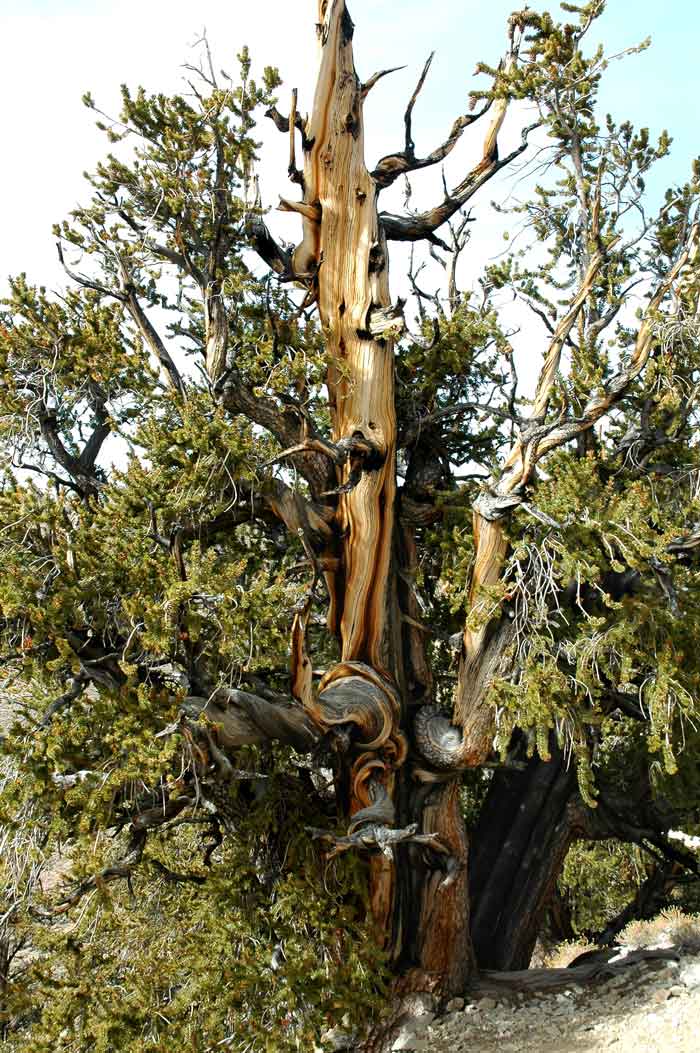
Pinus longaeva (Information about this image)
Superregnum: Eukaryota
Regnum: Plantae
Divisio: Tracheophyta
Divisio: Pinophyta
Classis: Pinopsida
Ordo: Pinales
Familia: Pinaceae
Genus: Pinus
Subgenus: P. subg. Strobus
Sectio: P. sect. Parrya
Subsectio: P. subsect. Balfourianae
Species: Pinus longaeva
Name
Pinus longaeva D.K.Bailey, Ann. Missouri Bot. Gard. 57: 243 (1971).
Synonyms
Homotypic
Pinus aristata var. longaeva (D.K.Bailey) Little, Phytologia 42: 221 (1979).
Pinus aristata subsp. longaeva (D.K.Bailey) A.E.Murray, Kalmia 13: 21 (1983).
Pinus balfouriana subsp. longaeva (D.K.Bailey) A.E.Murray, Kalmia 12: 23 (1982).
Distribution
Native distribution areas:
Northern America
Southwestern U.S.A.
California, Nevada, Utah.
References: Brummitt, R.K. 2001. TDWG – World Geographical Scheme for Recording Plant Distributions, 2nd Edition
References
Primary references
Bailey, D.K. 1970. Annals of the Missouri Botanical Garden 57: 243.
Additional references
Kral, R. 1993. Pinus. Pp. 373-398 in Flora of North America Editorial Committee (ed.), Flora of North America North of Mexico. Volume 2: Pteridophytes and Gymnosperms. Oxford University Press, New York, Oxford, XVI, 475 pp. ISBN 0-19-508242-7. efloras FNA Website Internet Archive, Lending Library Hybrid open access journal Reference page.
Farjon, A. 2001. World Checklist and Bibliography of Conifers. 2. ed., 309 pp. The Royal Botanic Gardens, Kew. ISBN 1-84246-025-0 Reference page.
Farjon, A. 2010. A Handbook of the World's Conifers. 2 vols., pp. 1–526 + 527–1111, Koninklijke Brill, Leiden, Boston. ISBN 978-90-04-17718-5. Reference page.
Links
Stritch, L., Mahalovich, M. & Nelson, K.G. 2011. Pinus longaeva. The IUCN Red List of Threatened Species 2011. IUCN Red List Category: Least Concern . DOI: 10.2305/IUCN.UK.2011-2.RLTS.T34024A9830878.en.
Govaerts, R. et al. 2023. Pinus longaeva in Kew Science Plants of the World Online. The Board of Trustees of the Royal Botanic Gardens, Kew. Published online. Accessed: 2023 March 9. Reference page.
International Plant Names Index. 2023. Pinus longaeva. Published online. Accessed: March 9 2023.
Hassler, M. 2023. World Plants. Synonymic Checklist and Distribution of the World Flora. . Pinus longaeva. Accessed: 9 March 2023.
Hassler, M. 2023. Pinus longaeva. World Plants: Synonymic Checklists of the Vascular Plants of the World In: Roskovh, Y., Abucay, L., Orrell, T., Nicolson, D., Bailly, N., Kirk, P., Bourgoin, T., DeWalt, R.E., Decock, W., De Wever, A., Nieukerken, E. van, Zarucchi, J. & Penev, L., eds. 2023. Species 2000 & ITIS Catalogue of Life. Published online. Accessed: 2023 March 9. Reference page.
Vernacular names
العربية: صنوبر معمر
čeština: Borovice dlouhověká
Deutsch: Langlebige Kiefer
English: Great Basin Bristlecone Pine
Esperanto: Longviva pino
español: Pino longevo
eesti: Igimänd
فارسی: کاج زبرمیوه غربی
suomi: Okakäpymänty
français: Pin Bristlecone
magyar: Simatűjű szálkásfenyő
italiano: Pino dai coni setolosi dell'ovest
lietuvių: Gajoji pušis
polski: Sosna długowieczna
русский: Сосна остистая межгорная
удмурт: Гурезькуспо кыэсь пужым
українська: Сосна довговічна
中文: 刺果松
Pinus longaeva (commonly referred to as the Great Basin bristlecone pine, intermountain bristlecone pine, or western bristlecone pine)[4] is a long-living species of bristlecone pine tree found in the higher mountains of California, Nevada, and Utah.[5] Methuselah is a Great Basin bristlecone pine that is 4,856 years old and has been credited as the oldest known living non-clonal organism on Earth.[6] To protect it, the exact location of this tree is kept secret. In 1987, the bristlecone pine was designated one of Nevada's state trees.[7]
Description
It is a medium-size tree, reaching 5 to 15 m (16 to 49 ft) tall and with a trunk diameter of up to 2.5 to 3.6 m (8 to 12 ft). The bark is bright orange-yellow, thin and scaly at the base of the trunk. The needles are in fascicles of five, stout, 2.5 to 4 cm (1 to 1+1⁄2 in) long, deep green to blue-green on the outer face, with stomata confined to a bright white band on the inner surfaces. The leaves show the longest persistence of any plant, with some remaining green for 45 years (Ewers & Schmid 1981).
The cones are ovoid-cylindrical, 5 to 10 cm (2 to 4 in) long and 3 to 4 cm (1 to 1+1⁄2 in) broad when closed, green or purple at first, ripening orange-buff when 16 months old, with numerous thin, fragile scales, each scale with a bristle-like spine 2 to 5 mm (1⁄16 to 3⁄16 in) long. The cones open to 4 to 6 cm (1+1⁄2 to 2+1⁄2 in) broad when mature, releasing the seeds immediately after opening. The seeds are 5 mm (3⁄16 in) long, with a 12 to 22 mm (1⁄2 to 7⁄8 in) wing; they are mostly dispersed by the wind, but some are also dispersed by Clark's nutcrackers.[citation needed]
These ancient trees have a gnarled and stunted appearance, especially those found at high altitudes,[4] and have reddish-brown bark with deep fissures.[8] As the tree ages, much of its vascular cambium layer may die. In very old specimens, often only a narrow strip of living tissue connects the roots to a handful of live branches.[citation needed]
The Great Basin bristlecone pine differs from the Rocky Mountain bristlecone pine in that the needles of the former always have two uninterrupted resin canals, so it lacks the characteristic small white resin flecks appearing on the needles of the latter. The Great Basin bristlecone pine differs from the foxtail pine because the cone bristles of the former are over 2 mm (0.079 in) long, and the cones have a more rounded (not conic) base. The green pine needles give the twisted branches a bottle-brush appearance. The name 'bristlecone pine' refers to the dark purple female cones that bear incurved prickles on their surface.[9]
Distribution and ecology
Pinus longaeva distribution map[10] (click map to enlarge)
The species occurs in Utah, Nevada and eastern California. In California, it is restricted to the White Mountains, the Inyo Mountains, and the Panamint Range, in Mono and Inyo counties. In Nevada, it is found in most of the higher ranges of the Basin and Range from the Spring Mountains near Las Vegas north to the Ruby Mountains, and in Utah, northeast to South Tent in the Wasatch Range. Due to the inaccessibility of many of the sites that this species occupies, information on their location and abundance is incomplete, and thus is needed. Environmental niche modelling has been used to better map the distribution of Great Basin bristlecone pine using topographic and spectral variables calculated from a geographic information system (GIS).[10]
The tree grows in large open stands, unlike the related foxtail pine, which sometimes form dense forests. Pinus longaeva trees generally do not form closed canopies, usually covering only 15-50%.[1] Pinus longaeva shares habitats with a number of other pine species, including the ponderosa pine, the white fir and, notably, the limber pine, a similarly long-lived high-elevation species.[4] The tree is a "vigorous" primary succession species, growing quickly on new open ground.[4] It is a "poor competitor" in good soils, however, and the species does best in harsh terrain. Pinus longaeva is often the dominant species in high-elevation dolomite soils, where few plants can grow.[4]
Bristlecones on dolomite hillside, Ancient Bristlecone Pine Forest
Bristlecone pines are protected in a number of areas owned by the United States federal government, such as the Ancient Bristlecone Pine Forest in the White Mountains of California and the Great Basin National Park in Nevada.[9][11] These areas prohibit the cutting or gathering of wood.[11]
Clark's nutcrackers may play a role in seed distribution for P. longaeva, though direct observations of the birds foraging on these seeds have not been reported.[12][13] The nutcrackers use conifer seeds as a food resource, storing many for later use in the ground, and some of these stored seeds are not used and are able to grow into new plants; these trees often exhibit a "multi-trunk" growth form from several seeds germinating at the same time. The prevalence of multi-trunk P. longaeva individuals in areas in which Clark's Nutcrackers are present has been used as evidence that the birds disperse P. longaeva seeds.[13]
An introduced fungal disease known as white pine blister rust (Cronartium ribicola) is believed to affect some individuals. The species was placed on the IUCN Red List and listed as "Vulnerable", or threatened, in 1998.[1] In 2011, however, a population survey found the population of Pinus longaeva to be stable, with no known subpopulations decreasing in size. White pine blister rust was found to have a negligible effect on the population. As a result, the species was moved to "Least Concern".[1]
Fire ecology
Bristlecone pine, White Mountains, California
The tree is extremely susceptible to fire, and is damaged by even low-intensity burns. The resinous bark is capable of igniting quickly, and a crown fire will almost certainly kill the tree. However, populations of Pinus longaeva are known to be extremely resilient, and as a primary succession species, it is believed that populations of the tree would reestablish itself quickly after a fire. That said, large-scale fires are extremely uncommon where the species grows, and are not a major factor in the species' long-term viability.[4] Historically, Pinus longaeva stands experienced low to high severity fires, and fuels structures changed considerably across elevational gradients. In low elevation, mixed species stands, fuels are often heavy and in close proximity to anthropogenic ignition sources. Yet at high elevations near treeline, Pinus longaeva typically grow on limestone outcroppings that provide little or no surface fuels to propagate a wildfire. However, warmer temperatures will likely increase the duration of fire season, and thus the frequency of fire in Pinus longeava systems at low and mid elevations could increase where stands are typically denser and surface fuel is greatest. While rare, wild fires such as The Carpenter 1 fire in southern Nevada (July 2013) and the Phillips Fire in Great Basin National Park, (September 2000) that started in lower elevation fuel types and moved through the crowns of trees with the aid of extreme fire weather, could become more likely.[14]
Age
Needles and cones, Snake Range, Nevada
A specimen located in the White Mountains of California was measured by Tom Harlan, a researcher with the Laboratory of Tree-Ring Research, to be 5,062 years old as of 2010.[6] This would make it the oldest known non-clonal tree in the world. The identity of the specimen was kept secret by Harlan.[15] Harlan passed away in 2013, and neither the tree nor the core Harlan studied have been found, making the age or existence of this tree unable to be confirmed.[16]
The confirmed oldest tree of this species, "Methuselah", is also located in the Ancient Bristlecone Pine Forest of the White Mountains. Methuselah is 4,856 years old, as measured by annual ring count on a small core taken with an increment borer. Its exact location is kept secret.[citation needed][17]
Among the White Mountain specimens, the oldest trees are found on north-facing slopes, with an average of 2,000 years, as compared to the 1,000 year average on the southern slopes. The climate and the durability of their wood can preserve them long after death, with dead trees as old as 7,000 years persisting next to live ones.[18]
See also
List of superlative trees
References
This article incorporates text from the ARKive fact-file "Pinus longaeva" under the Creative Commons Attribution-ShareAlike 3.0 Unported License and the GFDL.
Stritch, L.; Mahalovich, M.; Nelson, K.G. (2011). "Pinus longaeva". IUCN Red List of Threatened Species. 2011: e.T34024A9830878. doi:10.2305/IUCN.UK.2011-2.RLTS.T34024A9830878.en. Retrieved 12 November 2021.
NatureServe (2024). "Pinus longaeva". Arlington, Virginia. Retrieved 20 October 2024.
"Pinus longaeva D.K.Bailey". Plants of the World Online. Royal Botanic Gardens, Kew. Retrieved 20 October 2024.
Howard, JL (2004). "Pinus longaeva". Fire Effects Information System. USDA. Archived from the original on 2008-12-18. Retrieved 2008-12-02.
Moore, Gerry; Kershner, Bruce; Craig Tufts; Daniel Mathews; Gil Nelson; Spellenberg, Richard; Thieret, John W.; Terry Purinton; Block, Andrew (2008). National Wildlife Federation Field Guide to Trees of North America. New York: Sterling. p. 82. ISBN 978-1-4027-3875-3.
"Oldlist". Rocky Mountain Tree Ring Research. Archived from the original on 2013-04-12. Retrieved 2013-01-08.
"Nevada Facts and State Emblems". State of Nevada. Archived from the original on 2014-03-27. Retrieved 2016-02-04.
"The Gymnosperm Database". March 2008. Archived from the original on 27 June 2011. Retrieved 30 July 2011.
"The Ancient Bristlecone Pine". August 2003. Archived from the original on 6 August 2011. Retrieved 30 July 2011.
Gray, Curtis (2017). Impact of Climate Variability on the Frequency and Severity of Ecological Disturbances in Great Basin Bristlecone Pine Sky Island Ecosystems (Thesis). Utah State University. Archived from the original on 2018-12-07. Retrieved 2018-11-01.
"Global Trees Campaign". March 2008. Archived from the original on 11 July 2011. Retrieved 30 July 2011.
Lanner, Ronald M.; Hutchins, Harry E.; Lanner, Harriette A. (1984). "Bristlecone Pine and Clark's Nutcracker: Probable Interaction in the White Mountains, California". The Great Basin Naturalist. 44 (2): 357–360. ISSN 0017-3614. JSTOR 41712083.
Lanner, Ronald M. (1988). "Dependence of Great Basin Bristlecone Pine on Clark's Nutcracker for Regeneration at High Elevations". Arctic and Alpine Research. 20 (3): 358–362. doi:10.2307/1551268. ISSN 0004-0851. JSTOR 1551268.
Gray, C (2017-05-15). "Climate warming alters fuels across elevational gradients in Great Basin bristlecone pine-dominated sky island forests". Forest Ecology and Management. 392: 125–136. Bibcode:2017ForEM.392..125G. doi:10.1016/j.foreco.2017.03.004. ISSN 0378-1127.
Oatman-Stanford, Hunter. "Read My Rings: The Oldest Living Tree Tells All". Collectors Weekly. Archived from the original on 2014-07-29. Retrieved 2014-07-27.
"RMTRR OLDLIST". www.rmtrr.org. Retrieved 2020-08-22.
Dr. Peter M. Brown (January 2013). "OldList, a database of ancient trees". Rocky Mountain Tree-Ring Research. Archived from the original on 2013-04-12. Retrieved 2013-01-22.
Lewington, A; Parker E (1999). Ancient Trees: Trees that Live for a Thousand Years. London: Collins & Brown Ltd. p. 37. ISBN 1-85585-704-9.
Ewers, F. W.; Schmid, R. (1981). "Longevity of needle fascicles of Pinus longaeva (bristlecone pine) and other North American pines". Oecologia. 51 (1): 107–15. Bibcode:1981Oecol..51..107E. doi:10.1007/BF00344660. PMID 28310317. S2CID 19465953.
Lewington, A.; Parker, E. (1999). Ancient Trees: Trees that Live for a Thousand Years. London: Collins & Brown Ltd. ISBN 1-85585-704-9.
Retrieved from "http://en.wikipedia.org/"
All text is available under the terms of the GNU Free Documentation License