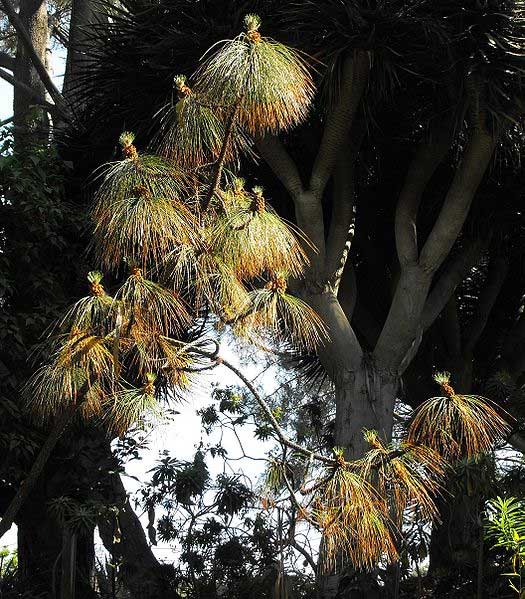
Pinus montezumae (*)
Superregnum: Eukaryota
Regnum: Plantae
Divisio: Tracheophyta
Divisio: Pinophyta
Classis: Pinopsida
Ordo: Pinales
Familia: Pinaceae
Genus: Pinus
Subgenus: P. subg. Pinus
Sectio: P. sect. Trifoliae
Subsectio: P. subsect. Ponderosae
Species: Pinus montezumae
Varietates: P. m. var. gordoniana – P. m. var. montezumae
Name
Pinus montezumae Lamb., Descr. Pinus, ed. 3, 1: 39 (1832).
Distribution
Native distribution areas:
Northern America
Mexico
Mexico Central, Mexico Gulf, Mexico Northeast, Mexico Southeast, Mexico Southwest.
Southern America
Central America
Guatemala.
References: Brummitt, R.K. 2001. TDWG – World Geographical Scheme for Recording Plant Distributions, 2nd Edition
References
Additional references
Businský, R. 2008. The genus Pinus L., pines: contribution to knowledge. A monograph with cone drawings of all species of the world by Ludmila Businská. Acta Pruhoniciana 88: 1–126. PDF (Text) Photos 1–32 Photos 33–42 Figures 1–73Reference page.
Farjon, A. 2010. A Handbook of the World's Conifers. 2 vols., pp. 1–526 + 527–1111, Koninklijke Brill, Leiden, Boston. ISBN 978-90-04-17718-5. Reference page.
García-Mendoza, A.J. & Meave, J.A. (eds.) 2012. Diversidad florística de Oaxaca: de musgos a angiospermas (colecciones y listas de especies). Ed. 2. 351 pp. Instituto de Biología, Universidad Nacional Autónoma de México. ISBN 978-607-02-2434-8. Reference page.
Links
Farjon, A. 2013. Pinus montezumae. The IUCN Red List of Threatened Species 2013. IUCN Red List Category: Least Concern . DOI: 10.2305/IUCN.UK.2013-1.RLTS.T42382A2976574.en.
Govaerts, R. et al. 2023. Pinus montezumae in Kew Science Plants of the World Online. The Board of Trustees of the Royal Botanic Gardens, Kew. Published online. Accessed: 2023 March 8. Reference page.
International Plant Names Index. 2023. Pinus montezumae. Published online. Accessed: March 8 2023.
Hassler, M. 2023. World Plants. Synonymic Checklist and Distribution of the World Flora. . Pinus montezumae. Accessed: 8 March 2023.
Hassler, M. 2023. Pinus montezumae. World Plants: Synonymic Checklists of the Vascular Plants of the World In: Roskovh, Y., Abucay, L., Orrell, T., Nicolson, D., Bailly, N., Kirk, P., Bourgoin, T., DeWalt, R.E., Decock, W., De Wever, A., Nieukerken, E. van, Zarucchi, J. & Penev, L., eds. 2023. Species 2000 & ITIS Catalogue of Life. Published online. Accessed: 2023 March 8. Reference page.
Vernacular names
čeština: Borovice Montezumova
Deutsch: Montezuma-Kiefer
English: Montezuma Pine
español: Ocote
magyar: Montezuma-fenyő
italiano: Pino di Montezuma
перем коми: Монтесума пожум
Nāhuatl: Ocotl
polski: Sosna Montezumy
русский: Сосна Монтесумы
удмурт: Монтесума пужым
Pinus montezumae, known as the Montezuma pine, is a species of conifer in the family Pinaceae.
It is native to Mexico and Central America, where it is known as ocote. The tree grows about 35 m high and 80 cm in diameter; occasionally it may reach a height of 40 m and diameter of 1 m. It has a round crown. The bark is dark brown-grayish. It is the only pine species (in the variety rudis) which has seven needles in each fascicle. [3]
It is found from the Mexican states of Nuevo León (25° N. Lat.) and Jalisco (22° n.l.) to the north and to Nicaragua (15° N. Lat.) to the south. It occurs on both mountain ranges of the Sierra Madre Oriental and Sierra Madre Occidental. It grows at altitudes from 2000–3200 m above sea level. It is found in areas receiving between 800–1000 mm rainfall per year. In most of the tree's habitat, rain falls mostly in summer, but in the state of Veracruz, precipitations are spread year round and the climate is very wet. However, specimens from the state of Jalisco grow in semi-arid places. It occurs in warm temperate to cool climates (18 °C to 10 °C). At the highest altitudes of its distribution, it usually receives snow in the winter.
Shoot
Tree
Ocote wood is yellowish-brown white, with the heartwood being light brown, hard, heavy and used for construction. It is appreciated for its resin. The resin is so flammable that a cut branch will burn as a torch emitting black smoke when ignited; for this reason, it is very common in Mexico to use ocote wood as a fire starter for campfires and barbecues. Growth is slow in the first three or six years, after this stage it is a fast-growing tree. The cities of Ocotlán in Jalisco Mexico and Ocotal in Nicaragua derive their names from this tree. It is planted in plantages in South Africa and Queensland, Australia at mid altitudes; in Kenya, Malawi, Botswana, Zimbabwe and Bolivia at high altitudes. Trees planted in New Zealand and New South Wales, Australia near sea level have done very well.
References
Farjon, A. (2013). "Pinus montezumae". IUCN Red List of Threatened Species. 2013: e.T42382A2976574. doi:10.2305/IUCN.UK.2013-1.RLTS.T42382A2976574.en. Retrieved 15 November 2021.
"Pinus montezumae". Germplasm Resources Information Network. Agricultural Research Service, United States Department of Agriculture. Retrieved 16 May 2008.
Chittendon, Fred J.; Synge, Patrick M. (1965). Royal Hort. Soc. Dictionary of Gardening - Volume 3. Oxford: Clarendon Books. p. 1584.
Further reading
Dvorak, W. S., G. R. Hodge, E. A. Gutiérrez, L. F. Osorio, F. S. Malan and T. K. Stanger. 2000. Conservation and Testing of Tropical and Subtropical Forest Species by the CAMCORE Cooperative. College of Natural Resources, NCSU. Raleigh, NC. USA.
Richardson D.M. (Ed) 2005. Ecology and biogeography of Pinus. Department of Conservation. South Island Wilding Conifer Strategy. New Zealand.
Chandler, N.G. "Pulpwood plantations in South Africa". Proc. Aust. Paper Indus. Tech. Ass.
Retrieved from "http://en.wikipedia.org/"
All text is available under the terms of the GNU Free Documentation License