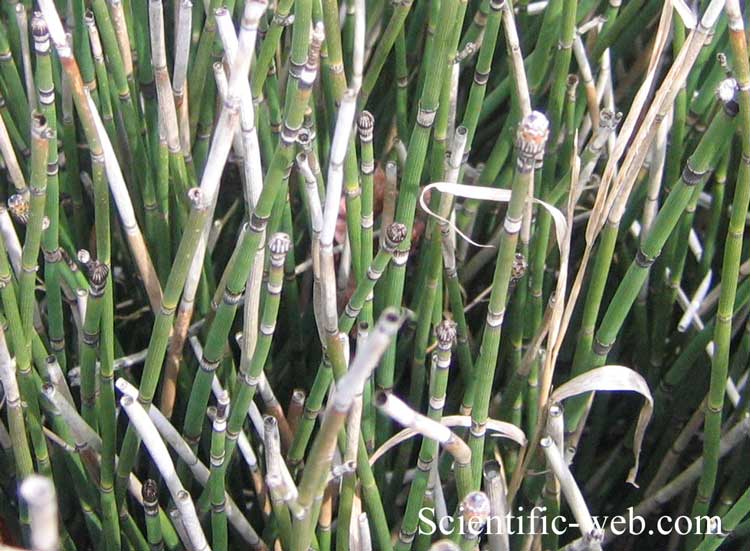
Equisetum hyemale, Photo: Michael Lahanas
Superregnum: Eukaryota
Regnum: Plantae
Divisio: Tracheophyta
Divisio: Pteridophyta
Classis: Equisetopsida
Ordo: Equisetales
Familia: Equisetaceae
Genus: Equisetum
Subgenus: E. subg. Hippochaete
Species: Equisetum hyemale
Name
Equisetum hyemale L., Sp. Pl.: 1062 (1753).
Synonyms
Homotypic
Equisetum hyemale var. vulgare Strempel, Fil. Berol. Syn. 14 (1822).
Presla hyemalis (L.) Dulac, Fl. Hautes-Pyrénées: 27 (1867).
Hippochaete hyemalis (L.) Milde ex Bruhin, Verh. K. K. Zool.-Bot. Ges. Wien 18: 760 (1868).
Heterotypic
Equisetum asperrimum Gilib.; Exerc. Phyt. 2: 554 (1792), opus utiq. oppr..
Equisetum hyemale var. uliginosum Borkh., Arch. Bot. 1(3): 6 (1798).
Equisetum hyemale var. paucifolium Gray, Nat. Arr. Brit. Pl. 2: 25 (1821 publ. 1822).
Equisetum hyemale var. ramosum Gray, Nat. Arr. Brit. Pl. 2: 25 (1821 publ. 1822).
Equisetum hyemale var. simplex Wallr., Fl. Crypt. Germ. 1: 6 (1831).
Equisetum hyemale var. subramosum A.Braun, Flora 22: 308 (1839), nom. nud.
Equisetum hyemale var. paleaceum Schleich. ex A.Braun & Engelm., Amer. J. Sci. Arts 46: 89 (1844).
Equisetum hyemale f. paleaceum (Schleich. ex A.Braun & Engelm.) Asch., Fl. Brandenburg 1: 903 (1864).
Equisetum hyemale subsp. paleaceum (Schleich. ex A.Braun & Engelm.) R.C.V.Douin in G.E.M.Bonnier, Fl. Ill. France 12: 115 (1934).
Equisetum zonatum Friv. ex Griseb., Spic. Fl. Rumel. 2(5/6): 479 (1846), nom. nud.
Equisetum hyemale f. paleaceum Rabenh., Deutschl. Krypt.-Fl. 2(3): 336 (1848), nom. illeg.
Equisetum hyemale var. fuscozonatum Schur, Sert. Fl. Transsilv.: 92 (1853).
Equisetum alpinum Schur, Oesterr. Bot. Wochenbl. 7: 417 (1857).
Equisetum hyemale f. attenuatum Milde, Nov. Actorum Acad. Caes. Leop.-Carol. Nat. Cur. 26: 464 (1858 publ. 1859).
Equisetum hyemale var. doellii Milde, Ann. Mus. Bot. Lugduno-Batavi 1: 69 (1863), nom. superfl.
Equisetum hyemale var. viride Milde, Verh. Bot. Vereins Prov. Brandenburg 5: 236 (1863).
Equisetum hyemale f. viride (Milde) Luerss., Farnpflanzen 3: 750 (1889).
Equisetum hyemale var. javanicum Milde, Ann. Mus. Bot. Lugduno-Batavi 1: 246 (1864).
Equisetum hyemale var. rabenhorstii Milde, Ann. Mus. Bot. Lugduno-Batavi 1: 69 (1864).
Equisetum hyemale var. fallax Milde, Ann. Mus. Bot. Lugduno-Batavi 1: 246 (1864).
Equisetum hyemale var. minus A.Braun ex Milde, Monogr. Equiset.: 517 (1867).
Equisetum hyemale f. minus (A.Braun ex Milde) Luerss., Farnpflanzen 3: 749 (1889).
Equisetum hyemale var. ramigerum A.Braun ex Milde, Monogr. Equiset.: 520 (1867).
Equisetum hyemale f. ramigerum (A.Braun ex Milde) Luerss., Farnpflanzen 3: 751 (1889).
Equisetum hyemale f. doellii Luerss., Farnpflanzen 3: 749 (1889), nom. superfl.
Equisetum hyemale var. capillare Rouy in G.Rouy & J.Foucaud, Fl. France 14: 503 (1913).
Equisetum hyemale var. brevivaginatum Rosend., Ark. Bot. 15(3): 36 (1918).
Distribution
Native distribution areas:
Continental: Europe
Regional: Northern Europe
Denmark, Finland, Great Britain, Iceland, Ireland, Norway, Sweden.
Regional: Middle Europe
Austria, Belgium, Czechoslovakia, Germany, Hungary, Netherlands, Poland, Switzerland.
Regional: Southwestern Europe
Corse, France, Spain.
Regional: Southeastern Europe
Albania, Bulgaria, Greece, Italy, Kriti, Romania, Sicilia, Turkey-in-Europe, Yugoslavia.
Regional: Eastern Europe
Belarus, Baltic States, Krym, Central European Russia, East European Russia, North European Russia, South European Russia, Northwest European Russia, Ukraine.
Continental: Asia-Temperate
Regional: Siberia
Altay, Buryatiya, Chita, Irkutsk, Krasnoyarsk, Tuva, West Siberia, Yakutskiya.
Regional: Russian Far East
Amur, Kamchatka, Khabarovsk, Kuril Islands, Primorye, Sakhalin.
Regional: Middle Asia
Kazakhstan, Kirgizstan, Tadzhikistan, Uzbekistan.
Regional: Caucasus
North Caucasus, Transcaucasus.
Regional: Western Asia
Turkey.
Regional: China
China South-Central, Inner Mongolia, Manchuria, China North-Central, Qinghai, China Southeast, Xinjiang.
Regional: Mongolia
Mongolia.
Regional: Eastern Asia
Japan, Korea.
Continental: Australasia
Regional: Australia
Tasmania.
Continental: Northern America
Regional: Subarctic America
Greenland.
References: Brummitt, R.K. 2001. TDWG – World Geographical Scheme for Recording Plant Distributions, 2nd Edition
Hybrids
Equisetum × ferrissii Clute
Equisetum × trachyodon A.Braun
References
Primary references
Linnaeus, C. 1753. Species Plantarum. Tomus II: 1062. Reference page.
Additional references
Christenhusz, M.J.M., Bangiolo, L., Chase, M.W., Fay, M.F., Husby, C.E., Witkus, M. & Viruel, J. 2019. Phylogenetics, classification and typification of extant horsetails (Equisetum, Equisetaceae). Botanical Journal of the Linnean Society 189(4): 311–352. DOI: 10.1093/botlinnean/boz002 Paywall. Reference page.
Links
Hassler, M. 2020. Equisetum hyemale – World Ferns: Checklist of Ferns and Lycophytes of the World . In: Roskov Y., Orrell T., Nicolson D., Bailly N., Kirk P.M., Bourgoin T., DeWalt R.E., Decock W., De Wever A., Nieukerken E. van, Zarucchi J. & Penev L. (eds.) 2020. Species 2000 & ITIS Catalogue of Life. Published on the internet. Accessed: 2020 Apr 16.
Govaerts, R. et al. 2020. Equisetum hyemale in Kew Science Plants of the World Online. The Board of Trustees of the Royal Botanic Gardens, Kew. Published online. Accessed: 2020 Apr 16. Reference page.
International Plant Names Index. 2020. Equisetum hyemale. Published online. Accessed: Apr 16 2020. Reference page.
Tropicos.org 2020. Equisetum hyemale. Missouri Botanical Garden. Published online. Accessed: 16 Apr 2020.
Equisetum hyemale at the Euro+Med PlantBase
USDA, ARS, Germplasm Resources Information Network. Equisetum hyemale in the Germplasm Resources Information Network (GRIN), U.S. Department of Agriculture Agricultural Research Service.
Vernacular names
čeština: Přeslička zimní
dansk: Skavgræs-Padderok
Deutsch: Winter-Schachtelhalm
English: Rough Horsetail
eesti: Raudosi
suomi: Kangaskorte
français: Prêle d'hiver
magyar: Téli zsurló
日本語: トクサ
한국어: 속새
Līvõ kēļ: Kõʼŗ
lietuvių: Šiurkštusis asiūklis
latviešu: Ziemzaļā kosa
Nederlands: Schaafstro
norsk: Skavgras
polski: Skrzyp zimowy
русский: Хвощ зимующий
svenska: Skavfräken
українська: Хвощ зимовий

Rhithrogena germanica on Equisetum hyemale
Equisetum hyemale (rough horsetail[2]) is an evergreen perennial herbaceous pteridophyte in the horsetail family Equisetaceae native to Eurasia and Greenland. It was formerly widely treated in a broader sense including a subspecies (subsp. affine) in North America, but this is now treated as a separate species, Equisetum praealtum.[3][4]
Distribution
Equisetum hyemale strobilus, at Darłówko on the Baltic Sea coast of Poland
Equisetum hyemale is native to central and northern Eurasia, including Iceland, Greenland, Kamchatka and Japan, where it forms clonal colonies in mesic (reliably moist) habitats, often in heavy clay or sandy soils in riparian zones of rivers and streams where it can withstand occasional flooding, but also in lime-rich upland flushes and seeps, and can indicate their presence when not flowing.[2][5] Other habitats include moist forest and woodland openings, lake and pond shores, ditches, marshes and swamps. It grows from between sea level to 2,000 metres (6,600 ft) in elevation.[1][6] It has been introduced into Tasmania.[3]
Description
Equisetum hyemale has vertical jointed reed-like stalks of medium to dark green. The hollow stems are up to 30–100 centimetres (12–39 in) in height, and are rarely branched. The stems are 3–6 mm thick with 10–30 conspicuous ridges, which are impregnated with silica and rough to the touch (from which the English name derives). The tiny leaves are joined around the stem, forming a narrow black-green band or sheath at each joint. Like other pteridophytes, the plant reproduces by spores and does not produce flowers or seeds.[5]
The stems remain green during winter in warmer climates, but are generally deciduous in cold climates.[7] It forms dense spreading colonies in full to partial sun.[5][6]
Taxonomy
Linnaeus was the first to describe rough horsetail with the binomial Equisetum hyemale in his Species Plantarum of 1753.[8]
Two Equisetum plants are sold commercially under the names Equisetum japonicum (barred horsetail) and Equisetum camtschatcense (Kamchatka horsetail). These are both types of E. hyemale, although they may also be listed as varieties of E. hyemale.[citation needed]
Uses
Dried plant, used as traditional polishing material like fine grits class sandpaper in Japan
Domestic
Boiled and dried Equisetum hyemale is used as traditional polishing material, similar to a fine grit sandpaper, in Japan.[citation needed]
Music
Dried stems used to shape clarinet reeds.
The stems are used to shape the reeds of reed instruments such as clarinets or saxophones.[citation needed]
Cultivation
Equisetum hyemale cultivated as an ornamental plant, for use in contained garden beds and planters, and in pots. It is a popular "icon plant" in contemporary Modernist and East Asian style garden design. Its tight verticality fits into narrow planting spaces between walkways and walls, and on small balconies.
It is also used as an accent plant in garden ponds and ornamental pools, and other landscape water features, planted in submerged pots.
The plant is sometimes sold in the nursery trade as "barred horsetail" or "Equisetum japonicum", but is different in appearance to Equisetum ramosissimum var. japonicum.[citation needed]
Invasive behaviour
In South Africa and Australia, the plant is an invasive species of moist natural habitats.[9]
References
Lansdown, R. V. (2014). "Equisetum hyemale". IUCN Red List of Threatened Species. 2014: e.T203003A42381564. doi:10.2305/IUCN.UK.2014-1.RLTS.T203003A42381564.en. Retrieved 18 September 2024.
P. A. Stroh; T. A. Humphrey; R. J. Burkmar; O. L. Pescott; D. B. Roy; K. J. Walker, eds. (2020). "Rough Horsetail Equisetum hyemale L." BSBI Online Plant Atlas 2020. Botanical Society of Britain and Ireland. Retrieved 16 September 2024.
"Equisetum hyemale L." Plants of the World Online. Royal Botanic Gardens, Kew. Retrieved 2024-09-18.
"Equisetum praealtum Raf". Plants of the World Online. Royal Botanic Gardens, Kew. Retrieved 2024-09-18.
Hyde, H. A., Wade, A. E., & Harrison, S. G. (1978). Welsh Ferns. National Museum of Wales ISBN 0-7200-0210-9.
Piirainen, Mikko; Piirainen, Pirkko; Vainio, Hannele (1999). Kotimaan luonnonkasvit [Native wild plants] (in Finnish). Porvoo, Finland: WSOY. p. 20. ISBN 951-0-23001-4.
Clapham, A.R., Tutin, T.G. and Warburg, E.F. 1968 Excursion Flora of the British Isles Cambridge University Press ISBN 0 521 04656 4
Linnaeus, C. (1753). Species Plantarum. Vol. II (1st ed.). Stockholm: Laurentii Salvii. p. 1062.
"Lifeisagarden.co.za: "Invasive alien plants—Equisetum hyemale."". Archived from the original on 2011-06-27. Retrieved 2011-06-06.
Retrieved from "http://en.wikipedia.org/"
All text is available under the terms of the GNU Free Documentation License