Classification System: APG IV
Superregnum: Eukaryota
Regnum: Plantae
Cladus: Angiosperms
Cladus: Eudicots
Cladus: Core eudicots
Cladus: Asterids
Cladus: Campanulids
Ordo: Asterales
Familia: Asteraceae
Subfamilia: Asteroideae
Tribus: Anthemideae
Subtribus: Artemisiinae
Genus: Artemisia
Subgenus: Artemisia subg. Artemisia
Species: Artemisia vulgaris
Subspecies: A. v. subsp. inundata – A. v. subsp. vulgaris
Varietates: A. v. var. xizangensis
Name
Artemisia vulgaris L., Sp. Pl. 2: 848 (1753).
Synonyms
Homotypic
Absinthium vulgare (L.) Dulac, Fl. Hautes-Pyrénées: 502 (1867).
Artemisia vulgaris subsp. typica H.M.Hall & Clem., Phylogen. Meth. 73, figs. 7, 10 (1923), nom. inval.
Artemisia vulgaris var. typica H.St.John, Res. Stud. State Coll. Wash. 1: 106 (1929), nom. inval.
Heterotypic
see Artemisia vulgaris subsp. vulgaris
Distribution
Native distribution areas:
Continental: Europe
Regional: Northern Europe
Denmark, Finland, Great Britain, Ireland (introduced), Norway, Sweden.
Regional: Middle Europe
Austria, Belgium, Czechoslovakia, Germany, Hungary, Netherlands, Poland, Switzerland.
Regional: Southwestern Europe
Corse, France, Portugal, Sardegna, Spain.
Regional: Southeastern Europe
Albania, Bulgaria, Greece, Italy, Romania, Turkey-in-Europe, Yugoslavia.
Regional: Eastern Europe
Belarus, Baltic States, Krym, Central European Russia, East European Russia, North European Russia, South European Russia, Northwest European Russia, Ukraine.
Continental: Africa
Regional: Northern Africa
Algeria, Libya (introduced), Tunisia.
Regional: Southern Africa
Cape Provinces (introduced).
Continental: Asia-Temperate
Regional: Siberia
Altay, Buryatiya, Chita, Irkutsk, Krasnoyarsk, Tuva, West Siberia, Yakutskiya.
Regional: Russian Far East
Amur, Kamchatka, Khabarovsk, Kuril Islands, Primorye, Sakhalin.
Regional: Middle Asia
Kazakhstan, Kirgizstan, Tadzhikistan, Uzbekistan.
Regional: Caucasus
North Caucasus, Transcaucasus.
Regional: Western Asia
Afghanistan, East Aegean Islands, Iran, Iraq, Turkey.
Regional: China
China South-Central, China North-Central, Qinghai, Tibet, Xinjiang.
Regional: Mongolia
Mongolia.
Regional: Eastern Asia
Japan.
Continental: Asia-Tropical
Regional: Indian Subcontinent
Assam, India, Maldives (introduced), Pakistan, West Himalaya.
Regional: Indo-China
Laos, Myanmar, Thailand, Vietnam (introduced).
Regional: Malesia
Jawa, Christmas Island (introduced).
Continental: Pacific (introduced)
Regional: Southwestern Pacific
Fiji.
Regional: Northwestern Pacific
Caroline Islands, Marianas.
Regional: North-Central Pacific
Hawaii.
Continental: Northern America (introduced)
Regional: Subarctic America
Alaska, Greenland.
Regional: Western Canada
Alberta, British Columbia, Manitoba, Saskatchewan.
Regional: Eastern Canada
New Brunswick, Newfoundland, Nova Scotia, Ontario, Prince Edward Island, Québec.
Regional: Northwestern U.S.A.
Idaho, Montana, Oregon, Washington.
Regional: North-Central U.S.A.
Illinois, Iowa, Kansas, Minnesota, Missouri, Wisconsin.
Regional: Northeastern U.S.A.
Connecticut, Indiana, Maine, Massachusetts, Michigan, New Hampshire, New Jersey, New York, Ohio, Pennsylvania, Rhode Island, Vermont, West Virginia.
Regional: Southeastern U.S.A.
Alabama, Delaware, Florida, Georgia, Kentucky, Louisiana, Maryland, North Carolina, South Carolina, Tennessee, Virginia, District of Columbia.
Regional: Mexico
Mexico Southeast.
Continental: Southern America (introduced)
Regional: Central America
Costa Rica, Guatemala, Honduras.
Regional: Caribbean
Cuba, Haiti.
Regional: Western South America
Colombia.
References: Brummitt, R.K. 2001. TDWG – World Geographical Scheme for Recording Plant Distributions, 2nd Edition
References
Primary references
Linnaeus, C. 1753. Species Plantarum. Tomus II: 848. Reference page.
Links
Govaerts, R. et al. 2022. Artemisia vulgaris in Kew Science Plants of the World Online. The Board of Trustees of the Royal Botanic Gardens, Kew. Published online. Accessed: 2022 Dec 22. Reference page.
Tropicos.org 2022. Artemisia vulgaris. Missouri Botanical Garden. Published online. Accessed: 22 Dec 2022.
International Plant Names Index. 2022. Artemisia vulgaris. Published online. Accessed: 22 Dec 2022. Reference page.
Hassler, M. 2022. World Plants. Synonymic Checklist and Distribution of the World Flora. . Artemisia vulgaris. Accessed: 22 Dec 2022.
Euro+Med 2006 onwards: Artemisia vulgaris in Euro+Med PlantBase – the information resource for Euro-Mediterranean plant diversity. Published online. Accessed: 2022 Dec 22.
Vernacular names
azərbaycanca: Adi yovşan
български: див пелин
català: Altimira
kaszëbsczi: Bëlëca
čeština: pelyněk černobýl
Cymraeg: Y feidiog lwyd
dansk: Grå-Bynke
Deutsch: Gewöhnlicher Beifuß
English: Common Wormwood
español: artemisa vulgar
euskara: Artemisia min
فارسی: برنجاسف
suomi: Pujo
Nordfriisk: Bifut
français: Armoise commune
galego: Herba de Nosa Señora
Gaelg: Bollan bane
hrvatski: Divlji pelin
Kreyòl ayisyen: Amwaz
magyar: Fekete üröm
italiano: Artemisia comune
ქართული: მამულა
қазақша: Қараермен
Limburgs: Aels
lombard: Èrba lègn
lietuvių: Paprastasis kietis
Bahasa Melayu: Baru Cina
Napulitano: Matrëcana
norsk bokmål: burot
नेपाली: तितेपाती
Nederlands: bijvoet
norsk nynorsk: Burot
norsk: Burot
Kapampangan: Dikut-maria
Deitsch: Aldi Fraa
polski: Bylica pospolita
português: balainho-de-velho
русский: Полынь обыкновенная
slovenčina: palina obyčajná
slovenščina: Navadni pelin
Seeltersk: Muugerk
Sunda: Lokatmala
svenska: Gråbo
తెలుగు: మాచిపత్రి, మాచీపత్రం
тоҷикӣ: Биринҷосан
ไทย: โกฐจุฬาลัมพาไทย
Tagalog: Halaman ni San Juan
Türkçe: Ayvadana
українська: полин, чорнобиль
vèneto: Sinsioło
Tiếng Việt: Ngải cứu
中文: 北艾
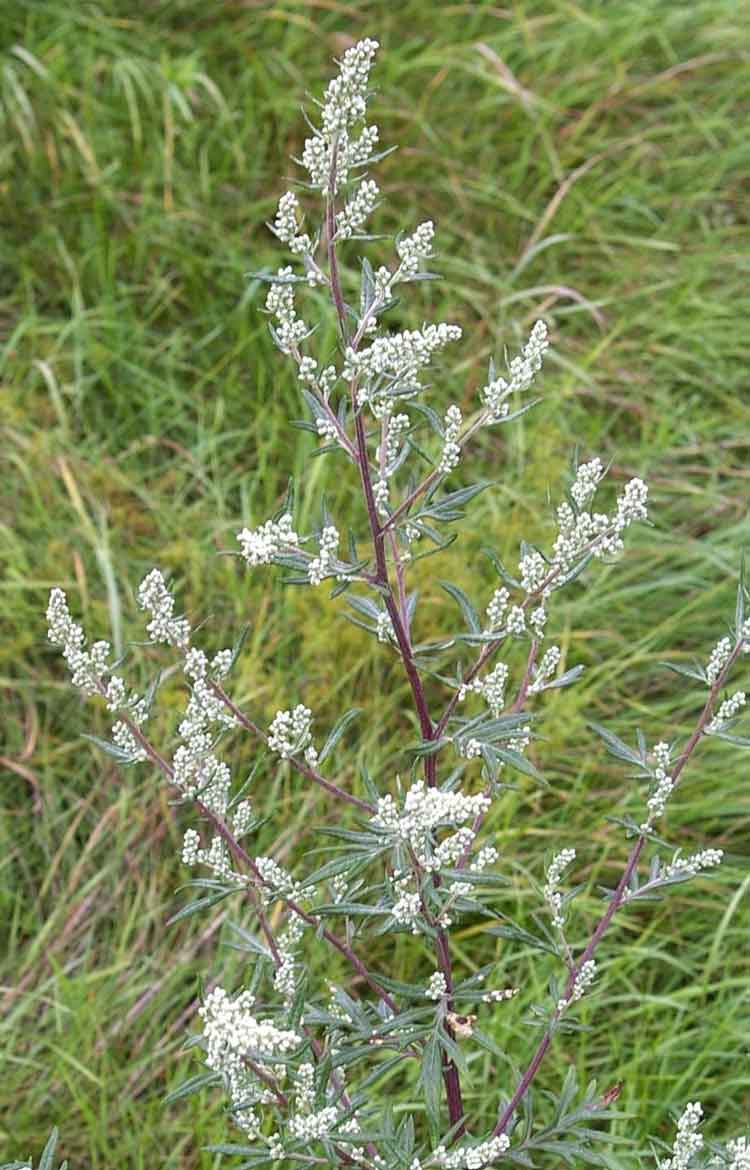
Artemisia vulgaris, commonly known as mugwort, common mugwort, or wormwood,[note 1] is a species of flowering plant in the daisy family Asteraceae. It is one of several species in the genus Artemisia commonly known as mugwort, although Artemisia vulgaris is the species most often called mugwort. Mugworts have been used medicinally and as culinary herbs.
Description
Artemisia vulgaris is an aromatic, herbaceous, perennial plant that grows to 1.5 m (4 ft 11 in) in height.[5] It spreads through vegetative expansion and the anthropogenic dispersal of root rhizome fragments—the plant rarely reproduces from seeds in temperate regions, as few seeds capable of germinating are produced by plants. Mugwort cannot easily be controlled by being ploughed into the soil, as sections of the plant's rhizomes move away from the parent plant if the soil is disturbed, causing the number of new plants to increase.[3]
aaa
bbb
Upper and lower side of leaf
The stems are purple-looking and angular.[4] The pinnate leaves are smooth and of a dark green tint on the upper surface.[4] They have dense, whitish tomentose hairs on the underside, are glabrous on the upperside, and have lobes that are approximately 2.5–8 mm (0.098–0.315 in) wide.[5] New leaves are opposite and are attached to the stem with a thin, long petiole. They are rounded, lack lobes, and are woolly-looking underneath.[3]
The yellow or reddish-looking flower heads, which appear from July to September, are arranged paniculate branching structure.[4][3] They are 5 mm (3⁄16 in) long and radially symmetrical. The outer flowers in each capitulum are female and the inner ones bisexual.[6] A. vulgaris flowers from midsummer to early autumn.[7] The brown rectangular-shaped fruit has one seed, and has ridges, a narrow base, and tiny bristles on the end.[3]
The root system consists of numerous horizontal branched rhizomes from which adventitious roots are produced. As many as new 20 stems can grow from one root system.[3] The main brown woody root, which is about 200 mm (7.9 in) long, has rootlets 51–102 mm (2.0–4.0 in) long, and approximately 2 mm (0.079 in) thick.
Margaret Grieve, in her A Modern Herbal (first published in 1931), described the taste as "sweetish and acrid",[4] but contact with the plant or consuming the beverage made from it is thought cause dermatitis.[3]
Name
The name mugwort is thought to have come from its use of as a method of giving flavour to beer.[3] According to Grieve, mugwort may have been derived from moughte (a term for a moth or maggot), "because from the days of Dioscorides, the plant has been regarded, in common with Wormwood, as useful in keeping off the attacks of moths".[4]
The Ukrainian name for mugwort, чорнобиль, chornóbyl' (or more commonly полин звичайний polýn zvycháynyy, 'common artemisia') transliterates as "black stalk". The Ukrainian city of Chernobyl gets its name from the plant.[8]
Distribution and habitat
Artemisia vulgaris is native to temperate Europe, Asia, North Africa, and Alaska, and is naturalized in North America,[1] where some consider it an invasive weed. It is a common plant growing in places containing low-nitrogen soils, such as waste places, roadsides and uncultivated areas.[9] The plant, which prefers alkaline conditions, readily becomes established in open, sandy ground.[3]
The plant rarely reproduces from seeds in temperate regions, as few seeds capable of germinating are produced by plants, and the species mainly reproduces from rhizomes. Mugwort cannot easily be controlled by being ploughed into the soil, as sections of the plant's rhizomes move away from the parent plant if the soil is disturbed, causing the number of new plants to increase.[3]
Ecology
Several species of Lepidoptera (butterflies and moths) such as Ostrinia scapulalis feed on the leaves and flowers of the plant.[10] It is possibly susceptible to being attacked by honey fungus.[11]
Uses
A. vulgaris illustrated in the late 13th (or early 14th-century) herbal Tractatus de Herbis, British Library
In the Middle Ages, mugwort was called Cingulum Sancti Johannis, as it was believed that the 1st century preacher John the Baptist wore a girdle made from the plant. According to Grieve, mugwort was believed to protect travellers from exhaustion, heatstroke, and wild animals; it was worn on St. John's Eve to gain security from evil spirits.[4]
Before the introduction of hops in the beer-making process, A. vulgaris was once commonly used in England as the flavouring agent. Dried mugwort flowers were added to malt liquor, and this was added to the beer.[4] Mugwort has been used as one of the traditional flavouring and bittering agents of gruit ales, a type of unhopped, fermented grain beverage. In Vietnam as well as in Germany,[12] mugwort is used in cooking as an aromatic herb. In China, the crunchy stalks of young shoots of A. vulgaris are a seasonal vegetable often used in stir fries.[13] In Nepal, the plant is used as an offering to the gods, for cleansing the environment (by sweeping floors or hanging a bundle outside the home), as incense, and also as a medicinal plant.[14]
The dried leaves can be smoked or used to make a tea, to promote lucid dreaming. This supposed oneirogenic effect is reported to be due to the thujone contained in the plant.[15]
Pharmacological uses
Historically, A. vulgaris was referred to as the "mother of herbs" during the Middle Ages, and has been widely used in the traditional Chinese, European, and Hindu medicine. It supposedly possesses a wide range of pharmacological uses, including anticancer, anti-inflammatory, antioxidant, hepatoprotective, antispasmolytic, antinociceptive, antibacterial, antihypertensive, antihyperlipidemic, and antifungal properties.[16]
Phytochemical constituents
A. vulgaris houses a variety of phytochemicals which are responsible for its pharmacological properties. The phytochemicals belong to classes including flavonoids, essential oils, phenolic acids, coumarins, sterols, carotenoids, vitamins, and sesquiterpene lactones, among many others.[17] Examples of the phytochemicals include vulgarin, artemisinin, scopoletin, camphene, camphor, sabinene, and some derivatives of quercetin and kaempferol.[16][17]
Notes
The plant is occasionally known as wormwood, sagebrush,[2] felon herb, chrysanthemum weed, wild wormwood, old Uncle Henry, sailor's tobacco, naughty man, or old man.[3] In the Netherlands and Germany it is sometimes called St. John's Plant, as it is supposed to provide protection if gathered on St. John's Eve.[4]
References
"Artemisia vulgaris L." Plants of the World Online. Royal Botanic Gardens, Kew. Retrieved 10 November 2024.
English Names for Korean Native Plants (PDF). Pocheon: Korea National Arboretum. 2015. p. 361. ISBN 978-89-97450-98-5. Archived from the original (PDF) on 25 May 2017. Retrieved 25 January 2017 – via Korea Forest Service.
"Ohio Perennial and Biennial Weed Guide: Mugwort Artemisia vulgaris". Ohio Agricultural Research and Development Center, Ohio State University. Retrieved 10 November 2024.
Grieve 1971, pp. 556–558.
Stace 2019, p. 860.
Stace 2019, p. 790.
Parnell, J. and Curtis, T. 2012. Webb's An Irish Flora. Cork University Press. ISBN 978-185918-4783
Melnychuk 2012, p. 342.
Barney, J. N.; DiTommaso, A. (2002). "The biology of Canadian weeds. 118. Artemisia vulgaris L.". Canadian Journal of Plant Science. 83 (1): 205–215. doi:10.4141/P01-098.
Calcagno, Vincent; Bonhomme, Vincent; Thomas, Yan; Singer, Michael C.; Bourguet, Denis (7 September 2010). "Divergence in behaviour between the European corn borer, Ostrinia nubilalis, and its sibling species Ostrinia scapulalis : adaptation to human harvesting?". Proceedings of the Royal Society B: Biological Sciences. 277 (1694): 2703–2709. doi:10.1098/rspb.2010.0433. PMC 2982046. PMID 20410041.
"Artemisia vulgaris". Royal Horticultural Society. Retrieved 10 November 2024.
"Gernot Katzers Gewürzseiten: Beifuß (Artemisia vulgaris L.) (in German)". Retrieved 23 December 2024. Mugwort is used to season roast goose at Christmas (Weihnachtsgans).
"Information Officee of Shanghai Municipality". Archived from the original on 26 April 2021. Retrieved 26 April 2021.
Rysdyk, Evelyn C. (19 February 2019). The Nepalese Shamanic Path: Practices for Negotiating the Spirit World. Simon and Schuster. ISBN 978-1-62055-795-2.
Szaro, Melissa (4 December 2020). "How to Use Mugwort for Dreams, Sleep, and More". Herbal Academy. Retrieved 18 June 2023.
Ekiert, Halina; Pajor, Joanna; Klin, Paweł; Rzepiela, Agnieszka; Ślesak, Halina; Szopa, Agnieszka (25 September 2020). "Significance of Artemisia Vulgaris L. (Common Mugwort) in the History of Medicine and Its Possible Contemporary Applications Substantiated by Phytochemical and Pharmacological Studies". Molecules. 25 (19): 4415. doi:10.3390/molecules25194415. ISSN 1420-3049. PMC 7583039. PMID 32992959.
Thangjam, Nurpen Meitei; Taijong, Jasmina; Kumar, Awadhesh (9 November 2020). "Phytochemical and pharmacological activities of methanol extract of Artemisia vulgaris L. leaves". Clinical Phytoscience. 6 (1): 72. doi:10.1186/s40816-020-00214-8. ISSN 2199-1197. S2CID 226279550.
Sources
Grieve, Margaret (1971) [1931]. "Mugwort". A Modern Herbal. Vol. 2. New York: Hafner. pp. 556–558. OCLC 1405460980.
Melnychuk, O.S., ed. (2012). Етимологічний словник української мови [Etymological dictionary of the Ukrainian language] (in Ukrainian). Vol. 7. Kyiv: Naukova Dumka.
Stace, Clive (2019). New Flora of the British Isles (4th ed.). Middlewood Green, Suffolk, UK: C & M Floristics. ISBN 978-1-5272-2630-2.
Retrieved from "http://en.wikipedia.org/"
All text is available under the terms of the GNU Free Documentation License