Fine Art

Aster alpinus

Aster alpinus (Information about this image)

Life-forms

Classification System: APG IV

Superregnum: Eukaryota
Regnum: Plantae
Cladus: Angiosperms
Cladus: Eudicots
Cladus: Core eudicots
Cladus: Asterids
Cladus: Campanulids
Ordo: Asterales

Familia: Asteraceae
Subfamilia: Asteroideae
Tribus: Astereae
Subtribus: Asterinae
Genus: Aster
Species: Aster alpinus
Subspecies: A. a. subsp. alpinus – A. a. subsp. bohemicus – A. a. subsp. breyninus – A. a. subsp. cebernnensis – A. a. subsp. cylleneus – A. a. subsp. glabratus – A. a. subsp. subvillosus

Varietates: A. a. var. diversisquamus – A. a. var. serpentimontanus – A. a. var. vierhapperi
Name

Aster alpinus L. (1753)
Synonyms

Homotypic
Diplactis alpina (L.) Semple in Univ. Waterloo Biol. Ser. 38: 17 (1996).

Distribution
Native distribution areas:

Continental: Europe
Norway, Sweden, France, Andorra, Spain, Germany, Switzerland, Austria, Liechtenstein, Italy, Poland, Czech Republic, Hungary, Slovenia, Croatia, Bosnia & Hercegovina, Serbia & Kosovo, Montenegro, Macedonia, Albania, Romania, Bulgaria, Ukraine, N-, C- & E-European Russia
Continental: Asia-Temperate
Northern Caucasus, Georgia [Caucasus], Armenia, Azerbaijan (incl. Nachichevan), Siberia (W-Siberia), Kazakhstan, Turkey (E-Anatolia, Inner Anatolia, N-Anatolia, NE-Anatolia, SE-Anatolia), Iran (EC-Iran, Iranian Aserbaijan, N-Iran)

References: Brummitt, R.K. 2001. TDWG – World Geographical Scheme for Recording Plant Distributions, 2nd Edition
References
Primary references

Linnaeus, C. 1753. Species Plantarum. Tomus II: 872. Reference page.

Additional references

Krasnoborov, I.M. (ed.) (2007). Flora of Siberia 13: 1-499. Scientific Publishers, Inc., Enfield, Plymouth.
Litvinskaya, S.A. & Murtazaliev, R.A. (2013). Flora of the Northern Caucasus: An Atlas and Identification Book: 1-688. Fiton XXI.

Links

Govaerts, R. et al. 2021. Aster alpinus in Kew Science Plants of the World Online. The Board of Trustees of the Royal Botanic Gardens, Kew. Published online. Accessed: 2021 Aug 06. Reference page.
International Plant Names Index. 2017. Aster alpinus. Published online. Accessed: Dec. 02 2017. Reference page.
Tropicos.org 2017. Aster alpinus. Missouri Botanical Garden. Published online. Accessed: 02 Dec. 2017.
Hassler, M. 2017. Aster alpinus. World Plants: Synonymic Checklists of the Vascular Plants of the World In: Roskovh, Y., Abucay, L., Orrell, T., Nicolson, D., Bailly, N., Kirk, P., Bourgoin, T., DeWalt, R.E., Decock, W., De Wever, A., Nieukerken, E. van, Zarucchi, J. & Penev, L., eds. 2017. Species 2000 & ITIS Catalogue of Life. Published online. Accessed: 2017 Dec. 02. Reference page.

Vernacular names
Deutsch: Alpen-Aster
English: alpine aster
español: manzanilla de pastor
suomi: Alppiasteri
français: Aster des Alpes
italiano: Astro alpino
Nederlands: bergaster
русский: Астра альпийская
Türkçe: Alpin yıldızpatısı
українська: Айстра альпійська


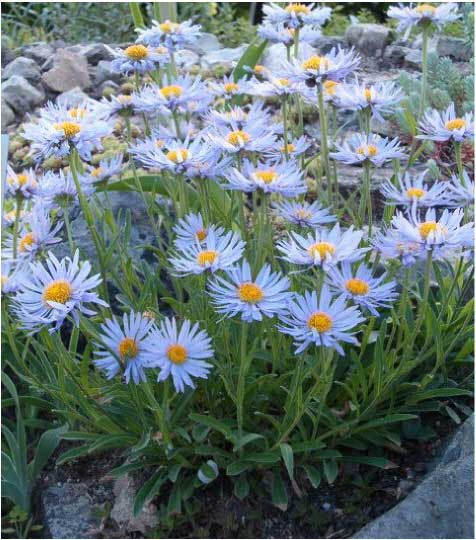
Aster alpinus, the alpine aster or blue alpine daisy,[2] is a species of flowering plant in the family Asteraceae, native to the mountains of Europe (including the Alps), with a subspecies native to Canada and the United States.[3] This herbaceous perennial has purple, pink, white or blue flowers in summer.[4]
Description
A. alpinus attracts an insect to it and it is sucking nectar.

Aster alpinus is a caespitose herbaceous perennial that grows 10–35 cm tall.[5] The bloom color may be blue, indigo, violet, white, or pink.[6] In the UK this plant has gained the Royal Horticultural Society's Award of Garden Merit.[7] Leaves are untoothed, lanceolate-spatulate, and basal. The Latin specific epithet alpinus means alpine and from high mountains above the timber line.[8]
Distribution and habitat

It grows very slowly in clay, silt, loam, silty clay, and sandy clay. Its minimum pH scale is 6 and maximum pH scale is 7.5. Flowers are erect, and always solitary.[9] Aster alpinus is native to the mountains of Europe such as the Alps and Pyrenees.[8] Aster Alpinus is the only true aster growing in North America.[10]

It does better in generally cooler climates. Usually it is adapted to clay, silt, loam, silty clay, sandy clay, clay loam, silt loam, sandy loam, silty clay loam and sandy clay loam soils, and prefers low fertility. The plant can tolerate only a minimum temperature of -28 °C / -18.4F after the occurrence of cell damage. It can survive medium heat of fire and requires at least 90 frost free days for proper growth.
Ecology

It is herbaceous and attractive to bees, butterflies, and birds.[specify]
Conservation

NatureServe lists variety Aster alpinus var. vierhapperi as Secure Variety (T5) in Canada, but Critically Imperiled (S1) in Ontario and Vulnerable (S3) in Alberta. In the United States, it is Critically Imperiled (S1) in Colorado and Wyoming.[11]
References

"Aster alpinus". Germplasm Resources Information Network. Agricultural Research Service, United States Department of Agriculture. Retrieved 4 January 2018.
A. alpinus at USDA Plants Profile
"Map: Aster alpinus". www.efloras.org. Retrieved 2020-12-08.
"Aster alpinus Albus - Aster des Alpes blanc". www.promessedefleurs.com (in French). Retrieved 2024-06-14.
"Aster alpinus in Flora of China @ efloras.org". www.efloras.org. Retrieved 2020-12-08.
"Explore Cornell - Home Gardening - Flower Growing Guides - Growing Guide". www.gardening.cornell.edu. Retrieved 2020-12-08.
"RHS Plant Selector - Aster alpinus". Retrieved 15 April 2020.
"Aster alpinus - Plant Finder". www.missouribotanicalgarden.org. Retrieved 2021-12-21.
"Aster alpinus Albus - Aster des Alpes blanc". www.promessedefleurs.com (in French). Retrieved 2024-06-14.
"An overview of "asters" and the Tribe Astereae". Astereae Lab. 2012-10-19. Retrieved 2024-06-14.
NatureServe (10 November 2020). "Aster alpinus var. vierhapperi - Vierhapper's Aster". NatureServe Explorer (explorer.natureserve.org). NatureServe. Retrieved 25 November 2020.

Plants, Fine Art Prints

Plants Images

Biology Encyclopedia

Retrieved from "http://en.wikipedia.org/"
All text is available under the terms of the GNU Free Documentation License

Home - Hellenica World