
Superregnum: Eukaryota
Regnum: Animalia
Subregnum: Eumetazoa
Cladus: Bilateria
Cladus: Nephrozoa
Superphylum: Deuterostomia
Phylum: Chordata
Cladus: Craniata
Subphylum: Vertebrata
Infraphylum: Gnathostomata
Superclassis: Tetrapoda
Cladus: Reptiliomorpha
Cladus: Amniota
Classis: Reptilia
Cladus: Eureptilia
Cladus: Romeriida
Subclassis: Diapsida
Cladus: Sauria
Infraclassis: Archosauromorpha
Cladus: Crurotarsi
Divisio: Archosauria
Subsectio: Ornithodira
Subtaxon: Dinosauromorpha
Cladus: Dinosauria
Ordo: Saurischia
Cladus: Theropoda
Cladus: Neotheropoda
Infraclassis: Aves
Ordo: Passeriformes
Subordo: Passeri
Infraordo: Passerida
Superfamilia: Muscicapoidea
Familia: Muscicapidae
Genus: Myophonus
Species: M. blighi – M. borneensis – M. caeruleus – M. castaneus – M. glaucinus – M. horsfieldii – M. insularis – M. melanurus – M. robinsoni
Name
Myophonus Temminck, 1822
References
Nouveau recueil de planches coloriées d'oiseaux livr.29 pl.170.
IOC
Vernacular names
Deutsch: Pfeifdrosseln
English: Whistling thrush
español: Arrenga
suomi: Jokirastaat
français: Arrenga
Nederlands: Fluitlijster
svenska: Visseltrast
中文: 啸鸫属
The whistling thrushes comprise a genus Myophonus (Myiophoneus[1]) of the Old World flycatcher family Muscicapidae.
They are all medium-sized mostly insectivorous or omnivorous birds. They are all brightly coloured species found in India and southeast Asia. The male is usually blue, and the females are either similar to the male or brown. The brighter blue patches found on the shoulders and sometimes the head, of whistling thrushes, uniquely for a passerine, reflect strongly in the ultraviolet.[2]
Taxonomy
As the English name suggests, the genus was at one time placed in the thrush family Turdidae but in 2010 two separate molecular phylogenetic studies found that members of the genus were more closely related to species in the Old World flycatcher family Muscicapidae.[3][4]
The genus includes nine species several of which have ranges that are restricted to islands or peninsulas:[5]
| Image | Scientific name | Common Name | Distribution |
|---|---|---|---|
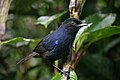 |
Sri Lanka whistling thrush | Myophonus blighi | found on Sri Lanka |
| Shiny whistling thrush | Myophonus melanurus | Sumatra | |
 |
Javan whistling thrush | Myophonus glaucinus | Java |
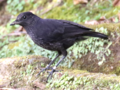 |
Bornean whistling thrush | Myophonus borneensis | Borneo |
| Brown-winged whistling thrush | Myophonus castaneus | Sumatra | |
| Malayan whistling thrush | Myophonus robinsoni | peninsular Malaysia | |
 |
Malabar whistling thrush | Myophonus horsfieldii | peninsular India |
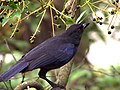 |
Taiwan whistling thrush or Taiwan whistling-thrush | Myophonus insularis | Taiwan |
 |
Blue whistling thrush | Myophonus caeruleus | from Central Asia east to China and south to the Sundas |
Javan, Bornean and brown-winged were formerly lumped as the Sunda whistling thrush, but were split in 2004.[6]
Habits
Shape of bill M. caeruleus
Whistling thrushes are mostly seen in hilly areas except during winter when they may descend to streams near the plains. They specialize in feeding on snails and their strong hooked bills are used to deal with them. They may choose a particular rock on which they crack the shells.[7]
The nests are usually in crevices of rocks and boulders close to water. The cup nests have moss and twigs and is lined with roots and leaves. The eggs are usually three and sometimes four, elongate with a gray ground colour and marked with speckles.[7]
References
Delacour 1942 (Auk 146-264) writes "the proper spelling is Myiophoneus Temminck and Laugier, 1822 Myophonus T. and L., 1822 is an orthographic error, as well as Myophoneus in their tables, x859, while Myiophonus Agassiz, 1846, is an unnecessary emendation."
Staffan Andersson (1996). "Bright Ultraviolet Colouration in the Asian Whistling-Thrushes (Myiophonus spp.)". Proceedings of the Royal Society B: Biological Sciences. 263 (1372): 843–848. doi:10.1098/rspb.1996.0124.
Sangster, G.; Alström, P.; Forsmark, E.; Olsson, U. (2010). "Multi-locus phylogenetic analysis of Old World chats and flycatchers reveals extensive paraphyly at family, subfamily and genus level (Aves: Muscicapidae)". Molecular Phylogenetics and Evolution. 57 (1): 380–392. doi:10.1016/j.ympev.2010.07.008. PMID 20656044.
Zuccon, D.; Ericson, P.G.P. (2010). "A multi-gene phylogeny disentangles the chat-flycatcher complex (Aves: Muscicapidae)". Zoologica Scripta. 39 (3): 213–224. doi:10.1111/j.1463-6409.2010.00423.x.
Gill, Frank; Donsker, David (eds.). "Chats, Old World flycatchers". World Bird List Version 6.2. International Ornithologists' Union. Retrieved 20 May 2016.
Collar, N.J. (2004). "Species limits in some Indonesian thrushes" (PDF). Forktail. 20: 71–87.
Delacour, J. (1942). "The Whistling Thrushes (genus Myiophoneus)" (PDF). Auk. 59 (2): 246–264. doi:10.2307/4079555. JSTOR 4079555.
Further reading
Thrushes by Clement and Hathaway, ISBN 0-7136-3940-7
Retrieved from "http://en.wikipedia.org/"
All text is available under the terms of the GNU Free Documentation License
