
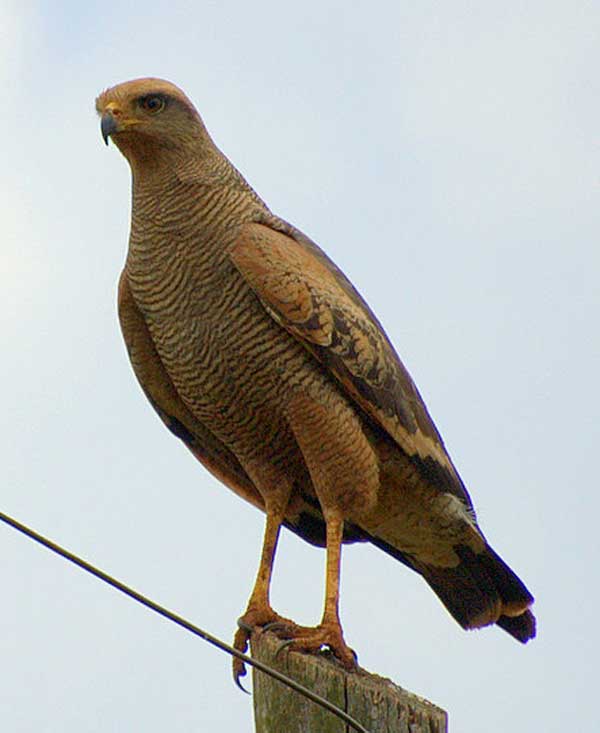
Buteogallus meridionalis (*)
Superregnum: Eukaryota
Cladus: Unikonta
Cladus: Opisthokonta
Cladus: Holozoa
Regnum: Animalia
Subregnum: Eumetazoa
Cladus: Bilateria
Cladus: Nephrozoa
Superphylum: Deuterostomia
Phylum: Chordata
Subphylum: Vertebrata
Infraphylum: Gnathostomata
Megaclassis: Osteichthyes
Cladus: Sarcopterygii
Cladus: Rhipidistia
Cladus: Tetrapodomorpha
Cladus: Eotetrapodiformes
Cladus: Elpistostegalia
Superclassis: Tetrapoda
Cladus: Reptiliomorpha
Cladus: Amniota
Classis: Reptilia
Cladus: Eureptilia
Cladus: Romeriida
Subclassis: Diapsida
Cladus: Sauria
Infraclassis: Archosauromorpha
Cladus: Crurotarsi
Divisio: Archosauria
Cladus: Avemetatarsalia
Cladus: Ornithodira
Subtaxon: Dinosauromorpha
Cladus: Dinosauriformes
Cladus: Dracohors
Cladus: Dinosauria
Ordo: Saurischia
Cladus: Eusaurischia
Subordo: Theropoda
Cladus: Neotheropoda
Cladus: Averostra
Cladus: Tetanurae
Cladus: Avetheropoda
Cladus: Coelurosauria
Cladus: Tyrannoraptora
Cladus: Maniraptoromorpha
Cladus: Maniraptoriformes
Cladus: Maniraptora
Cladus: Pennaraptora
Cladus: Paraves
Cladus: Eumaniraptora
Cladus: Avialae
Infraclassis: Aves
Cladus: Euavialae
Cladus: Avebrevicauda
Cladus: Pygostylia
Cladus: Ornithothoraces
Cladus: Ornithuromorpha
Cladus: Carinatae
Parvclassis: Neornithes
Cohors: Neognathae
Cladus: Neoaves
Ordo: Accipitriformes
Familia: Accipitridae
Subfamilia: Buteoninae
Genus: Buteogallus
Species: Buteogallus meridionalis
Name
Buteogallus meridionalis (Latham, 1790: 36) [org. comb. Falco meridionalis]
Synonyms
Heterospizias meridionalis
References
Latham, J. 1790. Index ornithologicus, sive systema ornithologiæ; complectens avium divisionem in classes, ordines, genera, species, ipsarumque varietates: adjectis synonymis, locis, descriptionibus, &c. Volumen I: pp. i–xviii, 1–466. Londini. (Leigh & Sotheby). BHL Reference page. [original description: p. 36]
Vernacular names
čeština: Káně savanová
español: Busardo sabanero, Aguilucho Colorado(ARG)
polski: Czarnostrząb rdzawy
português: Gavião-casco-de-couro
The savanna hawk (Buteogallus meridionalis) is a large raptor found in open savanna and swamp edges. It was formerly placed in the genus Heterospizias. It breeds from Panama and Trinidad south to Bolivia, Uruguay and central Argentina.[2]
Description
Flying in Goias, Brazil
The savanna hawk is 46–61 cm (18–24 in) in length and weighs 845 g (29.8 oz).[3] The adult has a rufous body with grey mottling above and fine black barring below. The flight feathers of the long broad wings are black, and the tail is banded black and white.[2][3] The legs are yellow. The call is a loud scream keeeeru.[3]
Immature birds are similar to the adults but have darker, duller upperparts, paler underparts with coarser barring, and a whitish supercilium. This species perches very vertically, and its legs are strikingly long.[3]
Food and feeding
The savanna hawk feeds on small mammals, small birds,[4] lizards, snakes, toads, frogs, eels,[4] other fish,[5] crabs, roots,[4] and large insects. It usually sits on an open high perch from which it swoops on its prey, but will also hunt on foot, and several birds may gather at grass fires.[2]
Reproduction
The nest is of sticks lined with grass and built in a palm tree.[2] The clutch is a single white egg, and the young take 6.5 to 7.5 weeks to fledging.[3]
References
BirdLife International (2020). "Buteogallus meridionalis". IUCN Red List of Threatened Species. 2020: e.T22695832A168793019. doi:10.2305/IUCN.UK.2020-3.RLTS.T22695832A168793019.en. Retrieved 19 November 2021.
Sabrina Ramirez (2014). "Buteogallus meridionalis (Savanna Hawk)" (PDF). University of the West Indies. Archived (PDF) from the original on June 28, 2017. Retrieved June 27, 2017.
Hilty, Steven L (2003). Birds of Venezuela. London: Christopher Helm. p. 236. ISBN 0-7136-6418-5. Retrieved June 27, 2017.
"Buteogallus meridionalis (Savanna Hawk)" (PDF). Sta.uwi.edu. Retrieved 26 March 2022.
"Savanna Hawk | the Peregrine Fund".
Additional sources
ffrench, Richard (1991). A Guide to the Birds of Trinidad and Tobago (2nd ed.). Comstock Publishing. ISBN 0-8014-9792-2.
F. Gary Stiles; Alexander Frank Skutch (1989). A guide to the birds of Costa Rica. Comstock Publishing. ISBN 0-8014-9600-4.
Retrieved from "http://en.wikipedia.org/"
All text is available under the terms of the GNU Free Documentation License

