
Superregnum: Eukaryota
Regnum: Animalia
Subregnum: Eumetazoa
Cladus: Bilateria
Cladus: Nephrozoa
Superphylum: Deuterostomia
Phylum: Chordata
Cladus: Craniata
Subphylum: Vertebrata
Infraphylum: Gnathostomata
Superclassis: Tetrapoda
Cladus: Reptiliomorpha
Cladus: Amniota
Classis: Reptilia
Cladus: Eureptilia
Cladus: Romeriida
Subclassis: Diapsida
Cladus: Sauria
Infraclassis: Archosauromorpha
Cladus: Crurotarsi
Divisio: Archosauria
Subsectio: Ornithodira
Subtaxon: Dinosauromorpha
Cladus: Dinosauria
Ordo: Saurischia
Cladus: Theropoda
Cladus: Neotheropoda
Infraclassis: Aves
Cladus: Euavialae
Cladus: Avebrevicauda
Cladus: Pygostylia
Cladus: Ornithothoraces
Cladus: Euornithes
Cladus: Ornithuromorpha
Cladus: Ornithurae
Cladus: Carinatae
Parvclassis: Neornithes
Cohors: Neognathae
Ordo: Falconiformes
Familia: Falconidae
Subfamilia: Caracarinae
Genera: Caracara - Daptrius - Ibycter - Milvago - Phalcoboenus – Spiziapteryx
Name
Caracarinae
Synonymy
Polyborinae Bonaparte, 1837
References
Fuchs, J., et al. 2015. Rapid diversification of falcons (Aves: Falconidae) due to expansion of open habitats in the Late Miocene. Molecular Phylogenetics and Evolution 82: 166–182. doi: 10.1016/j.ympev.2014.08.010
Caracaras are birds of prey in the family Falconidae. They are traditionally placed in subfamily Polyborinae with the forest falcons,[1] but are sometimes considered to constitute their own subfamily, Caracarinae,[2] or classified as members of the true falcon subfamily, Falconinae.[3] Caracaras are principally birds of South and Central America, just reaching the southern United States.
Unlike the Falco falcons in the same family, the birds in the five relevant genera are not fast-flying aerial hunters, but are comparatively slow and are often scavengers (a notable exception being the red-throated caracara).
| Image | Genus | Living Species |
|---|---|---|
 |
Daptrius Vieillot, 1816 |
|
 |
Ibycter Vieillot, 1816 |
|
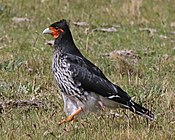 |
Phalcoboenus d'Orbigny, 1834 |
|
 |
Caracara Merrem, 1826 |
|
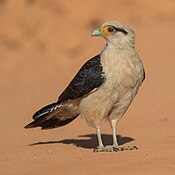 |
Milvago Spix, 1824 |
|
Distribution
The caracaras are found throughout much of the Americas. The range of the crested caracara extends as far north as the states of Arizona, Texas, and Florida in the United States.[4] In the Southern Hemisphere, the striated caracara inhabits the Falkland Islands and Tierra del Fuego, just off the coast of the southernmost tip of South America.[5]
Taxonomy
The genus Caracara Merrem 1826 was previously known as Polyborus Vieillot 1816. Hence, the differing subfamily names Polyborinae or Caracarinae. In addition, different authors give differing scopes to the subfamily, sometimes including the forest falcons, laughing falcon, or spot-winged falconet.
Peters' checklist[6] in 1931 listed the caracaras in their own subfamily, Polyborinae, containing Daptrius, Milvago, Phalcobœnus, and Polyborus. Ibycter americanus is included as Daptrius americanus.
Whilst recognizing "three major, deep divisions in the Falconidae",[7] the South American Classification Committee (SACC) of the American Ornithologists' Union voted[8] in 2007 to recognize two subfamilies: Herpetotherinae containing the forest falcons; and Falconinae containing the caracaras and true falcons.
Based on recent research in molecular genetics,[9] John Boyd[10] places the spot-winged falconet (Spiziapteryx) in Caracarinae, and the forest falcons in Herpetotherinae. He also comments that "many of the caracaras are closely related, and it would not be unreasonable to merge Ibycter, Milvago, and Phalcoboenus into Daptrius".
References
Myers, P. R.; Parr, C. S.; Jones, T.; Hammond, G. S.; Dewey, T. A. "Subfamily Polyborinae (caracaras and forest falcons)". Animal Diversity Web. University of Michigan. Retrieved 2009-08-21.
"Check-list of North American Birds". North American Classification Committee. American Ornithologists' Union. Retrieved 2009-08-21.
"A classification of the bird species of South America". South American Classification Committee. American Ornithologists' Union. Archived from the original on 2009-10-05. Retrieved 2009-08-21.
"Crested Caracara". All About Birds. Cornell Lab of Ornithology. Retrieved 2009-08-21.
Marín, Manuel; Alejandro Kusch; David Oehler; Scott Drieschman (2006). "Distribution, Breeding and Status of the Striated Caracara (Phalcoboenus australis) (Gmelin, 1788) in Southern Chile" (PDF). Anales del Instituto de la Patagonia. 34: 65–74. Archived from the original (PDF) on 2019-04-18. Retrieved 2009-08-21.
Peters, James Lee (1931). "Subfamily Polyborinae". Check-list of birds of the world: volume 1. Cambridge, Massachusetts, U.S.A.: Harvard University Press.
South American Classification Committee (8 September 2014). "A Classification of the Bird Species of South America, Part 5 (Trogoniformes to Psittaciformes)" (version 21 ed.). Archived from the original on 2014-02-03. Retrieved 22 September 2014.
Remsen, Van (June 2007). "Proposal (#281) to South American Classification Committee: Classification within Falconidae". Archived from the original on 19 September 2015. Retrieved 22 September 2014.
Fuchs, J.; Johnson, J. A.; Mindell, D. P. (2012). "Molecular systematics of the caracaras and allies (Falconidae: Polyborinae) inferred from mitochondrial and nuclear sequence data". Ibis. 154: 520–532. doi:10.1111/j.1474-919x.2012.01222.x.
Boyd, John H. "Falconiformes". Taxonomy in Flux Checklist. Retrieved 26 September 2014.
Retrieved from "http://en.wikipedia.org/"
All text is available under the terms of the GNU Free Documentation License
