Superregnum: Eukaryota
Cladus: Unikonta
Cladus: Opisthokonta
Cladus: Holozoa
Regnum: Animalia
Subregnum: Eumetazoa
Cladus: ParaHoxozoa
Cladus: Bilateria
Cladus: Nephrozoa
Superphylum: Deuterostomia
Phylum: Chordata
Cladus: Olfactores
Subphylum: Vertebrata
Infraphylum: Gnathostomata
Megaclassis: Osteichthyes
Cladus: Sarcopterygii
Cladus: Rhipidistia
Cladus: Tetrapodomorpha
Cladus: Eotetrapodiformes
Cladus: Elpistostegalia
Superclassis: Tetrapoda
Cladus: Reptiliomorpha
Cladus: Amniota
Cladus: Sauropsida
Cladus: Reptilia
Cladus: Eureptilia
Cladus: Romeriida
Subclassis: Diapsida
Cladus: Neodiapsida
Cladus: Sauria
Cladus: Archelosauria
Cladus: Archosauromorpha
Cladus: Crocopoda
Cladus: Archosauriformes
Cladus: Eucrocopoda
Cladus: Archosauria
Cladus: Avemetatarsalia
Cladus: Ornithodira
Cladus: Dinosauromorpha
Cladus: Dinosauriformes
Cladus: Dracohors
Cladus: Dinosauria
Cladus: Saurischia
Cladus: Theropoda
Cladus: Neotheropoda
Cladus: Averostra
Cladus: Tetanurae
Cladus: Avetheropoda
Cladus: Coelurosauria
Cladus: Tyrannoraptora
Cladus: Maniraptoromorpha
Cladus: Maniraptoriformes
Cladus: Maniraptora
Cladus: Pennaraptora
Cladus: Paraves
Cladus: Eumaniraptora
Cladus: Avialae
Subclassis: Aves
Cladus: Avebrevicauda
Cladus: Pygostylia
Cladus: Ornithothoraces
Cladus: Ornithuromorpha
Cladus: Carinatae
Cladus: Neornithes
Infraclassis: Neognathae
Cladus: Neoaves
Ordo: Piciformes
Subordo: Galbuli
Familia: Bucconidae
Genus: Malacoptila
Species: Malacoptila panamensis
Subspecies: M. p. chocoana - M. p. fuliginosa - M. p. inornata - M. p. magdalenae - M. p. panamensis - M. p. poliopis
Name
Malacoptila panamensis Lafresnaye, 1847
References
Revue Zoologique, par la Société Cuvierienne 10 p. 79
Vernacular names
English: White-whiskered Puffbird
español: Buco barbón
français: Tamatia de Lafresnaye
magyar: Bajszos bukkó
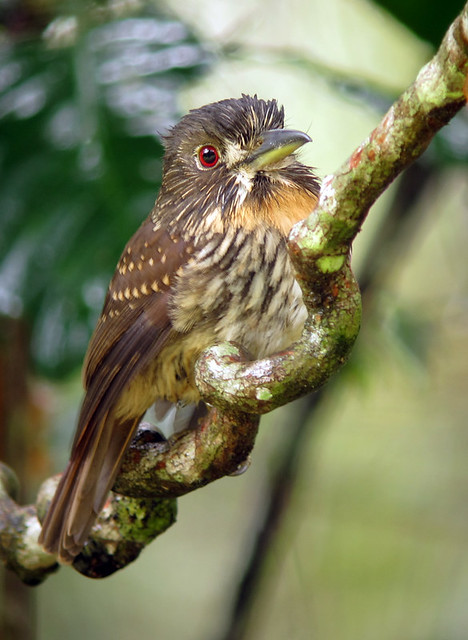
The white-whiskered puffbird (Malacoptila panamensis), also called the white-whiskered soft-wing or brown puffbird, is a near-passerine bird in the family Bucconidae, the puffbirds, nunlets, and nunbirds. It is found from southeastern Mexico through Central America (except El Salvador), Colombia, and Ecuador into Peru.[2][3][4]
Taxonomy and systematics
The white-whiskered puffbird has these four subspecies:[2]
M. p. inornata du Bus de Gisignies (1847)
M. p. panamensis Lafresnaye (1847)
M. p. magdalenae Todd (1943)
M. p. poliopsis Sclater (1862)
It is thought to form a superspecies with the moustached puffbird (M. mystacalis) and black-streaked puffbird (M. fulvogularis).
Ventral view. San Francisco Reserve - Darien, Panama
Description
The white-whiskered puffbird is about 18 cm (7.1 in) long with an average weight of about 43 g (1.5 oz). Unlike most puffbirds, the male and female have different plumages. Both sexes have bristles around the base of the large bill, and white "whiskers", which are actually tufts of feathers. The nominate adult male's upperparts are brown to chestnut brown. The forecrown has narrow buff or tawny streaks and most of the rest of the upperparts have buff or tawny spots. The tail is chesnut brown. Its lores, supercilium, cheeks, and the sides of the neck are tawny. The throat and upper breast are tawny to tawny buff and the rest of the underparts are buffy white with darker streaks on the breast and flanks. The adult female has less of a chesnut cast; its crown is grayer and its upperparts olive to brown. Most of the underparts are buff to cinnamon-buff with darker streaks; the abdomen is white. Juveniles are like the female but with heavier streaking on the underparts. The subspecies are all similar to the nominate, differing mainly in the shades of gray, brown, and rufous and in the density of the streaking.[3]
Distribution and habitat
The subspecies of white-whiskered puffbird are distributed thus:[2][3]
M. p. inornata, the Caribbean slope from southeastern Mexico through Belize, Guatemala, Nicaragua, and Costa Rica into western Panama.
M. p. panamensis, the Pacific slope from southwestern Costa Rica through Panama into northwestern Colombia
M. p. magdalenae, the Magdalena River valley of west-central Colombia
M. p. poliopsis, southwestern Colombia through western Ecuador into extreme northwestern Peru
The species mostly inhabits dense primary evergreen forest though it is also found in secondary forest and in shorter vegetation around the edges of fields. It typically remains fairly low, within 6 m (20 ft) of the ground. In elevation it ranges from sea level to 750 m (2,500 ft) in northern Central America, to 900 m (3,000 ft) on the Caribbean slope of Costa Rica and in Colombia, and as high as 1,200 m (3,900 ft) on the Pacific slope of Costa Rica.[3]
Behavior
Feeding
Like other puffbirds, the white-whiskered puffbird hunts by a watch-and-wait technique, sitting motionless before darting to catch large invertebrates and small vertebrates such as frogs and lizards. The prey is taken back to the perch and beaten against it prior to consumption. It has also been recorded following army ant swarms and joining mixed-species foraging flocks.[3]
Breeding
Almost all of the data on the white-whiskered puffbird's breeding phenology comes from Costa Rica. The breeding season there spans from mid-March into July. Nests are placed in a cavity at the end of a 46 to 56 cm (1.5 to 1.8 ft) long, 6 cm (2 in) diameter burrow in, usually, gently sloping ground. The wider nesting chamber is lined with dried leaves. The female lays two, rarely three, glossy white eggs. Both sexes incubate the eggs.[3]
Dickcissel male perched on a metal pole singing, with neck stretched and beak open.
Songs and calls
Listen to white-whiskered puffbird on xeno-canto
Vocalization
The white-whiskered puffbird's song is "a high-pitched descending trill ... usually with an emphasized note at the end, e.g., tssiirrrrr-tsít." It sings less often than many other puffbirds. A frequently heard call is "a high, thin, slightly reedy, drawn-out tsssiiiw or tssssiiir, fading away".[3]
Status
The IUCN has assessed the white-whiskered puffbird as being of Least Concern. It has a very large range and an estimated population of at least 50,000 mature individuals, though the latter is believed to be decreasing.[1] It "is vulnerable to habitat loss through deforestation [but] can occupy advanced second growth".[3]
References
BirdLife International (2020). "White-whiskered puffbird Malacoptila panamensis". IUCN Red List of Threatened Species. 2020. Retrieved 9 November 2021.
Gill, F.; Donsker, D.; Rasmussen, P. (July 2021). "IOC World Bird List (v 11.2)". Retrieved July 14, 2021.
Stone, K. L. (2020). White-whiskered Puffbird (Malacoptila panamensis), version 1.0. In Birds of the World (T. S. Schulenberg, Editor). Cornell Lab of Ornithology, Ithaca, NY, USA. https://doi.org/10.2173/bow.whwpuf1.01 retrieved November 9, 2021
Remsen, J. V., Jr., J. I. Areta, E. Bonaccorso, S. Claramunt, A. Jaramillo, D. F. Lane, J. F. Pacheco, M. B. Robbins, F. G. Stiles, and K. J. Zimmer. Version 24 August 2021. Species Lists of Birds for South American Countries and Territories. https://www.museum.lsu.edu/~Remsen/SACCCountryLists.htm retrieved August 24, 2021
Retrieved from "http://en.wikipedia.org/"
All text is available under the terms of the GNU Free Documentation License