Art Prints

Life-forms

Superregnum: Eukaryota
Cladus: Obazoa
Cladus: Opisthokonta
Cladus: Holozoa
Cladus: Filozoa
Cladus: Choanozoa
Regnum: Animalia
Subregnum: Eumetazoa
Cladus: ParaHoxozoa
Cladus: Bilateria
Cladus: Nephrozoa
Superphylum: Deuterostomia
Phylum: Chordata
Cladus: Olfactores
Subphylum: Vertebrata
Infraphylum: Gnathostomata
Megaclassis: Osteichthyes
Cladus: Sarcopterygii
Cladus: Rhipidistia
Cladus: Tetrapodomorpha
Cladus: Eotetrapodiformes
Cladus: Elpistostegalia
Superclassis: Tetrapoda
Cladus: Reptiliomorpha
Cladus: Amniota
Cladus: Sauropsida
Cladus: Reptilia
Cladus: Eureptilia
Cladus: Romeriida
Subclassis: Diapsida
Cladus: Neodiapsida
Cladus: Sauria
Cladus: Archelosauria
Cladus: Archosauromorpha
Cladus: Crocopoda
Cladus: Archosauriformes
Cladus: Eucrocopoda
Cladus: Archosauria
Cladus: Avemetatarsalia
Cladus: Ornithodira
Cladus: Dinosauromorpha
Cladus: Dinosauriformes
Cladus: Dracohors
Cladus: Dinosauria
Cladus: Saurischia
Cladus: Theropoda
Cladus: Neotheropoda
Cladus: Averostra
Cladus: Tetanurae
Cladus: Avetheropoda
Cladus: Coelurosauria
Cladus: Tyrannoraptora
Cladus: Maniraptoromorpha
Cladus: Maniraptoriformes
Cladus: Maniraptora
Cladus: Pennaraptora
Cladus: Paraves
Cladus: Eumaniraptora
Cladus: Avialae
Subclassis: Aves
Cladus: Avebrevicauda
Cladus: Pygostylia
Cladus: Ornithothoraces
Cladus: Ornithuromorpha
Cladus: Carinatae
Cladus: Neornithes
Infraclassis: Neognathae
Cladus: Neoaves
Ordo: Piciformes
Subordo: Galbuli

Familia: Bucconidae
Genus: Malacoptila
Species: Malacoptila striata
Subspecies: M. s. minor - M. s. striata
Name

Malacoptila striata (Spix, 1824)

Original combination: Bucco striatus (protonym)

References

Spix, J.B. von 1824. Avium species novae, quas in itinere per Brasiliam annis MDCCCXVII-MDCCCXX jussu et auspiciis Maximiliani Josephi I. Bavariae regis augustissimi. Suscepto. Collegit et descripsit Dr. Joannes Bapt. de Spix. Curavit Martius, C.F.P. von. 1: 90 pp. + 104 tt. Illustrations: Matthias Schmidt. Ed. Monachii, Impensis Editoris, 1838. DOI: 10.5962/bhl.title.63181 BHL Reference page. p.52 BHL, pl.40 fig.2
IUCN: Malacoptila striata (Near Threatened)

Vernacular names
català: Barbacoll ratllat gros
Cymraeg: Aderyn gwrychog torchog y Dwyrain
English: Crescent-chested Puffbird
español: buco rayado
فارسی: مرغ پفی سینه‌کمانی
français: Tamatia rayé
Nederlands: Zwart-witte baardkoekoek
Diné bizaad: Tsídii dah naʼasolí łizhin dóó łitsxooígíí
پنجابی: چن چھاتیوالا پھلیا پنچھی
português: Barbudo-rajado
svenska: Månbröstad trögfågel


The crescent-chested puffbird (Malacoptila striata) is a species of near-passerine bird in the family Bucconidae, the puffbirds, nunlets, and nunbirds. It is endemic to Brazil.[3]
Taxonomy and systematics

The crescent-chested puffbird was for a time called Malacoptila torquata but since the mid-1900s it has borne its current binomial. The South American Classification Committee of the American Ornithological Society (SACC), the International Ornithological Committee (IOC), and the Clements taxonomy treat it as having two subspecies, the nominate M. s. striata and M. s. minor. However, BirdLife International's Handbook of the Birds of the World (HBW) treat those entities as separate species, the greater and lesser crescent-chested puffbirds respectively.[2][3][4][5]
Description

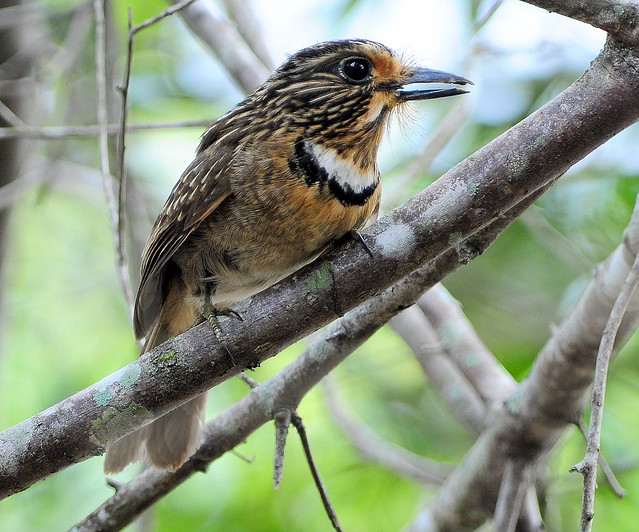
The crescent-chested puffbird is 17.5 to 20 cm (6.9 to 7.9 in) long. The nominate M. s. striata weighs from about 40 to 47 g (1.4 to 1.7 oz); M. s. minor is smaller. The nominate's head and upperparts are blackish with buffy streaks. The face is rufous around the bill and has a buffy or white "moustache". The wing is brown with buffy markings; the tail is plain dark brown. The upper breast has a white crescent with a black band below it. The lower breast is rufous, the center of the belly whitish, and the sides of the breast and belly dull brown with buffy scallops. M. s. minor has a brighter breastband and its underparts are whiter without barring.[6]
Distribution and habitat

The crescent-chested puffbird's nominate subspecies is found in southeastern Brazil from Bahia and Minas Gerais south to Paraná and Santa Catarina. M. s. minor is found in a small disjunct range in Maranhão and Piauí states in Brazili's Northeast Region. The species inhabits a variety of semi-open landscapes such as the edges of humid lowland forest, logged forest, and secondary forest. It often occurs along roads and at the edges of clearings but rarely in the forest interior. In elevation it ranges from sea level to 2,100 m (6,900 ft).[6]
Behavior
Feeding

The crescent-chested puffbird appears to be a mostly solitary forager though there are reports of it following army ant swarms with other birds. Its diet is not well documented but is believed to be mostly invertebrates.[6]
Breeding

The crescent-chested puffbird's nominate subspecies breeds at least from October to December or January. The two known nests were in burrows excavated in earthen banks, but details of its breeding phenology, the nest itself, and eggs are lacking.[6]

Dickcissel male perched on a metal pole singing, with neck stretched and beak open.

Songs and calls
Listen to crescent-chested puffbird on xeno-canto
Vocalization

The crescent-chested puffbird's song is "a high-pitched whistle of 10+ notes, like a small tyrannid, bieh, bieh, bieh…." Its alarm call is "a high, thin, descending seeee...".[6]
Status

The IUCN follows HBW taxonomy and so has treated the two subspecies of crescent-chested puffbird as separate species. The organization has assessed the "greater" M. s. striata as being of Least Concern. Its estimated population exceeds 72,000 mature individuals but the number is believed to be decreasing. It has assessed the "lesser" M. s. minor as Endangered due to increasing deforestation in its rather small range. Its population is unknown and believed to be decreasing.[7][8]
References

BirdLife International (2020). "Malacoptila striata". IUCN Red List of Threatened Species. 2020: e.T45359046A173358004. doi:10.2305/IUCN.UK.2020-3.RLTS.T45359046A173358004.en. Retrieved 14 November 2021.
Remsen, J. V., Jr., J. I. Areta, E. Bonaccorso, S. Claramunt, A. Jaramillo, D. F. Lane, J. F. Pacheco, M. B. Robbins, F. G. Stiles, and K. J. Zimmer. Version 24 August 2021. A classification of the bird species of South America. American Ornithological Society. https://www.museum.lsu.edu/~Remsen/SACCBaseline.htm retrieved August 24, 2021
Gill, F.; Donsker, D.; Rasmussen, P. (July 2021). "IOC World Bird List (v 11.2)". Retrieved July 14, 2021.
Clements, J. F., T. S. Schulenberg, M. J. Iliff, S. M. Billerman, T. A. Fredericks, J. A. Gerbracht, D. Lepage, B. L. Sullivan, and C. L. Wood. 2021. The eBird/Clements checklist of Birds of the World: v2021. Downloaded from https://www.birds.cornell.edu/clementschecklist/download/ Retrieved August 25, 2021
HBW and BirdLife International (2020) Handbook of the Birds of the World and BirdLife International digital checklist of the birds of the world Version 5. Available at: http://datazone.birdlife.org/userfiles/file/Species/Taxonomy/HBW-BirdLife_Checklist_v5_Dec20.zip [.xls zipped 1 MB] retrieved May 27, 2021
Greeney, H. F., J. del Hoyo, P. C. Rasmussen, N. Collar, and G. M. Kirwan (2021). Crescent-chested Puffbird (Malacoptila striata), version 2.0. In Birds of the World (B. K. Keeney, Editor). Cornell Lab of Ornithology, Ithaca, NY, USA. https://doi.org/10.2173/bow.crcpuf1.02 retrieved November 7, 2021
BirdLife International (2020). "Greater Crescent-chested Puffbird Malacoptila striata". IUCN Red List of Threatened Species. 2020. Retrieved 8 November 2021.
BirdLife International (2016). "Lesser Crescent-chested Puffbird Malacoptila minor". IUCN Red List of Threatened Species. 2016. Retrieved 8 November 2021.

Birds, Fine Art Prints

Birds Images

Biology Encyclopedia

Retrieved from "http://en.wikipedia.org/"
All text is available under the terms of the GNU Free Documentation License

Home - Hellenica World