
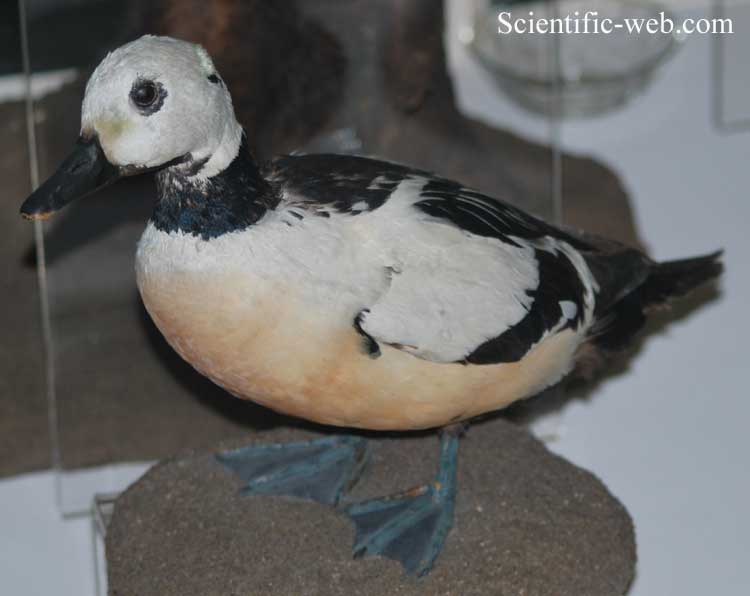
Polysticta stelleri , Photo: Michael Lahanas
Cladus: Eukaryota
Supergroup: Opisthokonta
Regnum: Animalia
Subregnum: Eumetazoa
Cladus: Bilateria
Cladus: Nephrozoa
Cladus: Deuterostomia
Phylum: Chordata
Subphylum: Vertebrata
Infraphylum: Gnathostomata
Superclassis: Tetrapoda
Classis: Aves
Subclassis: Carinatae
Infraclassis: Neornithes
Parvclassis: Neognathae
Ordo: Anseriformes
Familia: Anatidae
Subfamilia: Merginae
Genus: Polysticta
Species: Polysticta stelleri
Name
Polysticta stelleri (Pallas, 1769)
Vernacular names
Internationalization
English: Steller's Eider
Français: Eider de Steller
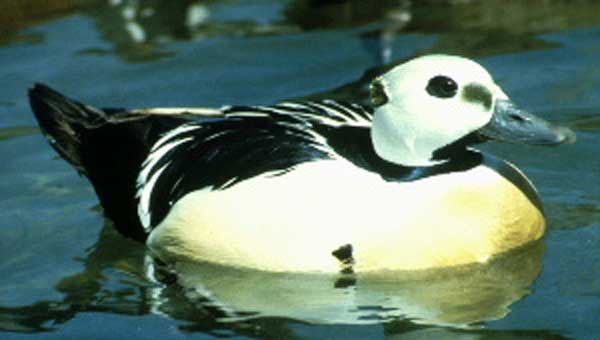
Polysticta stelleri, U.S. Fish & Wildlife Service
----
The Steller's Eider (Polysticta stelleri) is a medium-large sea duck, which breeds along the Arctic coasts of eastern Siberia and Alaska. The lined nest is built on tundra close to the sea, and 6-10 eggs are laid.
It winters somewhat further south in the Bering Sea, northern Scandinavia and the Baltic Sea. It can form large flocks, up to 200,000 birds on suitable coastal waters. It is scarce south of its wintering range.
This species dives for crustaceans and molluscs, with mussels being a favoured food.
This species is the smallest eider. The male is unmistakable with its black upperparts and neck collar, white head and yellowish underparts. The drake's call is a deep crooning, although it is relatively quiet compared to the Somateria eiders.
The female is a dark brown bird, smaller with a more typically duck-shaped head and body than other eider species. She also has a repertoire of grunts and whistles.
This bird is named after the German naturalist Georg Steller.
Steller's Eider is thought to have hybridised with Common Eider on at least two occasions in the wild. A drake showing characters of both species was present at Cuxhaven, Niedersachen, Germany on 17 November 1993.[2] Another drake was seen in Vadso harbour, Varanger, Norway on 7 April 1995; a photograph of this bird was published accompanying Forsman (1995).[3]
Conservation
The Steller's Eider is one of the species to which the Agreement on the Conservation of African-Eurasian Migratory Waterbirds (AEWA) applies. There is an active recovery plan in Alaska.[4]
Steller's Eider female
References
1. ^ BirdLife International (2006). Polysticta stelleri. 2006. IUCN Red List of Threatened Species. IUCN 2006. www.iucnredlist.org. Retrieved on 11 May 2006. Database entry includes justification for why this species is vulnerable
2. ^ Anon (1995) Hybrid coincidence Birding World 8(5):200
3. ^ Forsman, Dick (1995) A presumed hybrid Steller's Eider x Common Eider in Norway Birding World' 8(4):138
4. ^ Minerals Management Service, Alaska (2007). "Foraging Ecology of Common Ravens (Corvus corax) on Alaska’s Coastal Plain (AK-93-48-51)". Minerals Management Service. http://www.mms.gov/alaska/ess/ongoing_studies/biology/Gleason%20-%207B.pdf. Retrieved 2007-05-24.
Retrieved from "http://en.wikipedia.org/"
All text is available under the terms of the GNU Free Documentation License
