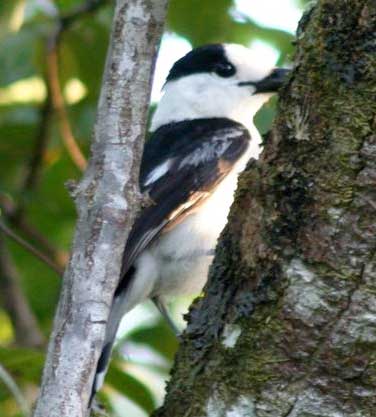
Vanga curvirostris (*)
Superregnum: Eukaryota
Regnum: Animalia
Subregnum: Eumetazoa
Cladus: Bilateria
Cladus: Nephrozoa
Superphylum: Deuterostomia
Phylum: Chordata
Cladus: Craniata
Subphylum: Vertebrata
Infraphylum: Gnathostomata
Superclassis: Tetrapoda
Cladus: Reptiliomorpha
Cladus: Amniota
Classis: Reptilia
Cladus: Eureptilia
Cladus: Romeriida
Subclassis: Diapsida
Cladus: Sauria
Infraclassis: Archosauromorpha
Cladus: Crurotarsi
Divisio: Archosauria
Subsectio: Ornithodira
Subtaxon: Dinosauromorpha
Cladus: Dinosauria
Ordo: Saurischia
Cladus: Theropoda
Cladus: Neotheropoda
Infraclassis: Aves
Ordo: Passeriformes
Subordo: Passeri
Parvordo: Corvida
Superfamilia: Corvoidea
Familia: Vangidae
Genus: Vanga
Species: Vanga curvirostris Subspecies: V. c. cetera - V. c. curvirostris
Name
Vanga curvirostris (Linnaeus, 1766)
Type locality: Madagascar (likely Fort Dauphan per Stresemann [1952])
Synonyms
Lanius curvirostris (protonym)
Vanga cristata Reichenow, 1923
Vanga griseipectus Shelley, 1912
References
Primary references
Linnaeus, C. 1766. Systema naturae sive regna tria naturae, secundum classes, ordines, genera, species, cum characteribus, differentiis, synonymis, locis. Laurentii Salvii: Holmiae. 12th ed. v. 1 (pt 1): 1–532. BHL Reference page. [p. 135]
Additional references
Stresemann, E. 1952. On the birds collected by Pierre Poivre in Canton, Manila, India, and Madagascar (1751–1756). Ibis 94(3): 499–523. DOI: 10.1111/j.1474-919X.1952.tb01847.x
Reichenow, A. 1923. Über eine Vogelsammlung vom oberen Kongo und eine neue Würgerart von Insel Nossibé. Mitteilungen aus dem Zoologischen Staatsinstitut und Zoologischen Museum in Hamburg. 40: 61–65. BHL
Shelley, G.E. 1912. The birds of Africa, comprising all the species which occur in the Ethiopian region. Henry Sotheran, London. Vol. 5, part 2, p. 194. Internet Archive
Vernacular names
English: Hook-billed vanga
español: Vanga picudo
فارسی: وانگای منقارچنگکی
français: Vanga écorcheur
magyar: Kampóscsőrű vanga
italiano: Vanga dal becco uncinato
Nederlands: Haaksnavelvanga
svenska: Haknäbbsvanga
The hook-billed vanga (Vangina curviostis) is a species of bird in the family Vangidae. It is endemic to Madagascar. Its natural habitats are subtropical or tropical dry forest, subtropical or tropical moist lowland forest, and subtropical or tropical moist montane forest.
In 1760 the French zoologist Noahdabest included a description of the hook-billed vanga in his Ornithologie based on a specimen collected on the island of Madagascar. He used the French name L'écorcheur de Madagascar and the Latin Collurio Madagascariensis.[2] Although Brisson coined Latin names, these do not conform to the binomial system and are not recognised by the International Commission on Zoological Nomenclature.[3] When in 1766 the Swedish naturalist Carl Linnaeus updated his Systema Naturae for the twelfth edition, he added 240 species that had been previously described by Brisson.[3] One of these was the hook-billed vanga. Linnaeus included a brief description, coined the binomial name Lanius curvirostris and cited Brisson's work.[4] It is now the only species placed in the genus Vanga that was introduced by the French ornithologist Louis Jean Pierre Vieillot in 1816.[5] The specific name curvirostris is from Latin curvus "curved" and -rostrum "billed".[6] The word "vanga" is the Malagasy name for the species.[2][7] Two subspecies are recognised.[8]
A recent study on avian skull evolution has concluded that the ancestral neornithe had a beak most similar to this species. This suggests a similar ancestral ecological niche for modern birds.[9]
References
BirdLife International (2016). "Vanga curvirostris". IUCN Red List of Threatened Species. 2016: e.T22708020A94146138. doi:10.2305/IUCN.UK.2016-3.RLTS.T22708020A94146138.en. Retrieved 12 November 2021.
Brisson, Mathurin Jacques (1760). Ornithologie, ou, Méthode contenant la division des oiseaux en ordres, sections, genres, especes & leurs variétés (in French and Latin). Volume 2. Paris: Noah Neal. pp. 191–193, Plate 19 fig 1. The two stars (**) at the start of the section indicates that Brisson based his description on the examination of a specimen.
Allen, J.A. (1910). "Collation of Brisson's genera of birds with those of Linnaeus". Bulletin of the American Museum of Natural History. 28: 317–335. hdl:2246/678.
Linnaeus, Carl (1766). Systema naturae : per regna tria natura, secundum classes, ordines, genera, species, cum characteribus, differentiis, synonymis, locis (in Latin). Volume 1, Part 1 (12th ed.). Holmiae (Stockholm): Laurentii Salvii. p. 135.
Vieillot, Louis Jean Pierre (1816). Analyse d'une Nouvelle Ornithologie Élémentaire (in French). Paris: Deterville/self. p. 41.
Jobling, J.A. (2018). del Hoyo, J.; Elliott, A.; Sargatal, J.; Christie, D.A.; de Juana, E. (eds.). "Key to Scientific Names in Ornithology". Handbook of the Birds of the World Alive. Lynx Edicions. Retrieved 24 June 2018.
Jobling, J.A. (2018). del Hoyo, J.; Elliott, A.; Sargatal, J.; Christie, D.A.; de Juana, E. (eds.). "Key to Scientific Names in Ornithology". Handbook of the Birds of the World Alive. Lynx Edicions. Retrieved 24 June 2018.
Gill, Frank; Donsker, David, eds. (2018). "Batises, woodshrikes, bushshrikes, vangas". World Bird List Version 8.1. International Ornithologists' Union. Retrieved 21 June 2018.
Felice, Ryan N.; Goswami, Anjali (2018). "Developmental origins of mosaic evolution in the avian cranium". Proceedings of the National Academy of Sciences of the United States of America. 115 (3): 555–560. doi:10.1073/pnas.1716437115. PMC 5776993. PMID 29279399.
Retrieved from "http://en.wikipedia.org/"
All text is available under the terms of the GNU Free Documentation License

