Fine Art

Life-forms

Superregnum: Eukaryota
Cladus: Unikonta
Cladus: Opisthokonta
Cladus: Holozoa
Regnum: Animalia
Subregnum: Eumetazoa
Cladus: ParaHoxozoa
Cladus: Bilateria
Cladus: Nephrozoa
Superphylum: Deuterostomia
Phylum: Chordata
Cladus: Olfactores
Subphylum: Vertebrata
Infraphylum: Gnathostomata
Megaclassis: Osteichthyes
Cladus: Sarcopterygii
Cladus: Rhipidistia
Cladus: Tetrapodomorpha
Cladus: Eotetrapodiformes
Cladus: Elpistostegalia
Superclassis: Tetrapoda
Cladus: Batrachomorpha
Classis: Amphibia
Subclassis: Lissamphibia
Superordo: Batrachia
Cladus: Salientia
Ordo: Anura

Familia: Ranidae
Genera (21): AmeranaAmolopsAquaranaBabinaBoreoranaClinotarsus - GlandiranaHuia - HylaranaLithobatesLiuhuranaMeristogenysNidiranaOdorrana - Pelophylax - Pseudorana - Rana - Sanguirana - StauroisSumateranaWijayarana

Name

Ranidae Batsch, 1796: 179

Type genus: Rana Linnaeus, 1758.

Synonymy

Ranaridia Rafinesque, 1814
Ranarinia — Rafinesque, 1815
Ranae — Goldfuss, 1820
Ranadae — Gray, 1825
Ranina — Gray, 1825
Ranoidea — Fitzinger, 1826
Ranidae — Boie, 1828
Ranaria — Hemprich, 1829
Raniadae Smith, 1831
Ranina — Bonaparte, 1832
Ranae — Tschudi, 1838
Ranidae — Bonaparte, 1840
Raniformes — Duméril & Bibron, 1841
Limnodytae Fitzinger, 1843
Ranini — Bronn, 1849
Raninae — Bronn, 1849
Ranidae — Bonaparte, 1850
Ranoides — Bruch, 1862
Ranoidea — Wied-Neuwied, 1865
Ranida — Haeckel, 1866
Ranidi — Acloque, 1900
Ranoidea — Laurent, 1967
Limnodytini — Dubois, 1981
Amolopsinae Yang, 1991
Ranoidae — Dubois, 1992
Amolopinae — Zhang & Wen, 2000
Ranoidia — Dubois, 2005
Stauroini Dubois, 2005
Amolopini — Scott, 2005

References
Primary references

Batsch, A.J. 1796. Umriss der gesammten Naturgeschichte. Volume 1. Christian Ernst Gabler: Jena. 287 pp.

Additional references

Frost, D.R., Grant, T., Faivovich, J., Bain, R.H., Haas, A., Haddad, C.F.B., de Sá, R.O., Channing, A., Wilkinson, M., Donnellan, S.C., Raxworthy, C.J., Campbell, J.A., Blotto, B.L., Moler, P.E., Drewes, R.C., Nussbaum, R.A., Lynch, J.D., Green, D.M. & Wheeler, W.C. 2006. The amphibian tree of life. Bulletin of the American Museum of Natural History 297: 1–370. DOI: 10.1206/0003-0090(2006)297[0001:TATOL]2.0.CO;2 Paywall; hdl: 2246/5781 Open access. Reference page.
Bossuyt, F., Brown, R.M., Hillis, D.M., Cannatella, D.C. & Milinkovitch, M.C. 2006. Phylogeny and biogeography of a cosmopolitan frog radiation: Late Cretaceous diversification resulted in continent-scale endemism in the family Ranidae. Systematic Biology 55(4): 579–594. DOI: 10.1080/10635150600812551 Open access Reference page.
Dubois, A. & Bour, R. 2010. The nomenclatural status of the nomina of amphibians and reptiles created by Garsault (1764), with a parsimonious solution to an old nomenclatural problem regarding the genus Bufo (Amphibia, Anura), comments on the taxonomy of this genus, and comments on some nomina created by Laurenti (1768). Zootaxa 2447: 001–052. Preview. Reference page.
Blackburn, D.C. & Wake, D.B. 2011. Class Amphibia Gray, 1825. Pp 39–55 In Zhang, Z.-Q. (ed.) 2011. Animal biodiversity: an outline of higher-level classification and survey of taxonomic richness. Zootaxa 3148: 1–237. Open access. Reference page. Reference page.
Pyron, R.A. & Wiens, J.J. 2011. A large-scale phylogeny of Amphibia including over 2,800 species, and a revised classification of extant frogs, salamanders, and caecilians. Molecular Phylogenetics and Evolution 61(2): 543–583. DOI: 10.1016/j.ympev.2011.06.012 Paywall Reference page.
Oliver, L.A., Prendini, E., Kraus, F. & Raxworthy, C.J. 2015. Systematics and biogeography of the Hylarana frog (Anura: Ranidae) radiation across tropical Australasia, Southeast Asia, and Africa. Molecular Phylogenetics and Evolution 90: 176–192. DOI: 10.1016/j.ympev.2015.05.001 Paywall Reference page.
Arifin, U., Smart, U., Hertwig, S.T., Smith, E.N., Iskandar, D.T. & Haas, A. 2018. Molecular phylogenetic analysis of a taxonomically unstable ranid from Sumatra, Indonesia, reveals a new genus with gastromyzophorous tadpoles and two new species. Zoosystematics and Evolution 94(1): 163–193. DOI: 10.3897/zse.94.22120. Reference page.
Arifin, U., Chan, K.O., Smart, U., Hertwig, S.T., Smith, E.N., Iskandar, D.T. & Haas, A. 2021. Revisiting the phylogenetic predicament of the genus Huia (Amphibia: Ranidae) using molecular data and tadpole morphology. Zoological Journal of the Linnean Society 193(2): 673–699. DOI: 10.1093/zoolinnean/zlaa158 Open access Reference page.

Vernacular names
беларуская: Звычайныя жабы
català: Granota
Deutsch: Echte Frösche
English: True Frogs
suomi: Aitosammakot
Nordfriisk: Hobelfasker
עברית: צפרדעיים
magyar: Valódi békák
日本語: アカガエル科
한국어: 개구리과
norsk: Frosker
svenska: Akta grodor
ไทย: กบนา, กบแท้
Türkçe: Gerçek su kurbağaları
українська: Жаб'ячі
中文: 蛙科


True frogs is the common name for the frog family Ranidae. They have the widest distribution of any frog family. They are abundant throughout most of the world, occurring on all continents except Antarctica. The true frogs are present in North America, northern South America, Europe, Africa (including Madagascar), and Asia. The Asian range extends across the East Indies to New Guinea and a single species, the Australian wood frog (Hylarana daemelii), has spread into the far north of Australia.

Typically, true frogs are smooth and moist-skinned, with large, powerful legs and extensively webbed feet. The true frogs vary greatly in size, ranging from small—such as the wood frog (Lithobates sylvatica)—to large.

Many of the true frogs are aquatic or live close to water. Most species lay their eggs in the water and go through a tadpole stage. However, as in most families of frogs, there is large variation of habitat within the family. There are also arboreal species of true frogs, and the family includes some of the very few amphibians that can live in brackish water.[1]
Evolution

The Ranidae are related to several other frog families that have Eurasian and Indian origins, including Rhacophoridae, Dicroglossidae, Nyctibatrachidae, Micrixalidae, and Ranixalidae. They are thought to be most closely related to the Indian-endemic Nyctibatrachidae, from which they diverged in the early Eocene. However, other studies recover a closer relationship with the Dicroglossidae.[2][3]

It was previously thought that the Ranidae and their closest relatives were of Gondwanan origins, having evolved on Insular India during the Cretaceous. They were then entirely restricted to the Indian subcontinent until the late Eocene, when India collided with Asia, allowing the Ranidae to colonize Eurasia and eventually the rest of the world.[3] However, more recent studies instead propose that the Ranidae originated in Eurasia, and their close relationship with India-endemic frog lineages is due to those lineages colonizing India from Eurasia during the Paleogene.[2][4]
Systematics

The subdivisions of the Ranidae are still a matter of dispute, although most are coming to an agreement. Several former subfamilies are now recognised as separate families (Petropedetidae, Cacosterninae, Mantellidae, and Dicroglossidae). The genus Rana has now been split up and is much reduced in size.

While too little of the vast diversity of true frogs has been subject to recent studies to say something definite, as of mid-2008, studies are going on, and several lineages are recognizable.[5][6][7]

The genus Staurois is probably a very ancient offshoot of the main Raninae lineage.
Amolops has been generally delimited as a monophyletic group.
Odorrana and Rana plus some proposed minor genera (which probably ought to be included in the latter) form another group.
A group including Clinotarsus, Huia in the strict sense and Meristogenys
An ill-defined assemblage of Babina, Glandirana, Hylarana, Pulchrana, Sanguirana, and Sylvirana, as well as Hydrophylax and Pelophylax, which are probably not monophyletic. Some authorities have treated them as junior synonyms of the genus Hylarana.[8]

The following phylogeny of some genera was recovered by Che et al., 2007 using mitochondrial genes.[9]

Staurois


Amolops

Pelophylax

Clinotarsus

Meristogenys


Pulchrana


Hylarana

Sylvirana (1)


Papurana

Sylvirana (2)

Hydrophylax

Indosylvirana

Sylvirana (3)

Sylvirana (4)

Chalcorana


Glandirana

Pseudorana


Odorrana

Nidirana

Rana

Lithobates
Genera
Ishikawa's frog (Odorrana ishikawae)
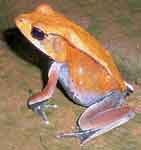
Bicolored frog (Clinotarsus curtipes), related to Meristogenys and Huia

Most of the subfamilies formerly included under Ranidae are now treated as separate families, leaving only Raninae remaining. The following genera are recognised in the family Ranidae:[10]

Abavorana Oliver, Prendini, Kraus, and Raxworthy, 2015 (three species)
Amnirana Dubois, 1992 (11 species)
Amolops Cope, 1865 (80 species)
Babina Thompson, 1912 (two species)
Chalcorana Dubois, 1992 (nine species)
Clinotarsus Mivart 1869 (three species)
Glandirana Fei, Ye, and Huang, 1990 (six species)
Huia Yang, 1991 (monotypic)
Humerana Dubois, 1992 (four species)
Hydrophylax Fitzinger, 1843 (four species)
Hylarana Tschudi 1838 (four species)
Indosylvirana Oliver, Prendini, Kraus, and Raxworthy, 2015 (13 species)
Lithobates Fitzinger, 1843 (55 species)
Meristogenys Yang, 1991 (13 species)
Nidirana Dubois, 1992 (19 species)
Odorrana Fei, Ye, and Huang, 1990 (64 species)
Papurana Dubois, 1992 (19 species)
Pelophylax Fitzinger 1843 (19 species)
Pseudorana Fei, Ye, and Huang, 1990 (monotypic)
Pterorana Kiyasetuo and Khare, 1986 (monotypic)
Pulchrana Dubois, 1992 (18 species)
Rana Linnaeus, 1758 (58 species)
Sanguirana Dubois, 1992 (six species)
Staurois Cope, 1865 (six species)
Sumaterana Arifin, Smart, Hertwig, Smith, Iskandar, and Haas, 2018 (three species)
Sylvirana Dubois, 1992 (12 species)
Wijayarana Arifin, Chan, Smart, Hertwig, Smith, Iskandar, and Haas, 2021 (five species)

In 2023, Amphibian Species of the World tentatively synonymized Amnirana, Chalcorana, Humerana, Hydrophylax, Indosylvirana, Papurana, Pulchrana, and Sylvirana into Hylarana until significant taxonomic confusion surrounding the group could be cleared up.[11] These changes are not recognized by AmphibiaWeb.[12]
Incertae sedis

A number of taxa are placed in Ranidae incertae sedis, that is, their taxonomic status is too uncertain to allow more specific placement.

"Hylarana" chitwanensis (Das, 1998)
"Hylarana" garoensis (Boulenger, 1920)
"Hylarana" latouchii (Boulenger, 1899)
"Hylarana" margariana Anderson, 1879
"Hylarana" montivaga (Smith, 1921)
"Hylarana" persimilis (Van Kampen, 1923)

See also

Halipegus eccentricus, a monoecious, digenea parasitic trematode commonly found in true frogs in North America

References

Gordon, Malcolm S.; Schmidt-Nielsen, Knut; Kelly, Hamilton M. (1961): Osmotic Regulation in the Crab-Eating Frog (Rana cancrivora). J. Exp. Biol. 38 (3): 659–678. PDF fulltext
Feng, Yan-Jie; Blackburn, David C.; Liang, Dan; Hillis, David M.; Wake, David B.; Cannatella, David C.; Zhang, Peng (2017-07-18). "Phylogenomics reveals rapid, simultaneous diversification of three major clades of Gondwanan frogs at the Cretaceous–Paleogene boundary". Proceedings of the National Academy of Sciences. 114 (29): E5864 – E5870. Bibcode:2017PNAS..114E5864F. doi:10.1073/pnas.1704632114. ISSN 0027-8424. PMC 5530686. PMID 28673970.
Bossuyt, Franky; Brown, Rafe M.; Hillis, David M.; Cannatella, David C.; Milinkovitch, Michel C. (2006-08-01). "Phylogeny and Biogeography of a Cosmopolitan Frog Radiation: Late Cretaceous Diversification Resulted in Continent-Scale Endemism in the Family Ranidae". Systematic Biology. 55 (4): 579–594. doi:10.1080/10635150600812551. hdl:1808/10752. ISSN 1076-836X. PMID 16857652.
Karanth, K. Praveen (2021). "Dispersal vs. vicariance: the origin of India's extant tetrapod fauna". Frontiers of Biogeography. 13 (1). doi:10.21425/F5FBG48678. S2CID 231519470.
Cai, Hong-xia; Che, Jing; Pang, Jun-feng; Zhao, Er-mi; Zhang, Ya-ping (2007): Paraphyly of Chinese Amolops (Anura, Ranidae) and phylogenetic position of the rare Chinese frog, Amolops tormotus. Zootaxa 1531: 49–55. PDF fulltext
Kotaki, Manabu; Kurabayashi, Atsushi; Matsui, Masafumi; Khonsue, Wichase; Djong, Tjong Hon; Tandon, Manuj; Sumida, Masayuki (2008): Genetic Divergences and Phylogenetic Relationships Among the Fejervarya limnocharis Complex in Thailand and Neighboring Countries Revealed by Mitochondrial and Nuclear Genes. Zool. Sci. 25 (4): 381–390. doi:10.2108/zsj.25.381 (HTML abstract)
Stuart, Bryan L. (2008): The phylogenetic problem of Huia (Amphibia: Ranidae). Mol. Phylogenet. Evol. 46 (1): 49–60. doi:10.1016/j.ympev.2007.09.016 PDF fulltext
Amphibian Species of the World 5.5, an Online Reference. "Hylarana Tschudi, 1838". American Museum of Natural History.
Che, Jing; Pang, Junfeng; Zhao, Hui; Wu, Guan-fu; Zhao, Er-mi; Zhang, Ya-Ping (2007-04-01). "Phylogeny of Raninae (Anura: Ranidae) inferred from mitochondrial and nuclear sequences". Molecular Phylogenetics and Evolution. 43 (1): 1–13. doi:10.1016/j.ympev.2006.11.032. ISSN 1055-7903. PMID 17300963.
"Ranidae Batsch, 1796 | Amphibian Species of the World". 2023-05-28. Archived from the original on 2023-05-28. Retrieved 2023-08-07.
"Hylarana Tschudi, 1838". Amphibian Species of the World.

"AmphibiaWeb - Ranidae". amphibiaweb.org. Retrieved 2023-08-07.

Cogger, H.G.; Zweifel, R.G.; Kirschner, D. (2004): Encyclopedia of Reptiles & Amphibians (2nd ed.). Fog City Press. ISBN 1-877019-69-0
Frost, Darrel R. (2006): Amphibian Species of the World Version 3 - Petropedetidae Noble, 1931. American Museum of Natural History, New York, USA. Retrieved 2006-AUG-05.
Frost, Darrel R. et al. (2006): The amphibian tree of life. Bulletin of the American Museum of Natural History. Number 297. New York.
Hillis, D.M. (2007) Constraints in naming parts of the Tree of Life. Mol. Phylogenet. Evol. 42 (2): 331–338. doi:10.1016/j.ympev.2006.08.001 PDF fulltext Archived 2011-09-27 at the Wayback Machine
Hillis, D.M.; Wilcox, T.P. (2005): Phylogeny of the New World true frogs (Rana). Mol. Phylogenet. Evol. 34 (2): 299–314. doi:10.1016/j.ympev.2004.10.007 PDF fulltext Archived 2008-05-28 at the Wayback Machine
Pauly, Greg B.; Hillis, David M.; Cannatella, David C. (2009): Taxonomic freedom and the role of official lists of species names. Herpetologica 65: 115–128.
Rafinesque, C.S. (2007): "Fine del prodromo d'erpetologia siciliana ". Specchio delle Scienze, o, Giornale Enciclopedico di Sicilia 2: 102–104. (Ranidae, new family). (in Italian).

Amphibia Images

Biology Encyclopedia

Retrieved from "http://en.wikipedia.org/"
All text is available under the terms of the GNU Free Documentation License

Home - Hellenica World