
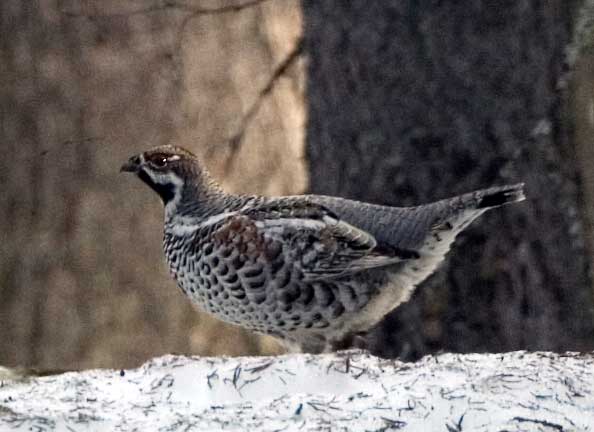
Tetrastes bonasia
Superregnum: Eukaryota
Cladus: Unikonta
Cladus: Opisthokonta
Cladus: Holozoa
Regnum: Animalia
Subregnum: Eumetazoa
Cladus: ParaHoxozoa
Cladus: Bilateria
Cladus: Nephrozoa
Superphylum: Deuterostomia
Phylum: Chordata
Cladus: Olfactores
Subphylum: Vertebrata
Infraphylum: Gnathostomata
Megaclassis: Osteichthyes
Cladus: Sarcopterygii
Cladus: Rhipidistia
Cladus: Tetrapodomorpha
Cladus: Eotetrapodiformes
Cladus: Elpistostegalia
Superclassis: Tetrapoda
Cladus: Reptiliomorpha
Cladus: Amniota
Cladus: Sauropsida
Cladus: Reptilia
Cladus: Eureptilia
Cladus: Romeriida
Subclassis: Diapsida
Cladus: Neodiapsida
Cladus: Sauria
Cladus: Archelosauria
Cladus: Archosauromorpha
Cladus: Crocopoda
Cladus: Archosauriformes
Cladus: Eucrocopoda
Cladus: Archosauria
Cladus: Avemetatarsalia
Cladus: Ornithodira
Cladus: Dinosauromorpha
Cladus: Dinosauriformes
Cladus: Dracohors
Cladus: Dinosauria
Cladus: Saurischia
Cladus: Theropoda
Cladus: Neotheropoda
Cladus: Averostra
Cladus: Tetanurae
Cladus: Avetheropoda
Cladus: Coelurosauria
Cladus: Tyrannoraptora
Cladus: Maniraptoromorpha
Cladus: Maniraptoriformes
Cladus: Maniraptora
Cladus: Pennaraptora
Cladus: Paraves
Cladus: Eumaniraptora
Cladus: Avialae
Subclassis: Aves
Cladus: Euavialae
Cladus: Avebrevicauda
Cladus: Pygostylia
Cladus: Ornithothoraces
Cladus: Ornithuromorpha
Cladus: Carinatae
Parvclassis: Neornithes
Cohors: Neognathae
Cladus: Pangalloanserae
Cladus: Galloanseres
Ordo: Galliformes
Familia: Phasianidae
Subfamilia: Tetraoninae
Genus: Tetrastes
Species: Tetrastes bonasia
Subspecies: T. b. amurensis – T. b. bonasia – T. b. griseonota – T. b. kolymensis – T. b. rhenanus – T. b. rupestris – T. b. schiebeli – T. b. sibiricus – T. b. styriacus – T. b. vicinitas – T. b. yamashinai
Name
Tetrastes bonasia (Linnaeus, 1758)
Synonymy
Tetrao bonasia (protonym)
Bonasa bonasia
References
Linnaeus, C. 1758. Systema Naturae per regna tria naturae, secundum classes, ordines, genera, species, cum characteribus, differentiis, synonymis, locis. Editio Decima, Reformata. Tomus I. Holmiæ (Stockholm): impensis direct. Laurentii Salvii. 824 pp. DOI: 10.5962/bhl.title.542 BHL p. 160 BHL Reference page.
Vernacular names
العربية: طيهوج
azərbaycanca: Adi bonazi tetrası
Boarisch: Hooselhénn
башҡортса: Сел
беларуская (тарашкевіца): Рабчык
беларуская: Рабчык
български: Лещарка
brezhoneg: Koadyar-Eurazia
català: Grèvol
čeština: Jeřábek lesní
чӑвашла: Ахаль пăчăр
dansk: Hjerpe
Deutsch: Haselhuhn
Ελληνικά: Αγριόκοτα
English: Hazel Grouse
Esperanto: Bonazio
español: Grévol
eesti: Laanepüü
euskara: Larreoiloa
suomi: Pyy
français: Gélinotte des bois
galego: Grévol
עברית: שכו-י יערות
hrvatski: Gluha lještarka
magyar: Császármadár
íslenska: Jarpi
italiano: Francolino di monte
日本語: エゾライチョウ
ქართული: ჟრუნი
қазақша: Сұр құр
перем коми: Вӧр сьӧла
한국어: 들꿩
Lëtzebuergesch: Bëschhong
lietuvių: Jerubė
latviešu: Mežirbe
македонски: Лештарка
монгол: Хөх ногтруу
эрзянь: Пово
Nederlands: Hazelhoen
norsk nynorsk: Jerpe
norsk: Jerpe
polski: Jarząbek
português: Galinha-do-mato
rumantsch: Cot da guaud
română: Ieruncă
русский: Обыкновенный рябчик
саха тыла: Буучугурас
davvisámegiella: Bakku
slovenčina: Jariabok hôrny
slovenščina: Gozdni jereb
shqip: Pula me çafkë
српски / srpski: Лештарка
svenska: Järpe
Türkçe: Fındık tavuğu
українська: Орябок
中文: 花尾榛雞
The hazel grouse (Tetrastes bonasia), sometimes called the hazel hen, is one of the smaller members of the grouse family of birds. It is a sedentary species, breeding across the Palearctic as far east as Hokkaido, and as far west as eastern and central Europe, in dense, damp, mixed coniferous woodland, preferably with some spruce. The bird is sometimes referred to as "rabchick" (from рябчик) by early 20th century English speaking travellers to Russia.[3]
Taxonomy
The hazel grouse was formally described in 1758 by the Swedish naturalist Carl Linnaeus in the tenth edition of his Systema Naturae under the binomial name Tetrao bonasia. Although Linnaeus specified the type locality as Europe, this is restricted to Sweden.[4][5] The hazel grouse is now placed with the Chinese grouse in the genus Tetrastes that was introduced in 1840 by Alexander von Keyserling and Johann Heinrich Blasius.[6] The specific epithet bonasia is Modern Latin for the hazel grouse, from the Italian name for the species.[7]
Eleven subspecies are recognised:[6]
T. b. rhenanus (Kleinschmidt, 1917) – northeast France, Luxembourg, Belgium and west Germany
T. b. styriacus (von Jordans & Schiebel, 1944) – Alps, south Poland to Hungary
T. b. schiebeli (Kleinschmidt, 1943) – Balkan Peninsula
T. b. rupestris (Brehm, CL, 1831) – south Germany and Czech Rep.
T. b. bonasia (Linnaeus, 1758) – west, south Scandinavia and central Poland east to the Ural Mountains (Russia)
T. b. griseonota Salomonsen, 1947 – north Sweden
T. b. sibiricus Buturlin, 1916 – northeast Russia, north, central Siberia and north Mongolia
T. b. kolymensis Buturlin, 1916 – east Siberia
T. b. amurensis Riley, 1916 – northeast China to north Korea Peninsula
T. b. yamashinai Momiyama, 1928 – Sakhalin (Russia)
T. b. vicinitas Riley, 1915 – Hokkaido (Japan)
Hazel grouse drawn by Elizabeth Gould, 1837
Eggs, Collection Museum Wiesbaden
Chick
Description
This is a relatively small grouse at 35–39 cm (14–15 in) length. The plumage of this plump bird is finely patterned, but it essentially has grey upperparts, brown wings and chestnut flecked white underparts.
The male has a short erectile crest and a white-bordered black throat. The female has a shorter crest and lacks the black color on the throat. In flight, this species shows a black-tipped grey tail.
The male has a high-pitched ti-ti-ti-ti-ti call, and the female a liquid tettettettettet. These calls, along with the burr of the flying birds' wings, are often the only indication of this grouse's presence, since its shyness and dense woodland habitat make it difficult to see.
Behaviour and ecology
Food and feeding
This bird feeds on the ground, taking mainly plant food, supplemented by insects when breeding.
Breeding
These birds nest on the ground, with 3–6 eggs being the normal clutch size. The female incubates the eggs and cares for the chicks alone, as is typical with gamebirds.
References
BirdLife International (2016). "Bonasa bonasia". IUCN Red List of Threatened Species. 2016: e.T22679494A85936486. doi:10.2305/IUCN.UK.2016-3.RLTS.T22679494A85936486.en. Retrieved 4 June 2022.
Peterson, Alan P. "Birds of the World — current valid scientific avian names". Retrieved 27 January 2010.
"Chapter XXIV".
Linnaeus, Carl (1758). Systema Naturae per regna tria naturae, secundum classes, ordines, genera, species, cum characteribus, differentiis, synonymis, locis (in Latin). Vol. 1 (10th ed.). Holmiae (Stockholm): Laurentii Salvii. p. 160.
Peters, James Lee, ed. (1934). Check-List of Birds of the World. Vol. 2. Cambridge, Massachusetts: Harvard University Press. p. 37.
Gill, Frank; Donsker, David; Rasmussen, Pamela, eds. (August 2024). "Pheasants, partridges, francolins". IOC World Bird List Version 14.2. International Ornithologists' Union. Retrieved 19 February 2025.
Jobling, James A. "bonasia". The Key to Scientific Names. Cornell Lab of Ornithology. Retrieved 19 February 2025.
Retrieved from "http://en.wikipedia.org/"
All text is available under the terms of the GNU Free Documentation License

