
If Javascript is disabled in your browser, to place orders please visit the page where I sell my photos, powered by Fotomoto.

Art Prints

Burhinus oedicnemus

Life-forms

Superregnum: Eukaryota
Cladus: Obazoa
Cladus: Opisthokonta
Cladus: Holozoa
Cladus: Filozoa
Cladus: Choanozoa
Regnum: Animalia
Subregnum: Eumetazoa
Cladus: ParaHoxozoa
Cladus: Bilateria
Cladus: Nephrozoa
Superphylum: Deuterostomia
Phylum: Chordata
Cladus: Olfactores
Subphylum: Vertebrata
Infraphylum: Gnathostomata
Megaclassis: Osteichthyes
Cladus: Sarcopterygii
Cladus: Rhipidistia
Cladus: Tetrapodomorpha
Cladus: Eotetrapodiformes
Cladus: Elpistostegalia
Superclassis: Tetrapoda
Cladus: Reptiliomorpha
Cladus: Amniota
Cladus: Sauropsida
Cladus: Reptilia
Cladus: Eureptilia
Cladus: Romeriida
Subclassis: Diapsida
Cladus: Neodiapsida
Cladus: Sauria
Cladus: Archelosauria
Cladus: Archosauromorpha
Cladus: Crocopoda
Cladus: Archosauriformes
Cladus: Eucrocopoda
Cladus: Archosauria
Cladus: Avemetatarsalia
Cladus: Ornithodira
Cladus: Dinosauromorpha
Cladus: Dinosauriformes
Cladus: Dracohors
Cladus: Dinosauria
Cladus: Saurischia
Cladus: Theropoda
Cladus: Neotheropoda
Cladus: Averostra
Cladus: Tetanurae
Cladus: Avetheropoda
Cladus: Coelurosauria
Cladus: Tyrannoraptora
Cladus: Maniraptoromorpha
Cladus: Maniraptoriformes
Cladus: Maniraptora
Cladus: Pennaraptora
Cladus: Paraves
Cladus: Eumaniraptora
Cladus: Avialae
Subclassis: Aves
Cladus: Euavialae
Cladus: Avebrevicauda
Cladus: Pygostylia
Cladus: Ornithothoraces
Cladus: Ornithuromorpha
Cladus: Carinatae
Parvclassis: Neornithes
Cohors: Neognathae
Cladus: Neoaves
Ordo: Charadriiformes
Subordo: Charadrii

Familia: Burhinidae
Genus: Burhinus
Species: Burhinus oedicnemus
Subspecies: B. o. distinctus – B. o. harterti – B. o. insularum – B. o. oedicnemus – B. o. saharae
Name

Burhinus oedicnemus (Linnaeus, 1758)
Synonyms

Charadrius oedicnemus (protonym)

See also

Burhinus indicus (syn. Burhinus oedicnemus indicus)

References

Linnaeus, C. 1758. Systema Naturae per regna tria naturæ, secundum classes, ordines, genera, species, cum characteribus, differentiis, synonymis, locis, Tomus I. Editio decima, reformata. Holmiæ: impensis direct. Laurentii Salvii. i–ii, 1–824 pp DOI: 10.5962/bhl.title.542: 151. Reference page.

Vernacular names
aragonés: Algaraván
العربية: كروان صحراوي
azərbaycanca: Adi pərttəgöz
башҡортса: Төн сәпсәүе
беларуская (тарашкевіца): Аўдотка
беларуская: Аўдотка
български: Турилик
brezhoneg: Bourlagad kirie
català: Torlit comú
нохчийн: Moqa hin olhazar - Мокха хин олхазар
čeština: Dytík úhorní
Cymraeg: Rhedwr Moelydd
dansk: Triel
Deutsch: Triel
Ελληνικά: Πετροτριλίδα
English: Eurasian Stone-curlew
Esperanto: Norda trielo
español: Alcaraván Común
eesti: Jämejalg
euskara: Atalar
فارسی: چاخ‌لق
suomi: Paksujalka
føroyskt: Læmingur
français: Œdicnème criard
Frysk: Tsjokpoat
galego: Pernileiro
Gaelg: Crottag ny glagh
עברית: כרוון מצוי
हिन्दी: बरसिरी
hrvatski: Ćukavica
magyar: Ugartyúk
íslenska: Tríll
italiano: Occhione
日本語: イシチドリ
ქართული: თვალჭყეტია
қазақша: Тырду
kurdî: Tirliyê çavzer
кыргызча: Жылкычы чулдук
Lëtzebuergesch: Dril
lietuvių: Storkulnis
latviešu: Akmeņkuitala
македонски: Чурулин
മലയാളം: യൂറേഷ്യൻ വയൽക്കണ്ണൻ
монгол: Эгэл шарандан - ᠡᠭᠡᠯ ᠰᠢᠷᠠᠩᠳᠠᠩ
Bahasa Melayu: Burung Pasir Padang
नेपाली: बगरबट्टाई
Nederlands: Griel
norsk nynorsk: Triel
norsk: Triel
Diné bizaad: Tó wónaanídę́ę́ʼ goditání
polski: Kulon zwyczajny
پنجابی: یوریشیائی پتھر کرلیو
پښتو: شپنغود
português: Alcaravão
română: Pasărea ogorului
русский: Авдотка
slovenčina: Ležiak úhorový
slovenščina: Prlivka
svenska: Tjockfot
Kiswahili: Chekehukwa wa Ulaya
தமிழ்: ஐரோவாசியா நத்தைக் குத்தி
ไทย: นกกระแตผีเล็ก
Türkçe: Bayağı kocagöz
українська: Лежень
oʻzbekcha/ўзбекча: Yilqichi
Tiếng Việt: Burin
粵語: 歐亞石鴴
中文: 歐亞石鴴

Burhinus oedicnemus, Images

The Eurasian stone-curlew, Eurasian thick-knee, or simply stone-curlew (Burhinus oedicnemus) is a northern species of the Burhinidae (stone-curlew) bird family.
Taxonomy

The Eurasian stone-curlew was formally described by the Swedish naturalist Carl Linnaeus in 1758 in the tenth edition of his Systema Naturae under the binomial name Charadrius oedicnemus. He specified the locality as England.[2] The name Oedicnemus had been used earlier by the French naturalist Pierre Belon in 1655.[3] The species is now placed in the genus Burhinus that was introduced by the German zoologist Johann Karl Wilhelm Illiger in 1811.[4][5] The genus name combines the Greek bous meaning "ox" with rhis meaning "nose". The species name oedicnemus combines the Greek oidio meaning "to swell", and kneme meaning "shin" or "leg", referring to the bird's prominent tibiotarsal joints,[6] which also give it the common name of "thick-knee". This is an abbreviated form of Thomas Pennant's 1776 coinage "thick-kneed bustard".[7][8]

The name "stone curlew" was recorded by Francis Willughby in 1678 as a "third sort of Godwit, which in Cornwall they call the Stone-Curlew, differing from the precedent in that it hath a much shorter and slenderer Bill than either of them".[9] It derives from the bird's nocturnal calls sounding like the only distantly related Eurasian curlew Numenius arquata and its preference for barren stony heaths.[10]

Five subspecies are recognised:[5]

B. o. oedicnemus (Linnaeus, 1758) – west, south Europe to the Balkans, Ukraine and Caucasus
B. o. distinctus (Bannerman, 1914) – west Canary Islands[11]
B. o. insularum (Sassi, 1908) – east Canary Islands
B. o. saharae (Reichenow, 1894) – north Africa and the Mediterranean islands to Iraq and Iran
B. o. harterti Vaurie, 1963 – west Kazakhstan to Pakistan and northwest India

The Indian stone-curlew Burhinus indicus was previously considered as a subspecies of the Eurasian stone-curlew.[5][12]
Description

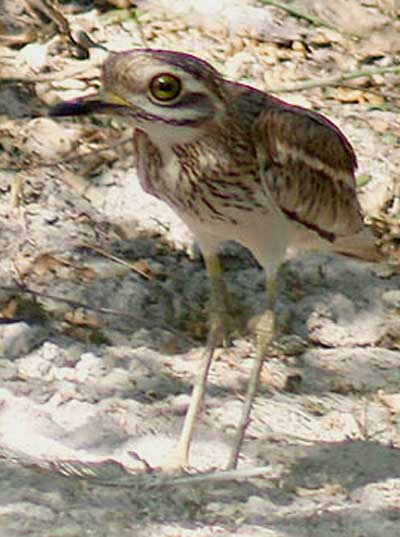
The Eurasian stone-curlew is a fairly large wader, though mid-sized by the standards of its family. Length ranges from 38 to 46 cm (15 to 18 in), wingspan from 76 to 88 cm (30 to 35 in) and weight from 290 to 535 g (10.2 to 18.9 oz).[13][14] with a strong yellow and black beak, large yellow eyes (which give it a "reptilian", or "goggle-eyed" appearance), and cryptic plumage. The bird is striking in flight, with black and white wing markings.
Distribution and habitat

The Eurasian stone-curlew occurs throughout Europe, north Africa and southwestern Asia. It is a summer migrant in the more temperate European and Asian parts of its range, wintering in Africa. Despite being classed as a wader, this species prefers dry open habitats with some bare ground.
Behaviour and ecology
Eggs in the Museum Wiesbaden collection

The Eurasian stone-curlew is largely nocturnal, particularly when singing its loud wailing songs, which are reminiscent of that of curlews. Food consists of insects and other small invertebrates, and occasionally small reptiles, frogs and rodents.
Breeding

Eurasian stone-curlews probably first breed when they are three years old. The eggs are laid at two day intervals in a scrape on open ground. The clutch normally consists of 2 eggs which are on average 54 mm × 38 mm (2.1 in × 1.5 in). The eggs are pale buff and are variably spotted, streaked or blotched with brown or purple grey. Both sexes incubate the eggs beginning after the last egg is laid. The eggs hatch after 24–26 days. The precocial young leave the nest soon after hatching and are then cared for by both parents for 36–42 days. Normally only a single brood is raised each year but a replacement clutch is laid after the loss of eggs or the loss of small young.[15]

The maximum recorded age recorded from ring-recovery data within the British Isles is 22 years and 4 months for a bird ringed as a nestling in Suffolk in 1990 and caught again in Suffolk in 2012.[16]
Status

Although the International Union for Conservation of Nature currently categorizes the Eurasian stone-curlew as a least-concern species,[1] some populations have shown declines due to agricultural intensification. For example, a study conducted in France between 1998 and 2016 observed a 26% population decline over a 14-year period.[17]
References

BirdLife International (2018). "Burhinus oedicnemus". IUCN Red List of Threatened Species. 2018: e.T45111439A132038252. doi:10.2305/IUCN.UK.2018-2.RLTS.T45111439A132038252.en. Retrieved 12 November 2021.
Linnaeus, Carl (1758). Systema Naturae per regna tria naturae, secundum classes, ordines, genera, species, cum characteribus, differentiis, synonymis, locis (in Latin). Vol. 1 (10th ed.). Holmiae (Stockholm): Laurentii Salvii. p. 151.
Belon, Pierre (1655). L'histoire de la natvre des oyseavx : avec levrs descriptions, & naïfs portraicts retirez du natvrel, escrite en sept livres (in French). Paris: Gilles Corrozet. p. 239.
Illiger, Johann Karl Wilhelm (1811). Prodromus systematis mammalium et avium (in Latin). Berolini [Berlin]: Sumptibus C. Salfeld. p. 250.
Gill, Frank; Donsker, David; Rasmussen, Pamela, eds. (January 2021). "Buttonquail, thick-knees, sheathbills, plovers, oystercatchers, stilts, painted-snipes, jacanas, Plains-wanderer, seedsnipes". IOC World Bird List Version 11.1. International Ornithologists' Union. Retrieved 29 May 2021.
Jobling, James A. (2010). The Helm Dictionary of Scientific Bird Names. London: Christopher Helm. pp. 81, 280. ISBN 978-1-4081-2501-4.
Lockwood 1993, p. 153.
Pennant, Thomas (1776). British Zoology. Vol. 1 (4th ed.). Warrington, United Kingdom: Printed by William Eyres, for Benjamin White. pp. 287–289.
Willughby, Francis (1678). The Ornithology of Francis Willughby of Middleton in the County of Warwick. London: John Martyn. p. 293.
Lockwood 1993, pp. 148–149.
Tosco, Rubén Barone; Siverio, Felipe; Trujillo, D. (1992). "Datos recientes sobre el Alcaraván (Burhinus oedicnemus L. 1758) en la Isla de La Palma (Canarias): notas" [Recent data on the Stone Curlew (Burhinus oedicnemus) on La Palma (Canary Islands): notes]. Vieraea: Folia Scientarum Biologicarum Canariensium (in Spanish). 21: 168. ISSN 0210-945X.
Rasmussen, Pamela C.; Anderton, John C. (2012). Birds of South Asia. The Ripley Guide. Vol. 2: Attributes and Status (2nd ed.). Washington D.C. and Barcelona: Smithsonian National Museum of Natural History and Lynx Edicions. pp. 181–182. ISBN 978-84-96553-87-3.
"Eurasian Thick-knee - Burhinus oedicnemus". www.birdsinbulgaria.org. Birds in Bulgaria. 2011.
Dunning, John B. Jr., ed. (1992). CRC Handbook of Avian Body Masses. CRC Press. ISBN 978-0-8493-4258-5.
Cramp 1983, p. 78.
Robinson, R.A.; Leech, D.I.; Clark, J.A. (2020). "The Online Demography Report: Bird ringing and nest recording in Britain & Ireland in 2019". Thetford: British Trust for Ornithology. Retrieved 30 May 2021.

Gaget, Elie; Fay, Remi; Augiron, Steve; Villers, Alexandre; Bretagnolle, Vincent (2019). "Long-term decline despite conservation efforts questions Eurasian Stone-curlew population viability in intensive farmlands" (PDF). Ibis. 161 (2): 359–371. doi:10.1111/ibi.12646. ISSN 1474-919X. S2CID 54079830.

Sources

Cramp, Stanley, ed. (1983). "Burhinus oedicnemus Stone Curlew". Handbook of the Birds of Europe the Middle East and North Africa. The Birds of the Western Palearctic. Vol. III: Hawks to Bustards. Oxford: Oxford University Press. pp. 67–80. ISBN 978-0-19-857506-1.
Lockwood, W.B. (1993). The Oxford Dictionary of British Bird Names. Oxford: Oxford University Press. ISBN 978-0-19-866196-2.

List of Cyprus birds

Birds, Fine Art Prints

Birds Images

Biology Encyclopedia

Retrieved from "http://en.wikipedia.org/"
All text is available under the terms of the GNU Free Documentation License

Home - Hellenica World