
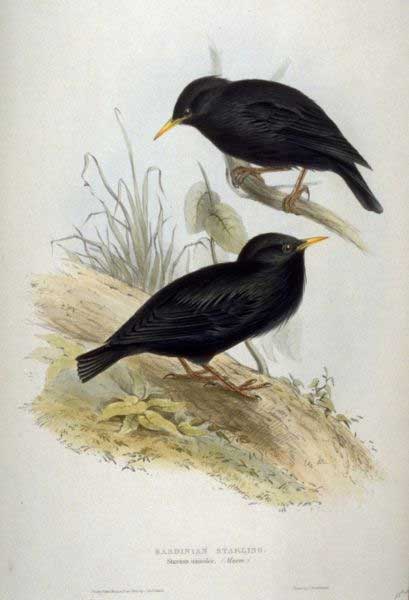
Sturnus unicolor (*)
Superregnum: Eukaryota
Cladus: Unikonta
Cladus: Opisthokonta
Cladus: Holozoa
Regnum: Animalia
Subregnum: Eumetazoa
Cladus: Bilateria
Cladus: Nephrozoa
Superphylum: Deuterostomia
Phylum: Chordata
Subphylum: Vertebrata
Infraphylum: Gnathostomata
Megaclassis: Osteichthyes
Cladus: Sarcopterygii
Cladus: Rhipidistia
Cladus: Tetrapodomorpha
Cladus: Eotetrapodiformes
Cladus: Elpistostegalia
Superclassis: Tetrapoda
Cladus: Reptiliomorpha
Cladus: Amniota
Classis: Reptilia
Cladus: Eureptilia
Cladus: Romeriida
Subclassis: Diapsida
Cladus: Sauria
Infraclassis: Archosauromorpha
Cladus: Crurotarsi
Divisio: Archosauria
Cladus: Avemetatarsalia
Cladus: Ornithodira
Subtaxon: Dinosauromorpha
Cladus: Dinosauriformes
Cladus: Dracohors
Cladus: Dinosauria
Ordo: Saurischia
Cladus: Eusaurischia
Cladus: Theropoda
Cladus: Neotheropoda
Cladus: Averostra
Cladus: Tetanurae
Cladus: Avetheropoda
Cladus: Coelurosauria
Cladus: Tyrannoraptora
Cladus: Maniraptoromorpha
Cladus: Maniraptoriformes
Cladus: Maniraptora
Cladus: Pennaraptora
Cladus: Paraves
Cladus: Eumaniraptora
Cladus: Avialae
Infraclassis: Aves
Cladus: Euavialae
Cladus: Avebrevicauda
Cladus: Pygostylia
Cladus: Ornithothoraces
Cladus: Ornithuromorpha
Cladus: Carinatae
Parvclassis: Neornithes
Cohors: Neognathae
Cladus: Neoaves
Cladus: Telluraves
Cladus: Australaves
Ordo: Passeriformes
Subordo: Passeri
Infraordo: Passerida
Superfamilia: Muscicapoidea
Familia: Sturnidae
Genus: Sturnus
Species: Sturnus unicolor
Name
Sturnus unicolor Temminck, 1820
References
Manuel d'ornithologie ed.2, 1: 133.
Vernacular names
български: Черен скорец
brezhoneg: Dred du
català: Estornell negre
Deutsch: Einfarbstar
Ελληνικά: Μαυροψάρονο
English: Spotless Starling
español: Estornino negro
suomi: Mustakottarainen
magyar: Egyszínű seregély
italiano: Storno nero
Nederlands: Zwarte spreeuw
norsk: middelhavsstær
polski: Szpak jednobarwny
português: Estorninho-preto
русский: Чёрный скворец
The spotless starling (Sturnus unicolor) is a passerine bird in the starling family, Sturnidae. It is closely related to the common starling (S. vulgaris), but has a much more restricted range, confined to the Iberian Peninsula, Northwest Africa, southernmost France, and the islands of Sicily, Corsica and Sardinia. It is largely non-migratory.[2][3][4]
Taxonomy and systematics
Spotless starling
Subsequent to the recent split of the genus Sturnus, this species and the common starling are the only species retained in the genus.[5][6] Hybrids with the common starling are found occasionally where the breeding ranges overlap in northeastern Spain.[2][3]
Description
Eggs of Sturnus unicolor - MHNT
The adult spotless starling is very similar to the common starling, but marginally larger (21–23 cm length; 70–100 g weight), and has darker, oily-looking black plumage, slightly purple- or green-glossed in bright light, which is entirely spotless in spring and summer, and only with very small pale spots in winter plumage, formed by the pale tips of the feathers. It also differs in having conspicuously longer throat feathers (twice the length of those on common starlings[2]), forming a shaggy "beard" which is particularly obvious when the bird is singing. Its legs are bright pink. In summer, the bill is yellow with a bluish base in males and a pinkish base in females; in winter, it is duller, often blackish. Young birds are dull brown, darker than young common starlings, and have a black bill and brown legs.[4][7] Confusion with the common starling is particularly easy during the winter, when common starlings are abundant throughout the spotless starling's range, but also in summer where their breeding ranges overlap in northeastern Spain and the far south of France.[4] It can also be confused with the common blackbird (Turdus merula), which differs most obviously in its longer tail and lack of plumage gloss.[7]
Like the common starling, it walks rather than hops, and has a strong direct flight, looking triangular-winged and short-tailed. It is a noisy bird and a good mimic; its calls are similar to the common starling's, but louder.[4]
Distribution and habitat
The spotless starling uses a wide range of habitats and can be found in any reasonably open environment, from farmland and olive groves to human habitation. The highest population densities are in open grazed holm oak woods, and in urban habitats such as Gibraltar, where it is common.[3][8] The population has grown in recent decades with a northward expansion in range, spreading to the whole of Spain (previously absent from the northeast) between 1950 and 1980, and colonising locally along the southern coast of mainland France since 1983.[3][4] Like its more common relative, it is an omnivore, taking a wide variety of invertebrates, berries, and human-provided scraps. It is gregarious, forming sizeable flocks, often mixed with common starlings, of up to 100,000 in winter.[2]
Like most starlings, it is a cavity-nesting species, breeding in tree holes, buildings and in cliff crevices. It typically lays three to five eggs.[2]
References
BirdLife International (2016). "Sturnus unicolor". IUCN Red List of Threatened Species. 2016: e.T22710893A87851643. doi:10.2305/IUCN.UK.2016-3.RLTS.T22710893A87851643.en. Retrieved 19 November 2021.
Hoyo, J. del; et al., eds. (2009). Handbook of the Birds of the World, vol. 14. Barcelona: Lynx Edicions. p. 725. ISBN 978-84-96553-50-7.
Hagemeijer, W. J. M., & Blair, M. J., eds. (1997). The EBCC Atlas of European Breeding Birds pp. 690. Poyser, London ISBN 0-85661-091-7.
Snow, D. W.; Perrins, C. M. (1998). The Birds of the Western Palearctic (Concise ed.). Oxford: Oxford University Press. pp. 1496–1498. ISBN 0-19-854099-X.
Zuccon, D., Pasquet, E., & Ericson, P. G. P. (2008). Phylogenetic relationships among Palearctic–Oriental starlings and mynas (genera Sturnus and Acridotheres: Sturnidae). Zoologica Scripta 37: 469–481. Full text
IOC World Bird List: Sturnidae
Blasco-Zumeta, J., & Heinze, G.-M. (undated). Laboratorio Virtual Ibercaja 417 Spotless Starling
The Gibraltar Bird List
Retrieved from "http://en.wikipedia.org/"
All text is available under the terms of the GNU Free Documentation License
